For a few months now, I’ve been attending Cornerstone Center for the Arts’ Public Domain Theatre. Held in the elegant E.B. Ball Auditorium at 6:30 p.m. on the third Wednesday of each month, the series features classic films no longer under copyright protection.
Last month’s movie was the 1922 German silent film “Nosferatu: A Symphony of Horror.” If you’re unfamiliar, “Nosferatu” was an unauthorized retelling of Bram Stoker’s 1897 novel “Dracula.” After it opened, Stoker’s widow sued the filmmakers for copyright infringement.
“Nosferatu” didn’t have an American release because of the suit. A German court ordered all copies of the film destroyed. Luckily, a few prints survived and circulated in the United States in the mid-20th century. The old movie ran occasionally on late-night television beginning in the 1980s.
The first Muncie exhibition of “Nosferatu” that I found took place on Oct. 25, 1999, at Ball State’s Pruis Hall. Music professor Kevin Purrone provided live piano accompaniment. Then years later, on Oct. 28, 2021, the film screened at Cornerstone Center for the Arts with a soundtrack played live by the Muncie Symphony Orchestra.
It’s one of my favorite movies. Even though it’s over a century old, the original “Nosferatu” is still a creepy vampire tale. It set a standard for horror movies that filmmakers emulate today.
Vampires remain pop-culture fixtures in the Western world, perhaps because bloodsucking supernatural monsters have haunted folklore for millennia. In Ancient Greek mythology, female night-phantoms called Empusa and Lamia seduced young men and drained away their vital essence. Romans, meanwhile, feared the Strixes — malevolent demon-birds that ate flesh and drank human blood.
Medieval Europeans had many strange tales about bloodthirsty revenants and other undead horrors refusing to stay buried. The word vampire derives from the Slavic upiór, an undead being said to rise from the grave to feast on human blood.
The Germans were plagued by Mara, supernatural entities that would come at night to suffocate the living and drain away life. In some traditions, they were called Night Hags or Mare. The word “nightmare” derives from this creature. The Muncie Morning News described them in 1889 as “Saxon demons … a kind of vampire that sat on a sleeper’s chest. They were said to be the guardians of hidden treasures, over which they brooded as hens.”
I looked long and hard in historical records for a “true” story about vampires stalking Delaware County residents. But sadly, none exist. If nosferatus ever preyed on Munsonians, no one wrote it down or shared such encounters publicly.
The closest I found came in 1895, when two South American vampire bats were put on display at the St. John’s Cigar Store in the Anthony Building. The Muncie Morning News described their wingspan as 4 feet from tip to tip. According to the paper, after finding someone asleep, the bats would fasten “their claws into his person and never loosen until the last drop of blood is sucked from his veins.” It’s not clear why they were hawking tobacco in the Magic City, but the “two blood sucking vampires” drew large crowds of Munsonians.
Just like today, most Americans understood vampires through media, which at that time meant vaudeville, books and early movies.
A popular genre then featured vampires as ruinous femme fatales, or “vamps,” who drained young men of their vitality, wealth and morality. The motif was made famous in Rudyard Kipling’s 1897 poem, “The Vampire,” which was reworked into plays, burlesques and films after 1900.
In mid-November of 1909, for instance, the Moulin Rouge Girls of the Big Burlesque Company performed the “Vampire Dance” in front of hundreds of slack-jawed Munsonians at the Wysor Grand Opera House. The Muncie Morning Star gushed: “The costuming is lavish, many bewitching and spicy. Gingerly dancing numbers are dispersed throughout.”
The next year, the Guy Stock Company performed a play titled “The Vampire” at the Majestic Theater on South Walnut. The Evening Press billed it: “many thrills throughout; murder being committed by the Vampire, sensation follows sensation with transformation scenes and brilliant electrical effects.”
The “vamp” motif was best represented by the 1915 silent film “A Fool There Was,” starring Theda Bara. The story follows Bara as a vamp draining away the wealth and health of a New York lawyer. The movie debuted in Muncie at the Wysor Grand on Feb. 17, 1915.
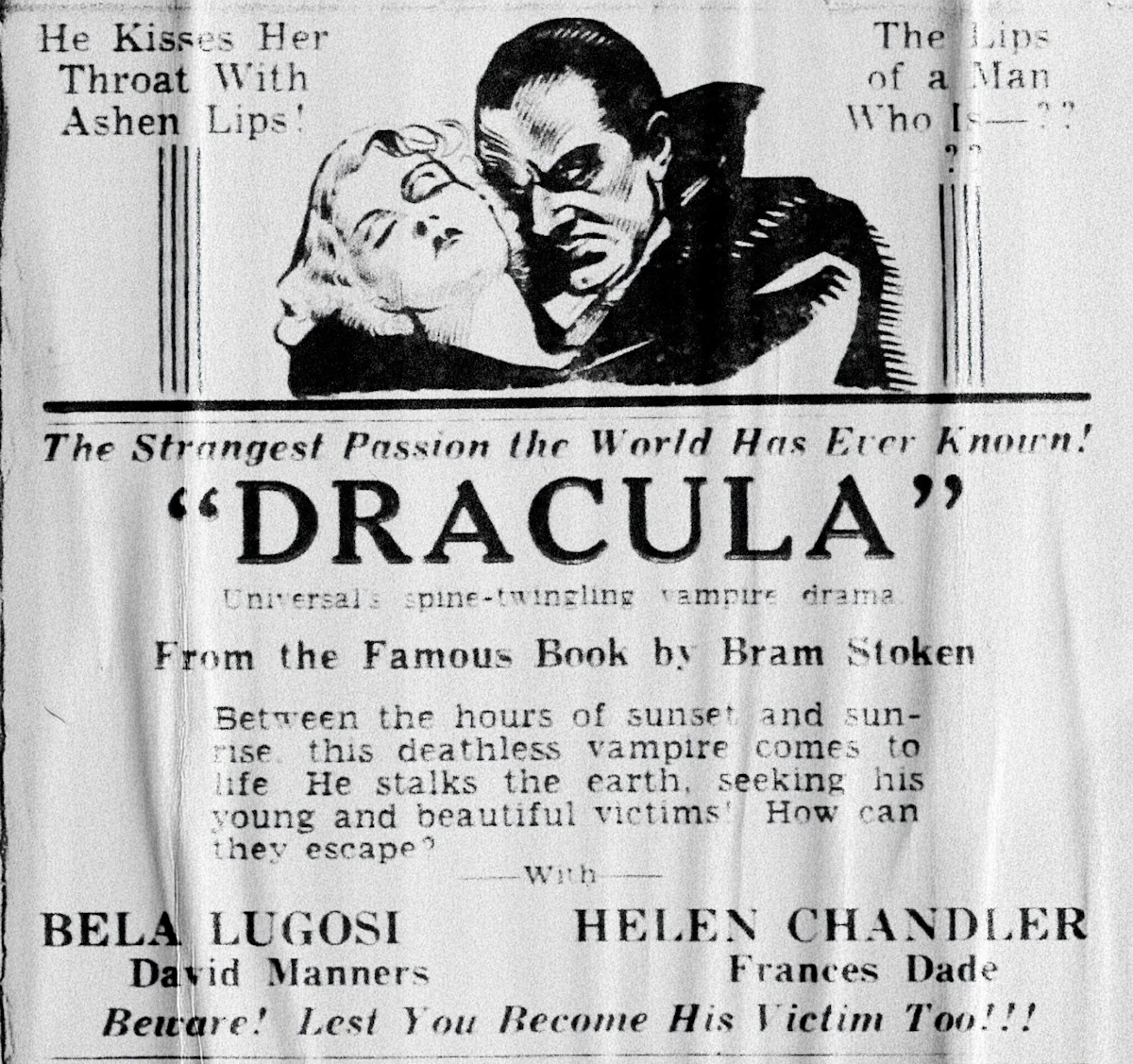
The sultry non-supernatural vamps of the early 1900s gave way to Bela Lugosi’s iconic Dracula of the late-1920s. In 1927, Broadway producer Horace Liveright secured the rights to perform Stoker’s story in the United States. The production opened on Oct. 5 at the Fulton Theatre in New York. Hungarian-American melodrama actor Bela Lugosi starred as the count.
Universal Pictures bought the rights in 1930. The next year, they released the first Hollywood version of “Dracula,” a blockbuster of the early sound era. Lugosi starred, reprising his stage role. In Muncie, the film opened at the Rivoli Theater to much fanfare on Feb. 24, 1931.
Capitalizing on “Dracula’s” success, Hollywood produced dozens of vampire films in the decades that followed. Many of them played in Muncie. In May 1946, the Wysor Grand screened “House of Dracula,” starring John Carradine and Lon Chaney. Nearly 20 years later, in November 1965, the Muncie Drive-In on Yorktown Pike featured the Italian B-film, “Planet of the Vampires.” Then fittingly on Friday, Nov. 13, 1992, Francis Ford Coppola’s “Bram Stoker’s Dracula” opened at Northwest Cinema 8 on McGalliard.
Finally, this past December, Robert Eggers’ overproduced version of “Nosferatu” played at AMC Muncie 12. Because, of course, nothing quite says Christmas like a bloodsucking Saxon demon.
Cornerstone’s next Public Domain Theatre feature is George Romero’s 1969 zombie classic, “Night of the Living Dead.” It’ll play in the E.B. Ball Auditorium on Wednesday, Oct. 15, at 6:30 p.m. Admission is free. In June of 1969, this film terrified Munsonians for the first time at the Ski-Hi Drive-In out on State Road 28. Now it’s back to haunt your October.
Chris Flook is a Delaware County Historical Society historian and senior lecturer of Media at Ball State University.
This article originally appeared on Muncie Star Press: ByGone Muncie: Vampires in the Magic City
‘ The preceding article may include information circulated by third parties ’
‘ Some details of this article were extracted from the following source www.yahoo.com ’