Sir George Ivan “Van” Morrison turns 80 today. He is one of the greatest singers and songwriters of all time, an inscrutable Belfast bruiser who has taken listeners on an incredible journey through song and sound, as if eternally seeking the ineffable in a shifting melange of jazz, blues, rock, soul and folk, using his pliant voice to manifest the inarticulate speech of the heart.
From his introduction to the world as the roaring teenage frontman of Northern Irish rockers Them in the 1960s, through his glorious ascendance as a free-flowing mystic troubadour in the 1970s to succeeding decades as a relentlessly prolific music maker and hard-touring road warrior, Morrison has led a life defined by his near obsessive relationship with his own art and craft.
But the great mystery of Morrison is the apparent gulf between the freedom, light, spirituality and unbounded emotion of his finest music and the often dark, grouchy and paranoid personality he presents to the world.
Let me start by telling you the funniest Van Morrison story I have ever heard, which was related to me by Pretenders frontwoman Chrissie Hynde. It was sometime in the late 1980s, backstage at a Bob Dylan concert, where Hynde and her then husband Jim Kerr (of Simple Minds) had been invited to aftershow drinks in Dylan’s Winnebago.

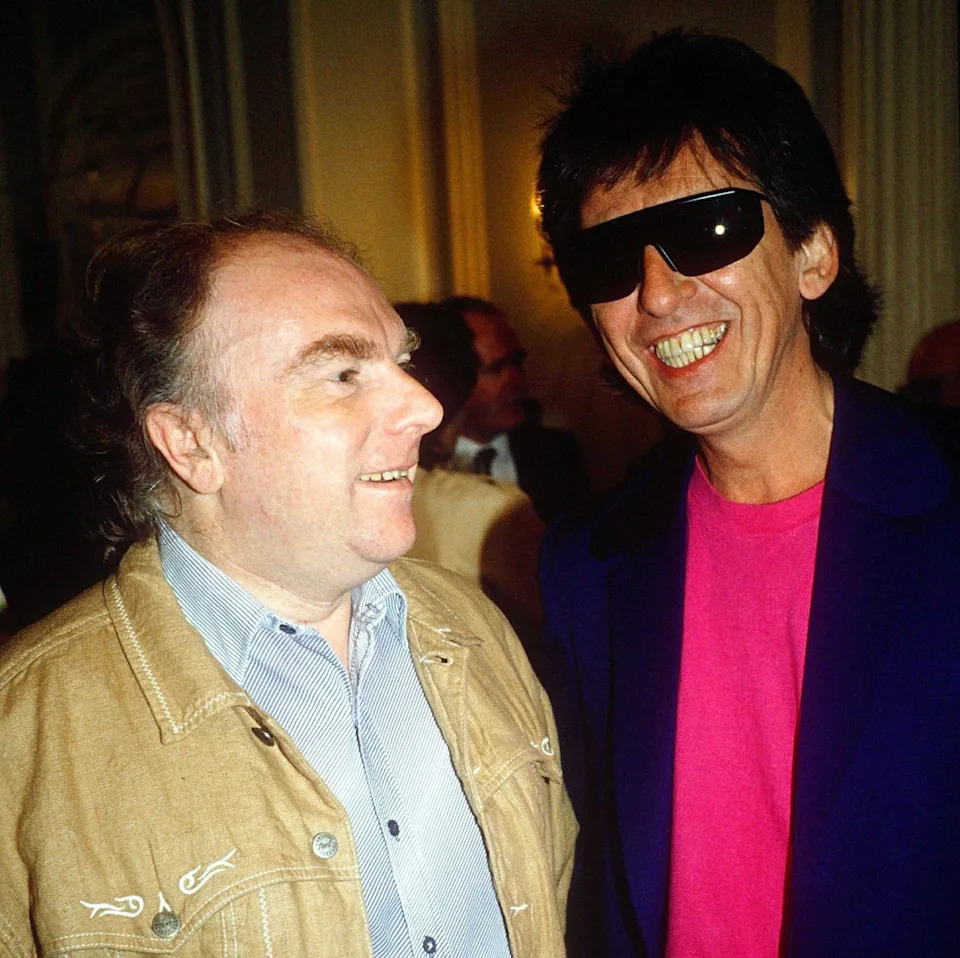
A starry gathering: Van Morrison and George Harrison pictured in 1990 – Richard Young/Shutterstock
They were joined by tennis champion John McEnroe and his then-wife, the actress Tatum O’Neal, as well as two of Dylan’s closest musical allies, George Harrison and the irascible Van. Quite the starry gathering. Drink was flowing freely, and by Hynde’s reckoning, Van was well into his cups when he discovered he had lost his wallet and started interrogating everyone in the Winnebago.
“Bob? Have you seen my wallet? George, have you seen my wallet?” he demanded, as if suspecting the rock legends of purloining it.
When they politely demurred, Morrison sat down, not talking to anyone, but continuing to drink heavily and stew in his thoughts. Much of the conversation focused on Harrison, with the starstruck McEnroe asking questions about his former band.

Suddenly Morrison could take it no more. He leapt up, shouted “Forget the Beatles! The Beatles are dead!” threw open the doors of the Winnebago and charged off into the night.
I have met Morrison on a few brief occasions, but made no impression upon him, as he gruffly shook my hand before moving on to someone considered more worthy of his attention. I got off lightly compared with Salman Rushdie, who was introduced to Morrison at a party at fellow Irish rock star Bono’s house and reported being “treated to the rough edge of the great man’s tongue”.
His disdain for the media is well known (“Newspaper barons are the scum of the lowest degree / And they prey on everybody,” he sang on his 2003 song Goldfish Bowl), leading veteran publicist Keith Altham, who represented Morrison for a period in the 1970s, to describe him as a “very aggressive and abrasive personality” who is “the worst PR of his work that I’ve ever come across”.
Nevertheless, I would still love to interview him. Like every journalistic fan, I fondly imagine I am going to be the one to get past his defences. But you should be careful what you wish for. When my friend Liam Mackey, a lifelong proselytiser of his music, sat down with him in Dublin, he only got to his third question when Morrison asked, “Is it OK if I go to sleep?” The encounter went downhill from there, with Morrison repeatedly snarling, “Have you got your pound of flesh?”
A few interviewers have had more luck, though often they have been close friends (Victoria Clarke, the wife of late Pogues frontman Shane MacGowan, enjoyed some productive encounters), lovers (his second wife, Michelle Rocca, interviewed him “exclusively” several times) and celebrities Morrison admires. Music magazine Q arranged an apparently jovial encounter with comedian Spike Milligan, one of Morrison’s childhood heroes, who later reported back, “The man was a pig”.
Morrison has notoriously blanked former band members, fired musicians in the middle of tours and recording projects and abused audiences for requesting old favourites (when someone called for Brown Eyed Girl at a 1974 show in San Francisco, Morrison retorted, “Yeah, if you shut your mouth and be quiet, you may get what you want, all right?”)
I once saw him play an intimate show at Ronnie Scott’s Jazz Club, in London, where he disappeared into his dressing room before sending the band out for an encore. He left them stranded onstage playing an instrumental blues riff for 10 minutes, before someone informed them – and the audience – that Morrison had left the building.
Yet still we come back for more, not because we are suckers for punishment but because there is something burning brightly inside the dark force field of Morrison’s musical personality; something that can take you to places few other musicians can reach.
At 80, Morrison is still making albums (at the rate of more than one a year) and still on the road (he aims to play two or three gigs a week). He continues to make music because he needs to sing, and he can still clamber up inside a song and punch through it like he is battling for spiritual release, until that incredible modulated voice is soaring somewhere unexpected, unbound by earthly restraints.
He has made a lot of fantastic records, but for the deepest Van experience I recommend his 1974 double live album It’s Too Late to Stop Now. As Bob Geldof said in 1999, “He is an extraordinary singer. No other person sounds like him. He is uniquely recognisable and he uses that beautiful thing to explore areas and depths few have charted successfully. It is like some long journey for meaning.”
I used to think Morrison’s cantankerousness was a response to the pressures of fame, but the more you learn about him, the more you realise it is an essential part of his character. Biographies suggest he was not well-liked as a teenager, with an aloofness that was sometimes excused as shyness and sometimes perceived as plain rudeness. “He was always a little s–t, and still is,” said Anne Denvir, who spent years as part of his Belfast social circle, in Johnny Rogan’s biography No Surrender. “Some people never change.”

Van Morrison (centre) with Bob Geldof (right) and Bono in Dublin in 1999 – John Minihan/Shutterstock
But there are more sides to Van than the grumpy malcontent who famously railed against Covid lockdowns. Close friends attest to a dry and sometimes surreal sense of humour. He is a voracious reader, fascinated by comparative religion and philosophy. His musical peers also tend to forgive him his social inadequacies, recognising something rare and precious in his spirit (Nick Cave admiringly noted that “sadness” pursues Morrison through his music “like a black dog”).
For long periods of his life, he masked his social discomfort with alcohol, which is often at the centre of his most outrageous public encounters. Consider the time in 1966 when he and his rock namesake, the Doors singer Jim Morrison, were thrown out of an LA club for catcalling blues guitarist Johnny Winter. It was a night that ended with the two Morrisons onstage at the Whiskey A Go Go, duetting on Van’s garage rock classic Gloria, something any music fan would feel thrilled to have witnessed. Jim, according to his Doors bandmate Ray Manzarek, was drawn to the Northern Irish singer’s “eerie darkness”.

Van Morrison relaxes in his dressing room after a gig at Hammersmith Odeon in London, 1974 – Patrick Baird/Alamy Stock Photo
MacGowan was another of his regular drinking companions in Dublin in the 1990s, but later admitted: “Van depressed me… I stayed up drinking with him many nights and I always tried to convince Van what a wonderful life he could be living if he stopped being such a miserable f—, but it didn’t work.” When even Shane McGowan thinks the drink is more of a problem than an aid, it’s probably time to knock it on the head.
Morrison, for all his irascibility and tendency to lash out, seems to recognise his own deficiencies. “I’m not a nice person,” he said in 1996. “I don’t expect anyone to say I’m a nice guy. If somebody says I’m grumpy, I’m a c–t, or whatever, that’s OK, because I don’t profess to be an angel… I think I’m a loner. I’m an outsider, not because I want to be, but I found I had to be.”
The one constant throughout his life has been music, and as much as it clearly means to him, the Belfast iconoclast rails and strains against any attempt by the world to define him by any other terms than his own.
Morrison’s unwillingness to explain himself, and his often abrasive relationship with the public and the media, might seem limiting and even self-destructive – except here he is, at 80, still out there, still famous, still rich, still acclaimed, still singing. To quote the exhortation from his extraordinary song Into the Mystic: “It’s too late to stop now!”
‘ The preceding article may include information circulated by third parties ’
‘ Some details of this article were extracted from the following source www.yahoo.com ’