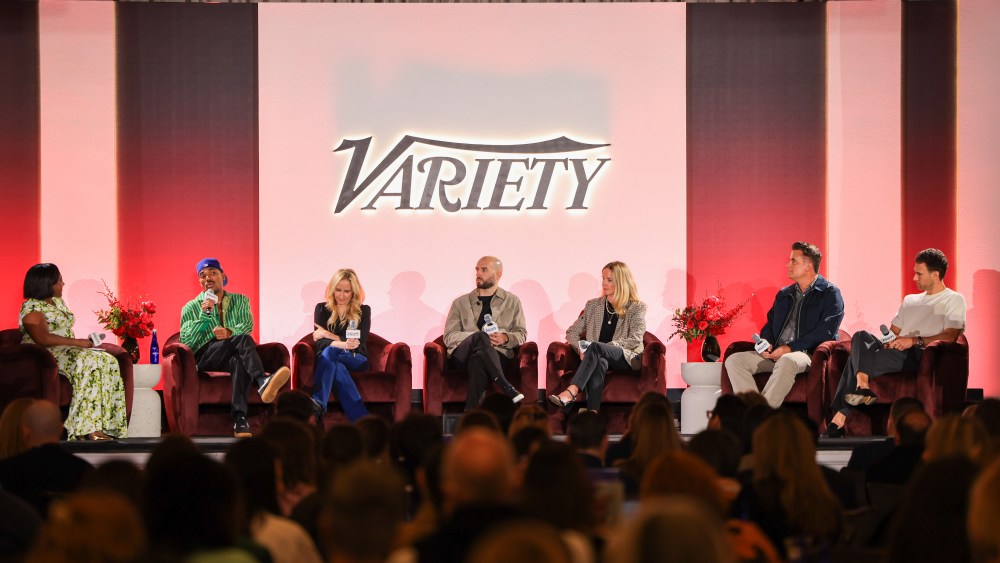
Variety’s Entertainment Marketing Summit in Los Angeles, presented by Deloitte, brought together the most influential marketers, creatives and brand leaders who are shaping the future of entertainment. Held April 22 at the Beverly Hilton, the summit covered the real-world impact of AI on creative workflows, how live experiences have become the center of the marketing mix, the evolution of franchise building and creator partnerships, and why authenticity with audiences has become the standard expectation.
Read below for key takeaways from the panels.
The Main Event – Best of Experiential, Live and Event Marketing
Live experiences have moved to the center of the marketing mix and the brands getting it right are treating their audiences as distribution channels, not just end points. NVE Experience Agency founder and CEO Brett Hyman argued that unlike any other form of marketing, brand experiences collapse the funnel, firing trial, affinity and content creation all at once. “The AI is going to be jet fuel for our industry,” Hyman said. “Because the more content, the more promises brands make, the more they’re going to have to prove it.”
Panelists also pushed back on the instinct to follow the leader with NASCAR Chief Brand Officer Tim Clark emphasizing that originality is the only real shortcut. “If you create such a great experience, your biggest problem is we need to scale this to get it to more people and more platforms,” he said. “I think I speak for all of us, I would welcome that as the challenge.” Taco Bell International’s Amy Durini agreed, pointing to the brand’s habit of mining its own comment section for creative direction and co-creating with fans rather than broadcasting at them as the reason its live events consistently land.
Keynote Conversation with Oliver Schusser, VP Apple Music and International Content
Oliver Schusser, Apple’s vice president of Apple Music, TV, sports, podcasts and Beats, made the case that the streaming industry’s free-tier model is holding the music business back. “We don’t think it’s the right thing for artists to give away music for free,” Schusser said, adding that he believes the business “could be much greater” without free tiers altogether.
On AI, Schusser revealed that Apple doubled its fraud penalty for labels caught submitting AI-generated content just two months ago and that the company has introduced tagging requirements for AI-made recordings, artwork and songwriting. He called on major label CEOs to convene as an industry to define what actually constitutes AI music. “Right now it’s very gray,” he said. “Is it 1% AI? Is it only 100%? Those are the questions we need to solve on an industry level.”
Schusser also reflected on Apple Music’s Super Bowl halftime show partnership, describing the six-month campaign ramp as the company’s biggest promotional push for any music property. He confirmed Apple and Roc Nation are already in discussions for next year’s show.
Leveling Up Fandom: How Games Extend Entertainment IP
Netflix Games president Alain Tascan and Deloitte managing director Wenny Katzenstein made the case that video games have moved from subculture to mainstream — with roughly 85% to 90% of kids under 18 now playing — and that entertainment companies ignoring that shift do so at their own peril.
Tascan announced that Netflix’s new kids gaming app, Playground, launches worldwide April 28, offering children interactive experiences with characters from shows available on the platform in what he described as a safe, parent-friendly environment. The app is part of Netflix’s broader strategy of organizing its games slate into four categories: kids, narrative, party games and mainstream titles, including a reimagined FIFA.
On the question of which IP translates to games and which doesn’t, Tascan was direct with the audience. The key is whether players can project themselves into a world rather than simply follow a character. “You want to be yourself in this world,” he said. “You want to express yourself.”
Tascan also teased a longer-term vision for where Netflix Games could go, including one where viewers pause a show mid-scene, take control of a battle sequence on their phone and then return the altered outcome back to the narrative. “I thought I was not going to see it in my career,” he said. “But I think I see it in my career.”
Breakthrough Brands – Innovating through AI
Speed emerged as the defining factor of AI adoption during the panel spanning Fox, Reddit, Warner Bros. Discovery, DoorDash and ad tech firm StackAdapt — with executives sharing concrete examples of how real-time AI integration is compressing creative timelines from weeks to minutes.
Fox CMO Brian Borkowski described a Daytona 500 campaign in which AI monitored the live race, generated headlines as events unfolded and piped them into paid media assets within 60 seconds. Click-through rates on those ads ran six times higher than anything else the team had produced. DoorDash VP of brand marketing Gina Igwe detailed how her team used AI during the Super Bowl to develop reactive social content on the fly — including a meme timed to Bad Bunny’s halftime performance and AI-designed gift cards featuring 50 Cent — all produced at what she called “net-breaking speed.”
Warner Bros. Discovery’s Jill Steinhauser said the company has embedded AI into its ad sales workflow, reducing a six-to-seven step order ingestion process down to two. On measurement, Igwe offered a framework her team calls “creative caps” — a currency tied to creative hours — with a mandate to increase output 30% per quarter. “The only way to get 30% more output with the same resources is you have to innovate,” she said.
Where Fandoms Collide & Culture Is Rewritten
Havas Play managing partner Andrea Isaac and SVP Juliet Tierney said that fandom is no longer siloed by category. Sports, gaming, music, fashion and entertainment are now interconnected layers of how people live, and brands that find the unexpected intersections between those worlds are the ones breaking through.
The pair described their approach as “experience first,” arguing that participation matters more than reach. As an example, Isaac described a campaign for a gaming client launching a new expansion with no sports connection whatsoever. By identifying an overlap between its core players and NFL fans, the agency built an activation at Gillette Stadium with a live Twitch stream component. The engaged core audience became brand ambassadors, and the resulting social reach was the best launch the client had ever had.
On Gen Z, both executives emphasized that the generation is nearly impossible to fool. Two thirds actively participate in a fandom, Isaac noted, but they will immediately sniff out anything that feels like marketing. Tierney cited a stat that 76% of Gen Z are seeking shared cultural experiences, calling them a “dichotomous generation” that is highly online yet craving genuine human connection.
Looking ahead, Isaac flagged that Meta is on pace to surpass Google in ad revenue for the first time this year, and that consumers increasingly begin searches on AI tools rather than traditional search engines. Big ideas, she argued, will still be what wins.
Hollywood New Leaders – Best of Creator Marketing
“Brands matter more than ever, and storytelling matters more than ever,” Warner Records EVP Dalia Ganz said at the close of a creator marketing panel including music, film, gaming and beauty executives. “It’s no longer good enough just to have great songs.”
The sentiment landed as a conclusion to a slew of examples that made the same case from different angles. Ganz described building a viral marketing team engineered around the two-to-three week lifespan of a music trend cycle, with direct influencer relationships and in-house infrastructure designed to activate within 48 hours. Success, she said, is measured not in views but in streams and physical sales. For a recent example of the organic approach done right, she pointed to artist Sombr, whose existing friendship with influencer Quenlin Blackwell led to a music video cameo and eventually a surprise guest appearance during Sombr’s Coachella Weekend Two set — a moment that generated buzz precisely because no one engineered it.
Content creator and music executive Carter Gregory, who attended both weekends, made the case that Weekend Two is becoming a serious opportunity for brands willing to invest there, noting this year’s edition was among the strongest in recent memory.
Sony Pictures EVP Rose Phillips detailed the rollout for the “Spider-Man: Brand New Day” trailer, which generated 1 billion views after the studio spent 24 hours finding genuine Spider-Man superfans in countries around the world to post as dawn broke in their time zones. One recruit, a man in Wales who climbs mountains dressed as Spider-Man for children’s charity, didn’t even have an Instagram account before Sony reached out. “Give it to the fans and let them run with it,” Phillips said. Phillips and Discord global head of media and entertainment Edvin Dapcevic also discussed a developing partnership around Resident Evil, with Discord’s more than 50,000 horror IP servers providing a ready-built fan base for immersive promotional experiences.
Sephora VP of social and influencer marketing Brent Mitchell described a same-day post with “Summer House” cast member Sara Miller that tied a viral reality TV scandal to Sephora’s loyalty event. The caption: “Sephora rewards loyalty.” Roblox head of entertainment and lifestyle partnerships Todd Lichten, meanwhile, noted the platform’s relationship with Hollywood is increasingly running both ways — studios bringing IP to Roblox’s 150 million players, and Roblox-born properties, including “99 Nights in the Forest,” now moving toward film development.
When Brand Meets Entertainment and Culture at the Speed of AI
The gap between AI adoption and AI readiness was central during the conversation between Qualcomm CMO Don McGuire and Deloitte principal Jasmin Jacks. The technology, both agreed, is outpacing the organizations trying to use it.
McGuire said his biggest concern isn’t leadership mandates or AI-native new hires. It’s the middle layer of any company — the people who have been doing things the same way for years and have the most to lose from disruption. “It’s not a matter of upskilling,” he said. “It is a retraining of your brain, of your behavior.” Jacks added that companies are spending 90% of their AI budgets on technology and only 10% on enabling the human shift required to actually adopt it.
On sports partnerships, McGuire traced Qualcomm’s evolution from touting processor specs to chasing fan passion, landing on soccer and Formula One as vehicles for emotional brand-building. Jacks added that most brands leave the biggest returns on the table by spending 80% of sponsorship budgets on rights acquisition and only 20% on activation. She called women’s sports a significant and still-underfunded opportunity. Asked for his ultimate competitive advantage, McGuire said, “Knowing who you are as a brand, knowing your audience, providing context, making it relevant, and driving action. That is the recipe.”
Building the Brand-Verse – Success with Franchises
Where the AI panel wrestled with organizational change, the franchise panel turned to a different challenge. The instinct to treat some fan touchpoints as more important than others, the group agreed, is a losing strategy. There is no such thing as an ancillary market.
Minecraft VP Kayleen Walters made the case most concretely. When the franchise released its theatrical film, the team wove elements from the movie into the live game, location-based experiences and merchandise simultaneously, so new audiences could feel the connection the moment they encountered it. The strategy was informed by a telling internal figure: more than 50% of Minecraft consumer product buyers have never played the video game. “People are complex,” Walters said. “They want more than just one thing from something.”
Skybound’s Josh Silverman offered a counterpoint on fan feedback, warning that the loudest voices rarely speak for the room. Stated preferences and expressed behavior, he argued, are two entirely different things. “If we listened to all the fans who didn’t want certain characters killed off, they would stop watching the show,” he said.
Blumhouse-Atomic Monster CMO Karen Barragan closed with a caution for anyone tempted to get ahead of themselves. “You really need to start with your core and build off of that core,” she said, “before you can start thinking about selling them T-shirts.”
In the Director’s Chair: Brand Storytelling Masters
Margaret Walker, Executive Vice President of Entertainment Marketing for NBC Universal, described how the studio sits “in a really unique place.”
“We have premium IP, we sit with culture and also commerce, right?,” she said. “We’re at this intersection of three things. And so for us, it’s not just about the placement, but about how do I participate in culture? And what that looks like for me is making sure, one, campaigns are breakthrough because we’re all looking for attention, and trying to find attention of the audiences we’re trying to serve, right? Secondly, it’s to be a culture catalyst. We’ve got to spark something and that can only happen if the audience is a fit. So like that work should have happened before they reached out to you. Is it an audience fit and is it authentic, right? It really is about driving culture forward or telling a story in a deeper or more dynamic way that speaks to both brands because otherwise, consumers are smart, they’re savvy.”
Summer Fridays co-founder Marianna Hewitt, who built the brand as a creator before launching it, said overly prescriptive briefs undermine the very thing brands are paying for. She described letting “Traitors” cast member Maura Higgins post a bag reveal where a Summer Fridays product appeared organically, without brand approval or talking points. “If it was our typical brand guidelines of waiting a week for approval, we would have lost out on that cultural conversation entirely,” she said. Not every product in the bag was Summer Fridays and that was the point.
Tubi CMO Nicole Parlapiano argued that meaning is the more valuable metric, pushing back on the industry’s fixation with scale. “The internet rewards specificity,” she said. She pointed to Tubi’s bet on TikTok creator Terri Joe, whose film “Missionary in Miami” hit No. 8 on the Luminate charts — with Red Bull’s brand integration earning positive Letterboxd reviews from viewers, which is a very rare outcome for a paid placement.
Pinterest CMO Claudine Cheever also noted that 96% of searches on the platform are unbranded, meaning users are actively looking for products rather than scrolling past them. The platform tracks saves and pins as purchase-intent signals, and buyers who discover products on Pinterest, she said, return items at a significantly lower rate than impulse purchasers on other platforms.
Conversation with Jack Harris, Innovative Artists Creators
Jack Harris, who runs the creator division at talent agency Innovative Artists, came to the job by way of the job itself. He dropped out of film school to become a content creator, then stumbled into representation after negotiating a deal on a friend’s behalf and realizing, as he put it, that he could argue with people for a living.
The advice he brought to a room full of marketers was to warn how brands spend too much time focused on what is happening today and not enough on what is happening tomorrow. The next generation of consumers, Harris said, is not growing up with network television or cable. They are growing up with YouTubers and Twitch streamers, and when they come of age, creators will be the default mainstream media.
On the question of who to work with, Harris pushed back on the fixation with follower count, arguing the industry is entering what he called the expert era. A small creator with a dedicated audience built around a specific niche, he said, will outperform a large lifestyle creator every time for a brand trying to sell something real. “There’s a big difference between having followers and having fans,” he said. “Followers watch what you do. Fans buy what you sell.”
Creators, he argued, know how to sell products to their own audiences better than any brand brief can. “If you allow a creator to sell a product to their audience authentically with their own voice,” he said, “there is no better magic than that.”
‘ The preceding article may include information circulated by third parties ’
‘ Some details of this article were extracted from the following source variety.com ’