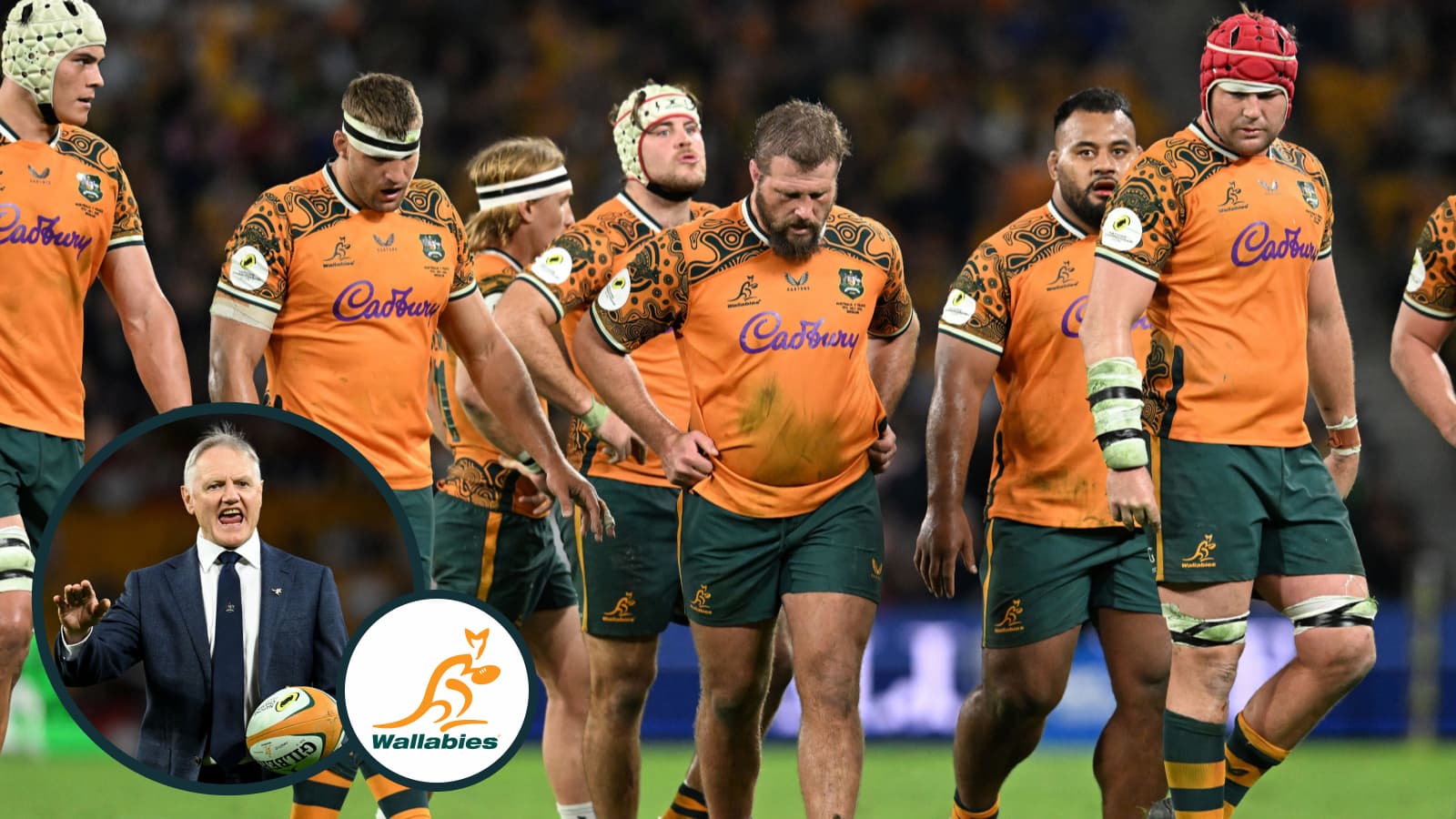
Given he’s about to leave the Wallabies, Joe Schmidt was never going to face the music. But that shouldn’t mean that Rugby Australia doesn’t.
After all, it’s RA that concocted the bizarre 15-month coaching transition between Schmidt and Les Kiss.
The national governing body could – and should – have flexed their muscle and called rank on Kiss taking over last year’s Rugby Championship, or at the very least paid some compensation to the Queensland Rugby Union to get him out of his three-year deal one year early. It worked alright when Michael Cheika doubled the load in 2015, didn’t it?
RA, too, decided to keep Schmidt in the job following last year’s Spring Tour – the worst in more than half-a-century as the Wallabies went winless from four Tests.
Instead, RA decided to keep the power dry, keep the gang together, including World Rugby pals Schmidt and Peter Horne, and hope that everything fell into place.
Where has that got the Wallabies?
They’ve lost nine of their past 10 Tests, including their past six matches; selection has been all over the place (full-back Jock Campbell was the Wallabies’ replacement playmaker against France despite not even being considered a No.10 by the Reds; and time is running out before next year’s World Cup on Australian soil.
So who is ultimately responsible?
Schmidt reports into RA high performance director Horne, but it also extends to the RA board, including CEO Phil Waugh and chairman Daniel Herbert.
The Wallabies greats have been on the RA board for years and the duo were members on the high-performance committee when Dave Rennie was still in charge in 2022. They were also involved in the process when the New Zealander was flicked for Eddie Jones in early 2023.
Meanwhile, as Rome burns, RA is trying to pretend like everything is fine. It’s not – and it hasn’t for years.
Playmaking fiasco Schmidt’s latest blunder
How the Wallabies ended up with Campbell playing at fly-half against France ranks as one of the most ill-thought-out selections in Australian history.
The 31-year-old is a fine full-back, he was even one of Australia’s best against Ireland a week earlier, but the departing Reds No.15 has never been a playmaker.
The Reds toyed with shifting Campbell to the playmaking role but quickly abandoned the plan last year.
Despite that, Schmidt demoted him to the bench and had him wear the No.22 jersey as cover for rookie Declan Meredith.
It was no surprise that Campbell struggled in the role, with the acting playmaker giving away a penalty for running behind his teammate deep in his half.
While Schmidt fell back on the fact that it was proving hard to get continuity in the playmaking channels because of the injuries to Carter Gordon and Ben Donaldson, it’s not as if they came on match eve.
In fact, both men were in doubt the day after the first-up loss to Ireland, with whispers of their injuries surfacing almost immediately.
Gordon, too, has unfortunately been injury-prone over the past 24 months.
But the fact is that Schmidt didn’t exactly try to convince Gordon to stay in Australian rugby in 2024, nor Noah Lolesio in 2025. Both departed after barely being convinced to stay, which was replicated in the deals put to them by RA.
Schmidt also selected Tane Edmed in his last 11 matchday squads in 2025 but looked past him in 2026. Ditto James O’Connor, who was in and out under Schmidt last year after being called up to take on the Springboks.
As such, it was an uncomfortable sight to see Campbell replace Meredith before the hour mark, particularly given Edmed had just played club rugby in Canberra, O’Connor was in the stands at Suncorp Stadium watching on, and Lolesio was in Sydney watching his sister play in the NRLW.
Surely that speaks of Schmidt not getting his selection right since taking over.
Concerning nature of Wallabies defeats
The bizarre and concerning aspect of the Wallabies’ opening two defeats in the Nations Championship is that they’ve come despite a dominant set-piece.
During the Wallabies’ end of season tour last year, their lineout crumbled the deeper the campaign went on.
But the scrum and lineout have both operated outstandingly in the opening two Tests.
Brandon Paenga-Amosa has had plenty to do with that, with the Force hooker proving his value.
Despite the dominance, the Wallabies have been put to the sword elsewhere – and that’s alarming.
The Wallabies’ defence and kick chase was terrible against France.
That was brutally shown in the 56th minute as France exposed the Wallabies’ broken line, lack of urgency and horrific work-rate from Meredith’s clearing kick. It led to France tearing the Wallabies apart and blowing open the match.
Big Suaalii call looms
Under Schmidt, Joseph Suaalii was his outside centre. But will Kiss share the same view?
It’s a massive call and one which will test RA’s coaching transition because selection, and where players play, must be a part of the conversations between coaches.
Suaalii’s evening in Brisbane was a bit like his transition to rugby over the past two years – good, bad, and ugly.
He won several kick restarts across the match, found some space and put away Max Jorgensen with a nice overhead pass, which the winger dropped in the process of trying to score.
But Suaalii was also found out defensively in the second half, which has been a problem ever since he returned to the XV-person game.
Together with Tom Wright, who was excellent in the first half, the duo are good for a few errors in a match, and that’s a big risk in a high-stakes game. Another leaguie, Angus Crichton, is due to join the Wallabies at year’s end to make a late play for the World Cup.
Which brings us back to Suaalii. Is he best suited at outside centre or in the outside backs because arguably the best No.13 in Australian rugby, Len Ikitau, is being forced to play at inside centre?
Meanwhile, another quality centre, Samu Kerevi, who managed to strike up a potent midfield combination with Ikitau that tamed the Springboks in 2021 in back-to-back fixtures, is somehow out of sight and out of mind.
TMO rears ugly head again
From Wellington, Brisbane and Newcastle, the officiating left a lot to be desired.
While all three Tests were engrossing, Luc Ramos was too whistle-happy in Wellington and immediately went to the pocket to show Ruben Love a yellow card for a so-called deliberate knockdown. The issue was, Love didn’t knock it on.
Want more from Planet Rugby? Add us as a preferred source on Google to your favourites list for world-class coverage you can trust.
Eventually, the right decision was made but only after play had continued and the TMO had interjected to urge Ramos to have a look at the big screen and reverse his decision.
Soon after, Karl Dickson had a similarly difficult evening as the TMO came in on a couple of occasions.
While the correct decisions were made, including the yellow card to Emmanuel Meafou in the first half, the decision to allow play to continue for two minutes in the second half before a tip-tackle was penalised was farcical.
Again, the right decision was ultimately made, but interestingly Dickson had allowed play to continue, simply saying that the tackle from Jorgensen on his opposite winger was “dominant” rather than illegal.
Nor were the two minutes put back on the clock, with everything that subsequently occurred irrelevant.
More TMO interventions occurred in Newcastle and given the scrum-heavy contest, it was even more jarring, especially when the man holding the whistle, Andrea Piardi, opted against penalising the Japanese for a deliberate knock-on.
It was a bad look and once again shone an unnecessary spotlight on the game’s issues.
‘ The preceding article may include information circulated by third parties ’
‘ Some details of this article were extracted from the following source www.planetrugby.com ’