After the loss of his titles and his arrest on suspicion of misconduct in public office, Andrew Mountbatten-Windsor now faces calls to remove him from the royal line of succession.
The former prince is currently eighth in line to the throne, but under growing pressure as claims about his relationship with paedophile financier Jeffrey Epstein and his time as UK trade envoy continue to mount.
The government has said it is ‘not ruling anything out’. However, while it is likely any steps would take place following the conclusion of police investigations, on Monday, Australian prime minister Anthony Albanese said he would back “any proposal” to ensure Mountbatten-Windsor can never inherit the throne.
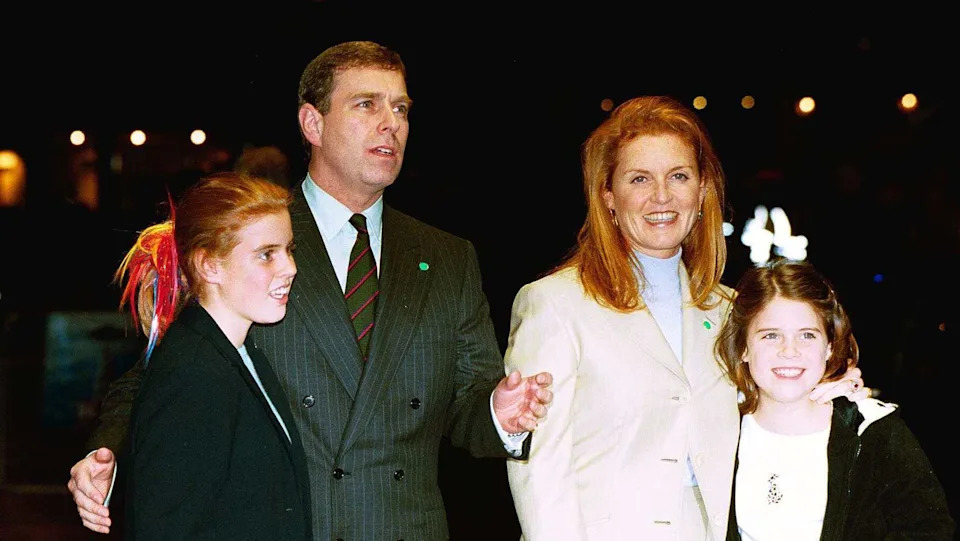
The developments also place a spotlight on the future status of his daughters – Princess Eugenie and Princess Beatrice – and his grandchildren, who occupy the six spaces in the line of succession below him.
Here’s what we know – and how any decision could impact Andrew’s descendants.
How could Andrew be removed from the line of succession?
Despite calls for Andrew to be removed from the line of succession – and indications this option is being explored – doing so could prove a complex process as the British monarch is head of state in several other countries.
“It’s complicated,” Kate Dewsnip, graduate teaching fellow and constitutional law specialist at Liverpool University and the Constitution Society, told Yahoo News.
“There has to be an act of parliament in the UK, but that won’t be passed in a huge rush because the government says it has to let the police investigation run its course.
“It won’t be like something like the Coronavirus Act and it won’t be particularly large because the issue is fairly self-contained.
“The UK will also need the approval of other states that have the King as their head of state and that can happen in different ways.”
The last time changes were made to the line of succession was in 2013, when rules were amended to end the male primogeniture which gave precedence to sons over daughters.
Andrew Mountbatten-Windsor and his ex-wife Sarah Ferguson, both maintained relationships with paedophile financier Jeffrey Epstein.
(ZUMA Press, ZUMA Press, Inc.)
But this took “years of delicate negotiations” according to Professor Robert Hazell, Professor of Government and the Constitution at University College London.
“In the past, both the palace and the British government have taken the view that everyone has to move in line, so we all have the same rules of succession,” he said. “That is because if that didn’t happen, at some point in the future there could be a different monarch in Australia than the person who is monarch in the UK.”
As well as the UK, King Charles is the head of state for 14 other countries, many of whom “will not welcome being required to spend political time and capital on this”, Professor Hazell added.
Then there is the issue of what other changes MPs may try to force through while voting on the necessary law change.
“These things rarely go according to plan,” Professor Hazell added. “I would bet amendments would be prepared if we were changing the lines of succession – why not tidy things up with Prince Harry? He’s left the country, so why is he still in the line of succession? I don’t think its passage would be simple.”
What could happen to Beatrice and Eugenie?
Andrew’s immediate family has also been caught in the fallout following the release of the Epstein files.
Unlike their father, Beatrice and Eugenie have so far retained their own titles and honours – although Andrew’s ex-wife, Sarah Ferguson, lost the use of her Duchess of York title when her ex-husband gave up the dukedom.
Ferguson has also been dogged by embarrassing revelations in the Epstein files – in one email exchange she appears to say to Epstein: “I am at your service. Just marry me.”
The files also suggest she took her daughters, then aged 20 and 19, to meet the paedophile financier just days after he was released from prison for soliciting a child for prostitution.
The former Prince Andrew was officially stripped of his titles and honours last year.
(Maureen McLean)
Were Andrew removed from the line of succession, it would not necessarily affect the position of the two sisters – apart from moving them and their children a step closer to the throne – unless this was also included in the legislation.
For example, when the Queen’s uncle, Edward VIII, abdicated after less than a year on the throne, the Act of Parliament that ended his reign specified his descendants would also be barred from ever inheriting the crown.
“[Beatrice and Eugenie are] where they always were,” said Prof Hazell. “I don’t think it affects them, depending on how the legislation is formed.”
But the specific wording of any act passed by parliament could still have consequences.
The 2013 Succession to the Crown Act, which ended male primogeniture and gave preference to sons over daughters, only applied to royals born after 2011. This meant Princess Anne remains behind both her younger brothers in the pecking order.
‘ The preceding article may include information circulated by third parties ’
‘ Some details of this article were extracted from the following source uk.news.yahoo.com ’