(Credits: Far Out)
“An Orwellian picture of what can happen is here, now. Can you imagine someone buying a David Hockney and then cutting it up in pieces to auction off to the highest bidder?”
These were the words of Keith LaQua, executive director of the Artists Rights Foundation, and the object of his concern was a Diet Coke advert which depicted a real-life Elton John alongside the very dead stars Humphrey Bogart, James Cagney, and Louis Armstrong. It was 1991, and the technology was rudimentary, essentially cutting the performers out of various pieces of decades-old footage and transplanting them onto new footage. But these days, with artificial intelligence metastasising in all directions, LaQua’s words have never been more relevant.
This week, it was announced that various Hollywood stars, including Michael Caine and Matthew McConaughey, had signed contracts with ElevenLabs, an AI firm that replicates voices. The deal grants the company the right to create a synthetic version of their voices and license them to clients who want to use them in various forms of content. McConaughey, who invested in the company in 2022, explained that ElevenLabs would be translating his newsletter into a Spanish-language audio form using his synthetic voice.
In a statement about the deal, Caine said, “For years, I’ve lent my voice to stories that moved people […] With ElevenLabs, we can preserve and share voices – not just mine, but anyone’s.”
Setting aside the fact that this sounds like it was written by ChatGPT and funnelled through ElevenLabs’ PR department, it begs the question: Isn’t Michael Caine’s body of work – encompassing eight decades and nearly 200 credits – all the preservation we need? And what will it mean when celebrities are digitally immortal?
This is made all the more pertinent by the fact that ElevenLabs has already secured the rights to the voices of a host of dead celebrities, including Judy Garland, John Wayne, Montgomery Clift, and, bizarrely, Mark Twain. The company is confined to audio, but it’s clear that licensing an actor’s image and likeness is not far off. In 2022, Bruce Willis became the first movie star to sign over his image rights to an AI company, and there’s no reason to believe that the estates of long-dead Hollywood icons won’t follow suit in the near future.
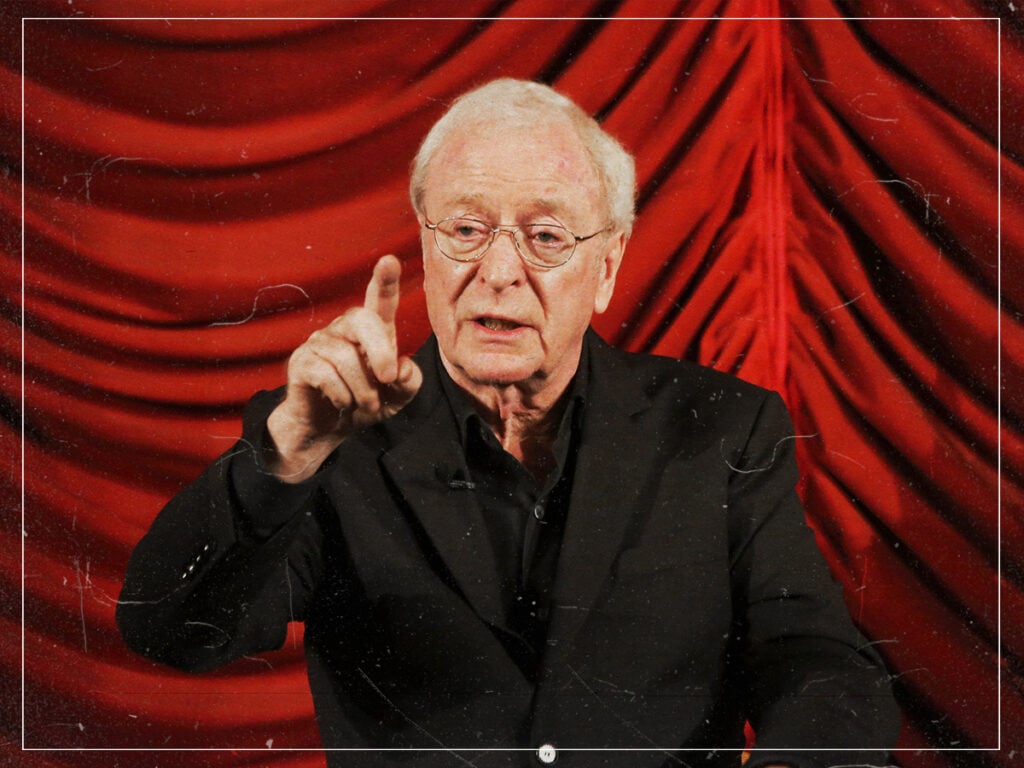
Michael Caine (Credits: Far Out / Manfred Werner / Tsui)
There are all kinds of ethical questions here about deepfakes, the career prospects for would-be stars in a world where Marilyn Monroe and James Dean can be cast in the next MCU movie, and whether Monroe, Dean, or any other deceased star would want to be reanimated decades after their death. But one of the hardest to answer is what will happen to the concept of the movie star when artificial intelligence makes their body of work all but infinite.
People have been banging on about the death of the movie star for decades now. The era of the industry-dominating actor is long gone. No one goes to the cinema to see a Chris Evans movie, they go to see a Captain America movie. Stars have been replaced by franchises and IP, and if you really stop to think about which working actors could rightfully be called movie stars, you’ll find that a lot of them are pushing 60. Denzel Washington, Tom Cruise, and Julia Roberts may be our last remnants of the larger-than-life, god-like figure whose mere involvement could singlehandedly guarantee a film’s success.
You could argue that bringing Old Hollywood celebrities back from the dead and onto the silver screen could be a boon for the star system. Wouldn’t it show a new generation of cinema-goers what star power actually is? But that misses a key factor in what makes a star a star: scarcity.
There’s a reason we fixate so obsessively on celebrities who died young. Monroe, Dean, Jean Harlow, Janis Joplin, Jimi Hendrix, Freddie Mercury, River Phoenix – all of them have legacies longer than their lifespans, and none of them seems to be dimming with the decades. We fawn over them all these years later, not just because they will forever be remembered for their youthful beauty and vigour, but because of how finite their careers were. Will our relationship to them change if they suddenly begin endorsing iPhones and starring opposite Glen Powell? Of course it will.
Franchises are largely to blame for the death of the modern movie star, but there is plenty of scope to blame social media, too. When you can see the behind-the-scenes lives of your favourite actors every day on your feed, a little bit of the magic wears off. Before social media brought the inner worlds of celebrities into the palm of our hands, there was the paparazzi making sure we didn’t miss a single supermarket visit or dinner date.
For human rights reasons, we do not want to go back to the era when studios ran every aspect of an actor’s life, including which photos the public got to see, what their names were, and who they married, but there is no denying that this careful moulding and titration of personas created Hollywood as we know it.
AI celebrity avatars could be the endgame in the arc of the movie star. Michael Caine might think that he’s elevating and preserving his voice by licensing it to an AI company, but it’s difficult to see how deals like this could accomplish anything other than the steady devaluation of his and others’ legacies. His stardom was built on the choices he made every day he showed up on set, the cultural currency of London in the 1960s, and the interviews he’s given and books he’s written.
As soon as someone takes his voice or his likeness and creates their own version of him, what we see and hear will no longer bear his singular approach, spontaneity, and creativity. We’ll be left with a voice and image that becomes increasingly unmoored from the person who gave them meaning, a contextless vessel for… anything at all. It won’t just be the equivalent of chopping up a David Hockney and selling it to the highest bidder, it will be the equivalent of generating digital images and labelling them as David Hockney creations long after anyone can remember who David Hockney was or what his art actually looked like.
Hollywood has many reasons to fear and embrace AI, but perhaps the most difficult consequence to quantify will be the slow and steady dilution of personas that were forged when artificial intelligence only existed in the realm of science fiction.
Related Topics
‘ The preceding article may include information circulated by third parties ’
‘ Some details of this article were extracted from the following source faroutmagazine.co.uk ’