A century and a half ago, Richard Wagner was running out of cash as he was preparing to stage his four momentous nights of opera known as the “Ring Cycle” when he got a message from the Women’s Centennial Executive Committee in Philadelphia. It offered him a princely $5,000 (around $150,000 today) to write a triumphant 12-minute orchestral score to open the Centennial Exposition in Fairmont Park celebrating the 100th anniversary of the Declaration of Independence.
On May 10, 1876, Theodore Thomas, perhaps America’s most famous conductor at the time (he would go on to head the New York Philharmonic and help found the Chicago Symphony), led the premiere of Wagner’s “Grosse Festmarsch” with a 150-member orchestra, its brass and percussion so impressive that the addition of cannon fire Wagner suggested was not needed. The crowd was said to number well over 100,000. President Ulysses S. Grant attended and invited Emperor Dom Pedro II of Brazil to join him along with members of Congress and Supreme Court justices for what remains a unique Declaration of Independence spectacle and debacle.
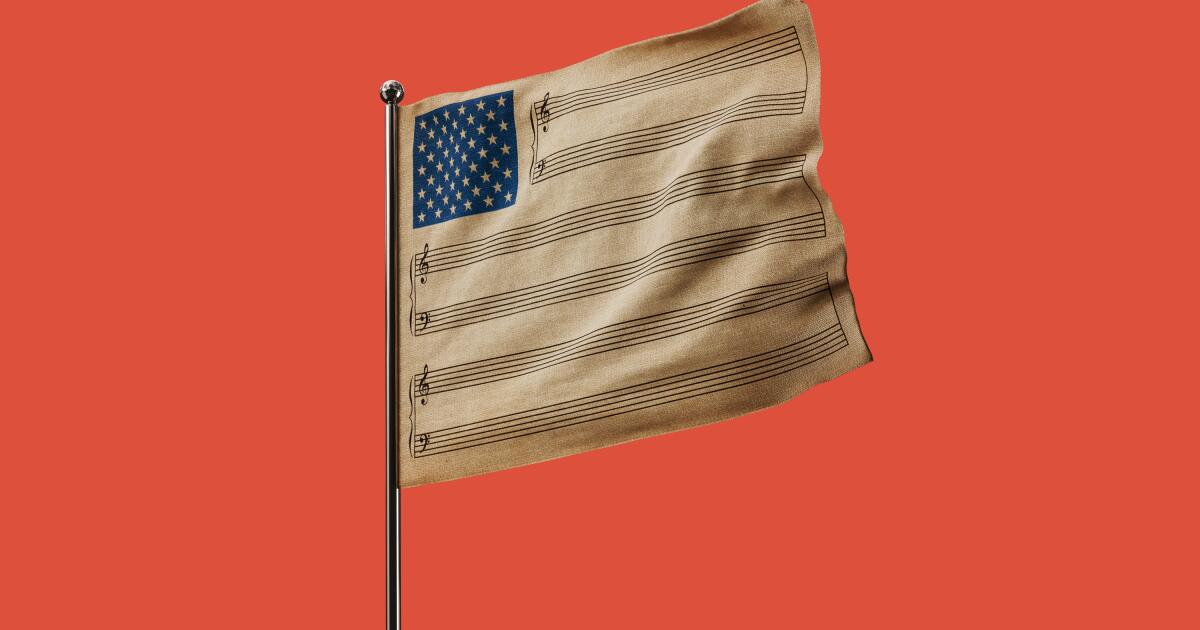
The “Centennial March,” as it came to be known, turned out to be dreck. Even Wagner, who carelessly tossed it off in a couple of weeks, said the best thing about the score was the fee, which he had demanded to be paid in gold. But what sounds like something AI might come up with if asked to write a pompous march in the style of Wagner began the American obsession with celebrating the Declaration of Independence, the words and deeds of our presidents, our very democracy with the assist of the symphony orchestra and opera.
One hundred years later, the country was awash with federal, state, city and philanthropic funding for a music-happy bicentennial of exceptional ambition. “With millions available in hand and more money to come,” Time Magazine wrote in 1975, “the Bicentennial is the biggest bonanza for the American composer since Hollywood discovered the musical.”
And so it was. The centerpiece was the National Endowment for the Arts Bicentennial Orchestra Commissioning Project. That funded America’s six top orchestras to each commission a major work that all six would play. In addition, the NEA offered further support to 34 American orchestras for dozens more new scores.
Everyone got into the act. The New York State Council of the Arts alone sponsored 68 commissions. Orchestras everywhere came up with striking projects. The Pittsburgh Symphony, for instance, premiered L.A. composer John LaMontaine’s opera/oratorio “Be Glad Then America” that featured the folk singer Odetta as the Muse of Liberty and enlisted ROTC students to reenact the Battle of Lexington overhead the orchestra.
The National Symphony commissioned symphonies from Roy Harris and William Schuman as well as Alan Hovhaness’ “Ode to Freedom,” a lovely short violin concerto written for Yehudi Menuhin. The list goes on.

We are obviously not seeing or hearing much like that in a semiquincentennial year when our government’s green gets the most attention for promoting algae. Even so, the NEA does indeed have an “America250” project (though it does little to publicize it, let alone fund it on the scale of 50 years ago) that is promoting more than 50 artworks. In music, they range from the Montgomery Symphony’s premiere in February of Nkeiru Okoye’s oratorio “A Time for Jubilee,” commemorating the 60th anniversary of the 1965 Selma-to-Montgomery civil rights marches, to a New West Symphony premiere last weekend of Michael Christie’s “A Ronald Reagan Portrait” at the Ronald Reagan Presidential Library and Museum.
The major East Coast orchestras are paying some attention. The New York Philharmonic premiered David Lang’s luminous “the wealth of nations.” The National Symphony got the most attention in its attempt to commission Philip Glass’ “Lincoln” Symphony, which the composer pulled in opposition to an un-Lincoln-like presidential takeover of the Kennedy Center. Glass then gave the rights to the Boston Symphony for a July 5 first performance.
The National Symphony did pull off the premiere of Peter Boyer’s “American Mosaic,” and it was to the Altadena composer that Philadelphia, this time around, entrusted its Declaration of Independence commemoration. Boyer’s multimedia oratorio, “A Hundred Years On,” was given its premiere by the Philadelphia Orchestra last month at the orchestra’s outdoor summer home, the Mann Center.
Upcoming will be a few repeat performances. Next month, “the wealth of nations” lands at the Aspen Festival, as does the “Lincoln” Symphony at the Cabrillo festival (with an L.A. Phil performance next season). “American Mosaic,” of which the Pacific Symphony was a co-commissioner, had its West Coast premiere in Costa Mesa last month and was scheduled to be performed at the Hollywood Bowl by the National Symphony in August, but that has now been replaced by Dvorak’s commonplace “New World Symphony.”
None of this comes close to comparing with the attempted civic zest of 1976. The NEA made it a matter of admirable policy that commissioned new works get multiple performances. Yet despite several of these being substantial works by some of our most noted and venturesome composers, few bicentennial commissions have survived. Even odder is that many of the composers did not necessarily feel compelled to explore nationalist themes. For them, American liberty implied freedom to simply write the kind of music they cared about.
The six works for the six orchestras were David del Tredici’s irresistibly over-the-top “Final Alice” (Chicago Symphony), Elliott Carter’s arrestingly impenetrable-on-first-hearing “Symphony for Three Orchestras” (New York Philharmonic), John Cage’s irrepressibly come-what-may “Renga” (Boston Symphony), Morton Subotnick’s brilliant electronic-landscaped “Before the Butterfly” (Los Angeles Philharmonic), Leslie Bassett’s introspective “Echoes From an Invisible World” and Jacob Druckman’s abstract-modernist “Chiaroscuro” (Cleveland Orchestra).
No orchestra has brought back its commission over the last half century, and only Chicago and New York recorded their commissions. No recording at all exists of L.A.’s, although Subotnick’s inventive uses of electronic music with a standard symphony orchestra went on to have considerable influence. None of these works, it appears, are likely to be heard anywhere in America this year, with one sort-of exception.
An explanation for that may be that, while 1976 was a fraught time for America — the country was recovering from the Vietnam War, we had a president and vice president who were not elected, there was runaway inflation, etc. — the music of the time represented optimism. Many works around the country explored new electronic music technology. It was the year Glass wrote “Einstein on the Beach” and Steve Reich created “Music for 18 Musicians” — the composers’ first masterpieces — demonstrating that Minimalism mattered.
That sense of liberation is clearly behind Del Tredici’s “Final Alice,” an hourlong romp around the ending of “Alice in Wonderland” for superhuman soprano and orchestra. It is so obsessively and addictively wild that its tamest moments sound like Richard Strauss on LSD. It does have a cult following although performances are few and far between.
Cage’s score is an abstract work based on the Japanese form of collective poetry known as renga, in which each poet attempts to write a line that is as distant as possible in meaning from the preceding line. Cage translates that to an independence of instrumental parts. While “Renga” can be performed alone Cage further suggests it be played along with an actual bicentennial work he wrote separately, “Apartment House 1776.” That is what Boston and the other orchestras did.
Indeed, “Apartment House” got the lion’s share of bicentennial attention and ridicule. When Zubin Mehta conducted it at the Dorothy Chandler Pavilion, the L.A. Philharmonic did not take it seriously and many walked out on it.
The work features four vocal soloists who represent Native American, Sephardic, African American and Protestant religious traditions, along with instrumental music based on early American hymn tunes. Everything is cut up and put together through chance operations into what Cage called a Musicircus. Under the circumstances “Renga” was hardly noticed, although two decades later, “Renga” came into its own when Michael Tilson Thomas famously conducted it with the San Francisco Symphony and the surviving members of the Grateful Dead.
Still the idea that “Apartment House” need not stand alone, that our traditions and those of long-ago Japan belong together, represented for Cage a future for America. We need not act like a superpower, he noted, but merely be one nation, no more and no less, among many.
We are obviously not that nation. A half-century later, “Apartment House” tends to exist mainly in its own right. An excellent London new music ensemble calls itself Apartment House. Detroit Opera recently staged it with a 2026 need to give the singers the opportunity to select their own music rather than reflect on our heritage. If American music in 1976 represented a collective, inquisitive, inventive American spirit of discovery, the semiquincentennial in the age of social media has become more about the individual identity.
As a sign of how we think about ourselves, the Los Angeles Philharmonic begins its Hollywood Bowl season five days after the 4th with a program of American music conducted by Thomas Wilkins that opens with Valery Coleman’s “Fanfare for Uncommon Times,” which was written five years ago.
But for now, the work that stands out is Lang’s “the wealth of nations.” It balances harsh thoughts of how the promise of capitalism has failed society and how racism remains with music of stunning beauty and glory, to gently but forcefully show us, in our age of American dissatisfaction, the direction in which we might go to make us proud again. It needs many performances.
‘ The preceding article may include information circulated by third parties ’
‘ Some details of this article were extracted from the following source www.latimes.com ’