Dance review
Sometimes a live performance will start slowly, then build to a punch that sneaks up on you. That wasn’t the case for Seattle contemporary dance company Whim W’Him’s latest show, “Spring ’26,” which opened Friday and runs through May 16.
The triple bill opened with a decisive bang, an exhilarating new work by choreographer James Gregg called “Static Bloom.” Its high energy lingered through the two quieter dances that followed. I couldn’t help thinking of a century-old poem by T.S. Eliot, “The Hollow Men,” that proclaimed the world wouldn’t end with a bang, but a whimper. There were no whimpers in the “Spring ’26” program, but the works by Rena Butler and Olivier Wevers couldn’t surpass the impact of Gregg’s “Static Bloom.”
Whim W’Him, currently in its 16th season, has earned a national reputation for commissioning and presenting nine new dances each year. Founder and company Artistic Director Wevers usually creates two of them, then fills his three annual programs with choreographers who very often are new to Seattle but have gone on to earn national and international reputations, including artists like Annabelle Lopez Ochoa and Penny Saunders.
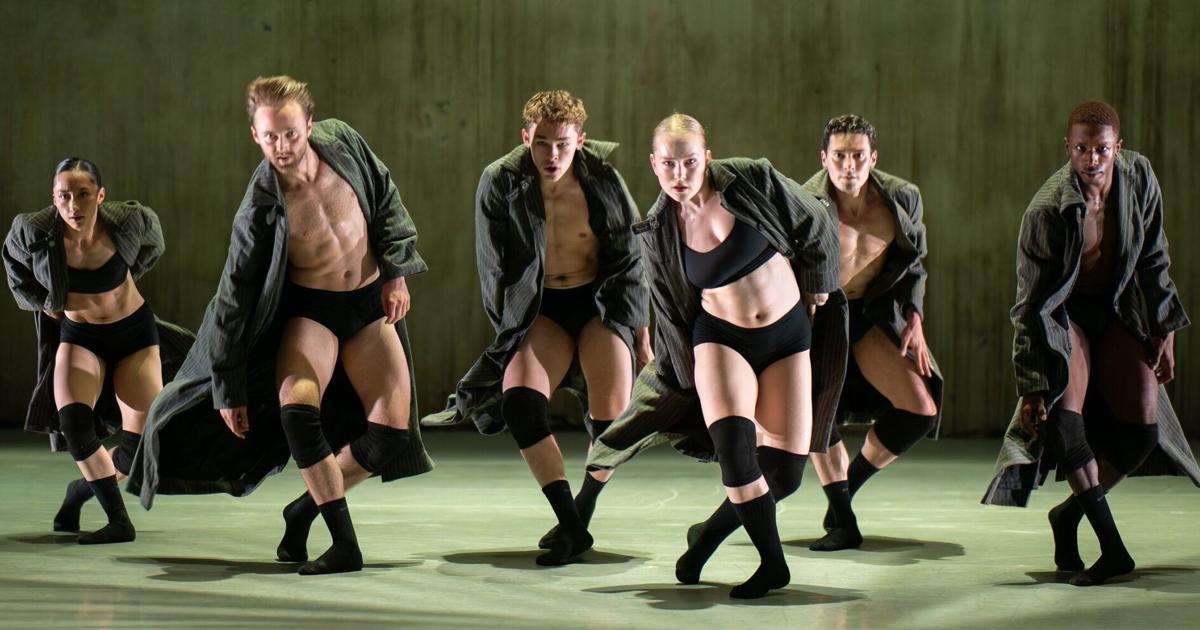
In what felt like a mashup of a high-energy club dance and demanding contemporary choreography, Gregg, in “Static Bloom,” had the full seven-member company moving in unison, from intricate footwork through pulsating torsos, to the twists of their hands, arms and even coordinated head turns.
The dancers opened Gregg’s piece clad in Bermuda shorts, knee pads and long coats, which they shed to reveal black briefs (with bralike tops for Ashley Rivette and Aliya Janov). I’m sure there were a few breaks from the nonstop movement to let the dancers catch their breaths, but the overall impression was of intricate, intoxicating movement that made at least this audience member yearn to join in.
Butler’s “Black Moon” traced what the choreographer calls the “sour edge of solitude.” With its melodic score and technically challenging steps, the piece felt less sour than contemplative. While the company members had ample opportunity to strut their individual prowess, the curtain came down on “Black Moon” while dancer Jacob Beasley stood alone, center stage, his body pulsating like the rhythm of a heartbeat. This audience favorite was less an illustration of the sourness of solitude and more an example of the technical quality the Whim W’Him dancers display.
Wevers’ “Dark Echoes Come Shining” ended this spring program with a look at human relationships through a series of duets and one trio performed to an original score by Philip Daniel. Lighting designer Michael Mazzola’s work played a large role in Wevers’ storytelling, evolving from the white-clad dancers performing with their own shadowy images to a brighter stage that gave us a clearer view of the dancers interacting with one another.
Both Butler and Wevers’ pieces got standing ovations from the audience, but neither was as rapturously received as Gregg’s “Static Bloom.”
All three of the “Spring ‘26” dances feature performances by the entire Whim W’Him company. Although dancers like Beasley might be showcased in a particular work, Wevers has expressed his preference for a company that depends less on individual stars and more on a team of equally adept artists. All seven company members will return in September for Whim W’Him’s 17th season, and Wevers announced on opening night that several of the veteran choreographers, including Saunders, will create new works. It’s a pleasure to take in world premieres each year, and to have a chance to watch the company artists mature.
‘ The preceding article may include information circulated by third parties ’
‘ Some details of this article were extracted from the following source www.yakimaherald.com ’