The world premiere of ensemble member Matthew C. Yee’s “White Rooster” at Lookingglass Theatre should be riveting. It has all the elements of compelling drama: a multi-layered plot that mixes genres including ghost stories, Chinese folklore and the mythology of the American West; a dedicated ensemble creating intriguing characters; plenty of dark humor; lively original rock music; imaginative stagecraft and, last but not least, puppets.
But for all its ambition and artistry, the show misses the mark. Like Yee’s “Lucy and Charlie’s Honeymoon,” which premiered at Lookingglass in 2023, it packs in too much and is seriously in need of editing, a problem perhaps exacerbated by the fact that Yee directed as well as writing and co-composing (with Justin Cavazos).
Seemingly set in an American post-Gold-Rush era “ghost town” where everyone is hungry (both literally and figuratively), the script weaves together at least half a dozen loosely connected, sometimes overlapping ghost stories. A young woman named Min (Sunnie Eraso) is at the center of two of them.
After an opening musical sequence informing us “There’s ghosts in this town, they stop and say hi/But no one can tell if they’re dead or alive,” we meet her trying to communicate with someone she hears in her attic, though her parents, Maria (Karen Aldridge) and John (Mark L. Montgomery), insist no one is there.
When Min and June (Noelle Oh) connect via a hand-clapping game — using a hanging sheet and nifty shadow puppetry showing a different perspective from either side — June warns Min she might be a ghost and gives her a gift for the boy she’ll find singing outside the defunct mine.
Min complies and meets Pong (Reilly Oh), a pleasant young man who enables John’s obsessive digging but helps Min lure her father back home. As payment, Maria tells a story of the town, years ago, in the midst of a drought, when she offered herself to the demon behind the crisis. This story, combined with the attraction between Min and Pong, sparks disaster: Min’s home burns, and Pong and John, compelled to dig, are killed along with many others when the mine collapses.
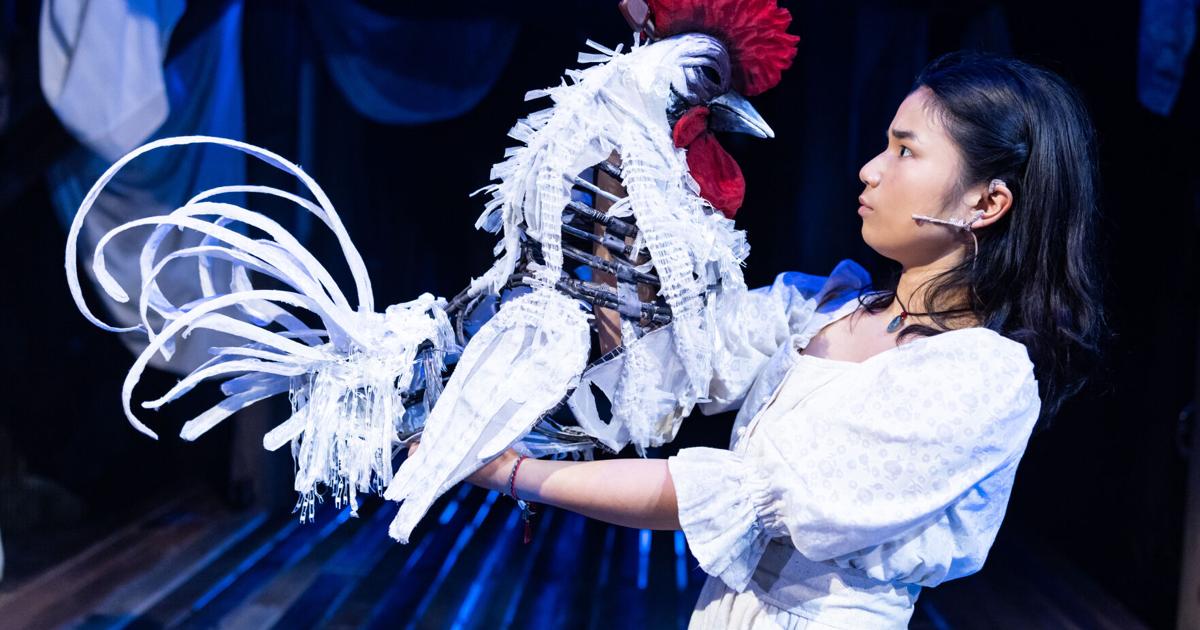
This leads to a ghost marriage tale inspired, the playwright has said, by his own family history. Pong’s grandparents, Judy (Louise Lamson) and Hao (Daniel Lee Smith), convince the vulnerable Min to marry the spirit of Pong in the form of a white rooster so he won’t be lonely in death — and so she’ll feel compelled to care for them in their old age. When Min talks to the rooster as if he were really Pong, and he replies in Pong’s voice and offers a chunk of gold (which was June’s gift), she takes it to the town’s shaman, Wu (Elliot Esquivel until April 5, Nik Kmiecik thereafter). A magic spell results in Pong’s resurrection as a monstrous half-rooster creature.
Min’s mother re-emerges and her father is somehow resurrected, whereupon a narrative fraught with stories of hunger, betrayal, death and reincarnation circles back to June, whose identity we’ve figured out by now, and her horrendous treatment by Maria and John. The denouement of sorts is not completely satisfying.
There’s plenty of symbolism in all of this, of course, but also a tendency for scenes to go on too long, even the initial encounter between Min and June in the attic. It’s also frustrating that the play starts with that dysfunctional family saga, then drops it and doesn’t come back to it until near the end. The narrative arc could have been much stronger.
While the cast is excellent, the actors tend to be on different wavelengths. Aldridge’s impassioned Maria is especially moving, while Montgomery’s John goes over the top. Esquivel’s loopy Wu is a hoot. The weak link is Eraso’s Min, but her lack of personality is more the fault of the playwright.
Natsu Onoda Power’s scenic design consists of a slatted two-level structure that serves as various locations around town and a system of white sheets and pulleys that transform the space into real and mythical locations, as well as providing a backdrop for sophisticated shadow puppetry designed by Caitlin McLeod. Her practical puppets peak with the marvelous rooster that comes to life when Min (or anyone else) operates him.
Hannah Wien’s lighting design makes good use of traditional stage lights seeping up through the set and ghost story tropes, such as actors wielding flashlights. Cavazos’ sound design helps keep the action flowing.
Mara Blumenfeld’s costumes create a generalized past for the characters with flourishes like Rooster/Pong’s outfit.
“White Rooster” could be really first rate. What it needs most is a stronger, clearer narrative structure, some trimming of the slow sections and a main character we can really care about.
‘ The preceding article may include information circulated by third parties ’
‘ Some details of this article were extracted from the following source www.hpherald.com ’