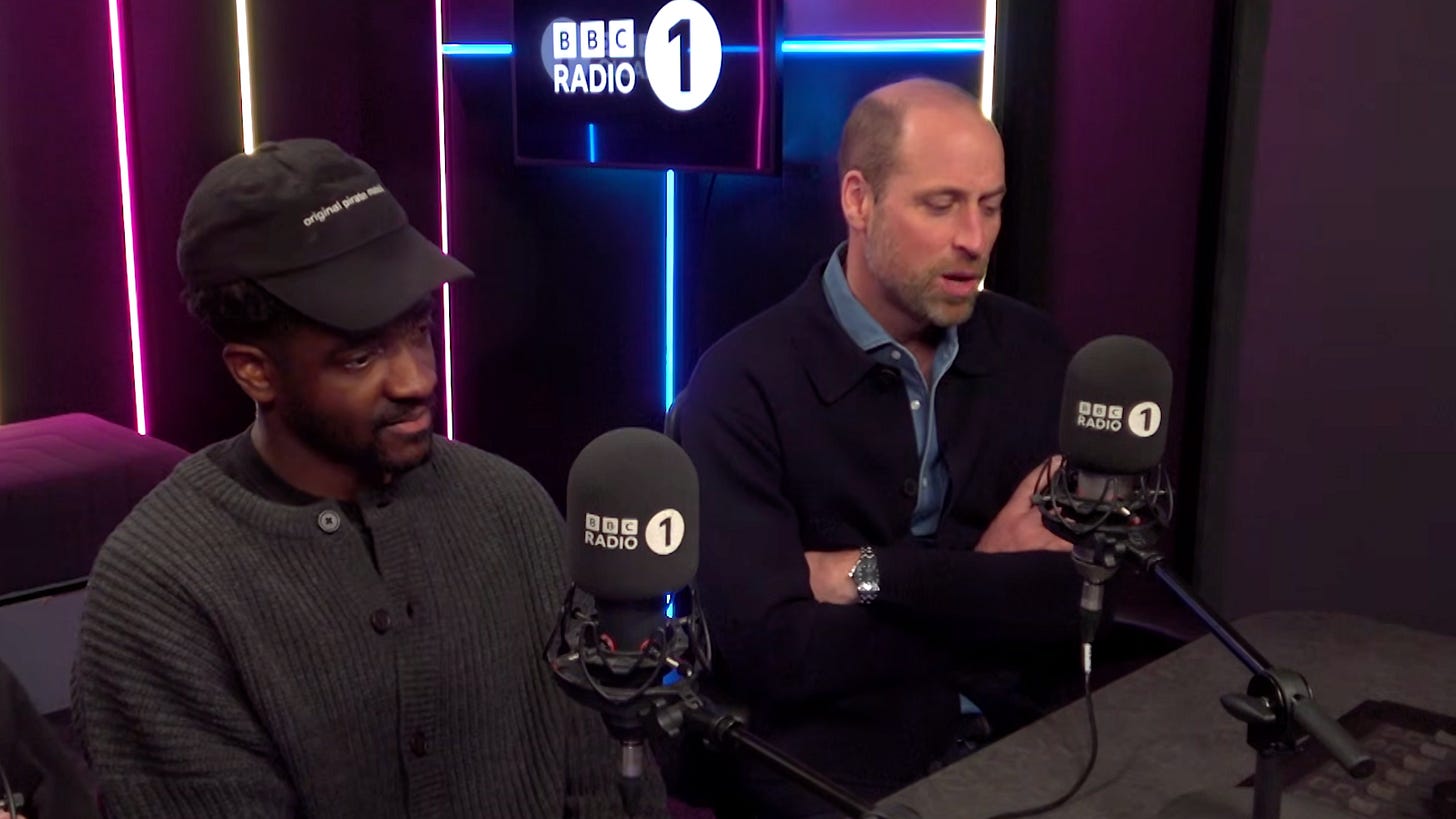
I was struck watching Prince William’s new interview with BBC Radio 1, released on YouTube a few hours ago, about mental health and suicide prevention, at how genuine he seems.
It feels like a clear glimpse of the man he is, and the kind of king he intends to become.
William has been criticized for letting it be known he does not want to scale down the pomp and ceremony when he becomes king. Things will be stripped back, there will be fewer working royals, less pageantry, fewer processions. Unlike his father who never saw a ceremonial uniform he didn’t like, I do not get the sense we will see this man wrapped in ermine and silk at every opportunity.
Watching this interview, you can understand why he believes it is important to be approachable and “normal,” to sit in a studio in a sweater like everyone else, rather than appear as a distant caricature on a balcony.
King Charles III has spent decades trying not to seem aloof—through the Prince’s Trust, his environmental work, and public visits. There is real compassion there.
But even at his most relaxed, Charles can seem like an avuncular headmaster: caring, but still in charge. With William, especially in this conversation, the mood is closer to that of a counselor. The difference is subtle but noticeable.
What stands out most is how he pulls off the trick of rooting the conversation in his own experience without making it about himself. He speaks about his time as an air ambulance pilot, about seeing people in “very difficult situations,” and about only later realizing that his own mental health had been affected.
He also points out that he was able to take time off and access support, and that many people in similar roles cannot. He does not pretend to be ordinary. He acknowledges his position in a straightforward and grateful way.
Another striking feature is how often he defers to others. He repeatedly highlights the work of charities, clinicians, and campaigners, saying they are the experts. He speaks about building a mental “toolbox,” collecting tools that might help later, and about learning to “love yourself and understand yourself,” but then redirects attention to the organizations doing the work. He is not presenting himself as an authority. He is using his platform to amplify others.
This may be why William’s way of speaking about mental health seems so different from his brother’s.
Prince Harry has spoken openly about his mental health for years. When he was a working royal and appeared on interviews such as the “Mad World” podcast, many found his comments powerful. It felt like a break from a culture that had been unhealthily reserved for too long.
But the context has changed. Similar material, when linked to a memoir, a Netflix series, or a paid corporate role, feels different. If you leave the royal family and enter the commercial world, your work must generate income. That is the reality.
But content that might have once been seen as outstanding and brave royal work became something else once it is produced outside the institution. The same dynamic applies in reverse to Catherine, Princess of Wales. Her nature videos drew some criticism, but as they were not viewed as commercial ventures, as people didn’t feel they were being sold something, the context was very different to Meghan’s syrupy salutes to the Californian sage which, er, fed the bees that made her $15 jars of honey.
One of the monarchy’s great advantages is that it operates without a direct profit motive. Sure, it is publicly funded, and people can object to that (or say it’s the same thing), but Wiliam is not selling jam at the end of an interview.
It was also notable how William addressed the culture often described as the “stiff upper lip,” without using the phrase, which Meghan notably did use (pejoratively, of the royals) in her exit interview with Oprah.
William said that earlier generations were less open about emotions, but he framed it with context. He referred to the trauma of the Second World War, to communities shaped by loss and hardship, and suggested that for many people, discussing feelings did not seem like a solution at the time. His tone was understanding rather than accusatory and critical as Meghan’s was.
If anything in this piece connects to how you are feeling and you are struggling or feel suicidal, help is available.
In the UK and Ireland, Samaritans can be contacted free, 24 hours a day, on 116 123, or through the NHS website or your GP.
In the United States, you can call or text the 988 Suicide & Crisis Lifeline at 988 for confidential support, or use their online chat.
You can also reach Crisis Text Line by texting HOME to 741741 for free, round-the-clock text support.
If you or someone else is in immediate danger, call emergency services. You do not have to face it alone.
I’d suggest watching the full video however you are feeling. I thought it was brilliant.
‘ The preceding article may include information circulated by third parties ’
‘ Some details of this article were extracted from the following source theroyalist.substack.com ’









![pt. 1474 | J. Cole – She Knows (Slowed) [Edit Audio] #music #jcole #sheknows](https://celebrity.land/en/wp-content/uploads/2026/07/1784762006_maxresdefault-120x86.jpg)