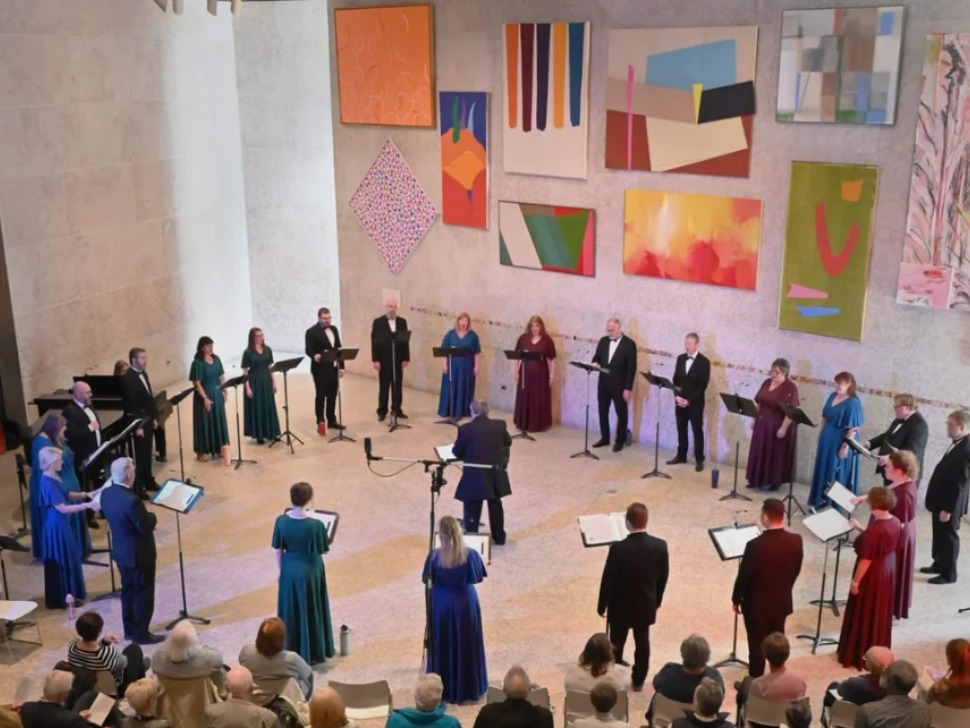
Coming up this Sunday, March 22nd at 3 p.m. at the WAG-Qaumajuq, the Winnipeg Singers present Voices of a New Generation, a concert dedicated to showcasing the evolving landscape of contemporary choral music. With a program featuring eleven works; nine by Canadian composers. The performance promises to highlight both innovation and national pride in equal measure.
The concert “shines a spotlight on the future of choral music,” offering audiences a chance to experience the fresh perspectives and bold artistic voices shaping the genre today. The choir will perform works by composers such as Kathleen Allan, Matthew Emery, and Nicholas Ma, among many others, in a program that spans a wide emotional and stylistic range, from “lush, expressive harmonies” to “striking experimental textures and deeply resonant texts.”
Narrator Muriel Smith joins the ensemble and conductor Yuri Klaz to guide audiences through the program, offering context and insight into each work. Speaking about the vision behind the concert, she explains, “I think the program committee is looking at the direction Canadian choral music is going, and not just Canadian, but choral music [in general]. I have a sense, because we have a lot of Canadian composers on there, we’re kind of looking… at where we’re going, and we’re kind of feeling perhaps even a bit proud of who’s up and coming, for the future.”
The role of the narrator
While some choral concerts rely purely on music, Voices of a New Generation incorporates a spoken element designed to deepen the audience’s connection to the repertoire. Smith’s role is not to tell a continuous story, but rather to illuminate the works and their creators.
“It’s not really a narrative, but I do introduce the composers and the perspectives on their music,” she explains. “I think that the whole point of the, I guess it’s a narrative, a narrative this time is to bring forth these exciting voices.”
Smith’s academic background (she holds a Ph.D. in musicology from York University in the UK and is the author of A Century of Sound Connections: The Manitoba Registered Music Teachers’ Association 1919-2019) makes her particularly well-suited to the task. Although she was not involved in selecting the repertoire, she embraced the opportunity to research it. “I’m sad to say I didn’t [pick the music], but boy, I’m glad they picked them because I had a field day looking up information on these people.”
Lyrical beauty and musical craft
Among the standout works on the program are compositions by Kathleen Allen and Matthew Emery, both of whom exemplify the richness and accessibility of contemporary choral writing.
Smith speaks enthusiastically about Allen’s “Stars”. “It’s like has a kind of a calm essence to it. And it flows in and out of dissonance and consonance. It leaves us in a kind of a space where we’re just hanging in space.”
She highlighted Allen’s sensitivity to text setting, noting, “What I love about what she’s doing is she’s using the language, the rhythm of the poetry. She creates her musical rhythm that way. It really matches super, super well.” One particularly striking moment comes when, “the words are, ‘Hang jewel upon a silver thread,’” where the music rises and suspends the listener. “She doesn’t leave us hanging. She leaves us just in the air, floating.”
Matthew Emery’s Misa Brevis Boreal offers a different but equally compelling experience. “He’s using the traditional mass, except he uses three parts, the Kyrie, the Sanctus, and the Agnus Dei,” Smith explains. “And each of them sits really comfortably with us.”
She described the piece as highly accessible: “I don’t find it takes us to great places one way or another, but it makes us feel comfortable, really comfortable. It’s accessible for everybody, which is great.” Each movement has its own character, from the gently unfolding Kyrie to the rhythmically engaging Sanctus, where “the altos and the basses are just playing with this rhythm back and forth.”
Experimentation and imagination
The concert also embraces more adventurous territory, particularly in works that explore unconventional sounds and ideas. Katerina Gimon’s “To the Peak of the Mountain” is one such piece, filled with vivid textures and dramatic momentum.
“That piece brings in a lot of different sounds and textures,” Smith says. “That whole song actually is… it’s driving. It’s driving to a climax, which is at the end.” The choir is called upon to create atmospheric effects: “The choir gets to do bird sounds and wind sounds and, some rustling leaf sounds.”
As the piece unfolds, it builds intensity through rhythm and pitch. “There’s drums and the drums drive us forward the whole way… the pitch rises, rises, rises, right to the end, to the peak of the mountain.”
In contrast, Andrea Ramsey’s “Imaginary Creatures” offers a lighter, more playful experience. Based on texts written by children, the work captures a sense of spontaneity and surprise. “This one I was not expecting… it’s five, five little pieces written by children age five to eight,” Smith noted. “And they are honest. Kids are honest.”
The result is unpredictable and delightful: “They will make you laugh. You will think, ‘Oh, here we are. We’re going to go along and along. And it’s like, we’ve got like 18 bars. Is it done?’ It’s going to be loads of fun.”
Technology, tradition, and takeaways
One of the most thought-provoking works on the program is Nicholas Ma’s Human Touch, which grapples with the role of artificial intelligence in artistic creation. In a striking twist, the text itself was generated using AI.
“Nicholas Ma has said basically that the significance of this piece is how AI is going to influence us as humans in the technological age,” Smith explains. “It is an ironic twist that he used ChatGPT to create the text.”
The piece builds toward a powerful climax: “It keeps moving faster and faster and faster, so the text just shatters into French, Latin, Italian, and German.” The effect raises profound questions about communication and human identity. “It’s questioning whether we are echoing the ancient fable of the Tower of Babel.”
At the same time, the program remains grounded in local and historical traditions. The inclusion of “Bonny Portsmore”, arranged by Winnipeg educators Philip Lapatha and Dorothy Dyck, reflects a commitment to community and continuity. As Smith notes, “I think the Winnipeg Singers and other Winnipeg choirs like to put forward their own, right?” She added that the piece is “part of this lovely long line of a tradition that teachers write for their students.”
Ultimately, Voices of a New Generation is about more than just new music, it’s about the vitality of choral art as a whole. Smith hopes audiences leave inspired: “Well, I hope that they take away this sense that the choral music in Canada is flourishing.”
She continued, “It’s taking us in new directions… it’s establishing, or continuing to establish, I guess, that we, as Canadians, have a really, really strong choral tradition.”
“I hope they go away with a hop and a skip in their step and a smile on their face and lightness in their heart.”
Voices of a New Generation takes place this Sunday, March 22 at 3 p.m. at the WAG-Qaumajuq.
‘ The preceding article may include information circulated by third parties ’
‘ Some details of this article were extracted from the following source classic107.com ’