Throughout its six-episode run, HBO’s “Half Man” has proven itself to be one of this year’s most daring series. Focusing on the toxic relationship between Niall Kennedy (Mitchell Robertson, Jamie Bell) and his pseudo-stepbrother Ruben Pallister (Stuart Campbell, Richard Gadd), the series takes risks while examining shame and queerness in a way that many shows shy away from. Niall and Ruben are drawn to each other, despite Niall’s shrewdness and Ruben’s penchant for violence, igniting between them a spark that quickly festers and begins to ruin each of their lives.
Gadd, the show’s creator and star, who won Emmys for his Netflix series “Baby Reindeer,” is fascinated by how toxic masculinity impacts relationships between men. Yet, the show has a glaring problem that many series focusing on white queer characters do: “Half Man” doesn’t reckon with the intersection of race and toxic masculinity and how it impacts characters of color.
When Niall leaves for university, he meets Alby Safadi (Bilal Hasna, Charlie De Melo), a gay student of color who is one of the few people he can open up to. Their relationship slowly becomes romantic, with Alby allowing Niall space to finally admit to himself that he likes men. Time and time again, Alby is a shoulder for Niall to cry on, often casting his own interests, and safety, to the side. Just when it appears that Niall has finally found a confidant in his tumultuous life, Alby’s encouragement for Niall to come out ends with Ruben interpreting this revelation as a personal attack, resulting in him brutally assaulting Alby.
It’s here that “Half Man” begins to ask its audience to dispel any disbelief that Ruben’s targeting of Alby has nothing to do with his race and everything to do with his queerness. Yes, the series is centered on the tumultuous relationship between Niall and Ruben, but by making Alby a man of color, Gadd fails to engage with how “Half Man” is stilted by its precarious representation of race. (The show also never mentions his nationality or ethnicity.) The assault results in Alby being put into a coma and left permanently disfigured, and also results in the collapse of Niall and Ruben’s already fraught relationship.

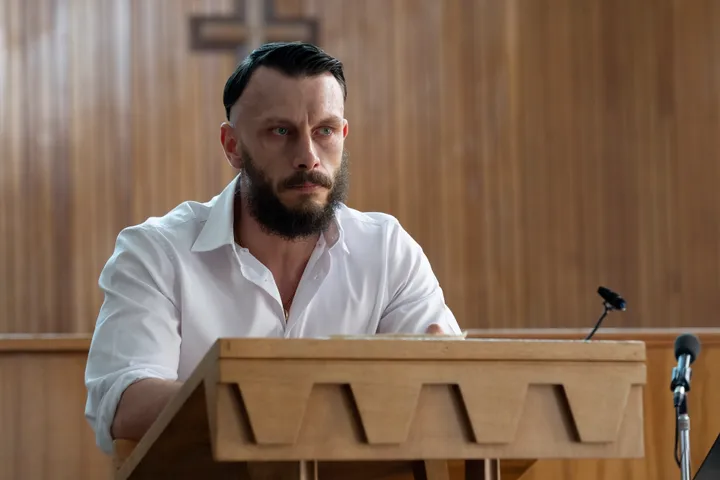
Alby’s character is mostly thrown to the wayside, even throughout a trial in which Ruben claims the assault was the result of Alby groping him. The series is set from the late 1980s to the present day, so to say that Alby’s race is not a factor in how Ruben, his family and the justice system see him is laughable. From here on, Alby’s presence in the show, despite being revealed to be Niall’s husband in present day, is one of a ghost. His existence has been irrevocably changed by the series narrative, yet it is never given the space or screen time to have any significant impact on the story.
Save for “Heated Rivalry,” “Interview with the Vampire” and perhaps a few other shows, the landscape of queer television has long focused on white characters or white ensembles, where queer characters of color are often relegated to sidekick roles or the love interests of white protagonists, like Alby is. The positioning of these characters as secondary to the plot isn’t necessarily the problem; it is instead the way in which they are treated within the narrative and by the writers who created them. Alby’s existence in “Half Man” is a pillar of the show’s conflict in the 1990s timeline, yet it is only Niall’s trauma from the assault that is allowed to be known.
Displayed to audiences through harsh breaths, moments of confusion and glances of horror toward Ruben, the impact of witnessing Alby’s assault consumes Niall. Alby’s reaction to his own assault is only ever clear through the physical scars we can see on his face, with no regard for how this attack impacted his schooling, his subsequent career and even his rekindled relationship with Niall. Obviously, being attacked to the point that you end up in a coma is significant, but the trauma the sole character of color in this series endures is never given the same amount of space as the other characters.

If Alby were to only exist in the past timeline, there really wouldn’t be a need for this to be explored. But, he and Niall get married in the present day, in which Ruben’s presence at their wedding causes both men to panic. The mental and physical scars on Alby clearly exist, so the diminishing of each feels like an ignorant dismissal. It follows a worrying and growing trend within queer television.
The series finale, instead of giving us any inkling that Alby and Niall’s relationship is as damaged or fascinating as Niall and Ruben’s, displays Alby as passive and nearly docile once again. Then when he and Niall reunite after Ruben is sent to prison in the late 2000s, he tells his partner he should attempt to reconcile with the man who has destroyed both of their lives. In doing so, Gadd proves that Alby is nothing more than a pseudo-therapist for Niall, who since their university days has become a despondent addict entrenched in shame and obsession.
“Half Man” is a story about how toxic masculinity shapes and warps men and their relationships, yet there are so many cracks in the narrative.
There’s no denying that the series is one of the best of the year, but with it, Gadd has proved himself as a writer who has no desire to tackle how toxic masculinity is directly linked to both Ruben and Niall’s whiteness.
Since Alby’s assault, villainization and subsequent reappearance, “Half Man” has forced me to question why Alby was cast as a man of color if its creator didn’t explore how their violence directly impacts the lives of the men of color around them. By using Alby as a therapist for the show’s white protagonist — and as a punching bag for its white antagonist — the otherwise bold and tightly written series is softened by its disregard for racial politics, pointing to a larger problem that continues to grow in queer television.
“Half Man” is streaming on HBO Max.
‘ Este Articulo puede contener información publicada por terceros, algunos detalles de este articulo fueron extraídos de la siguiente fuente: www.celebrity.land ’