The latest edition of New Music Dublin took place from 15 to 19 April at various spaces in the National Concert Hall, Project Arts Centre and Windmill QTR. Maintaining the expanded five-day format of last year, the festival featured a multi-faceted programme of new work by composers from Ireland, Europe and North America. This review looks at four concerts from Thursday and Friday of the festival.
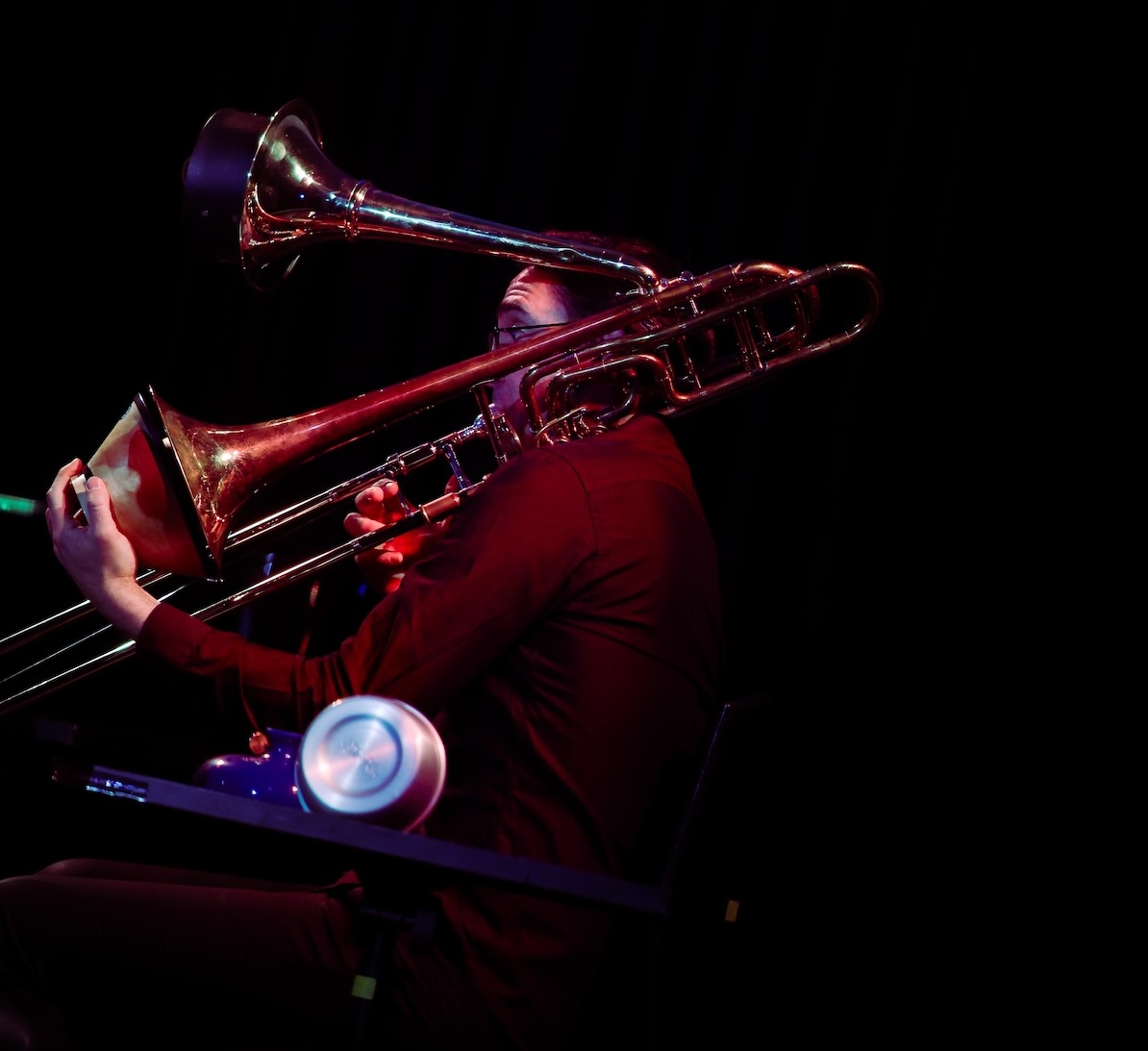
Ensemble Musikfabrik, the pioneering German contemporary music group, returned to New Music Dublin for the first time since their 2019 appearance with saxophonist Peter Brötzmann. This year’s visit focused on works for brass and amplified string ensemble spread over two concerts at the National Concert Hall on Thursday. The second of these featured the Irish premiere of Georges Aperghis’ Heart Blowing and the world premiere of a version of Jessie Marino’s NO SALT, along with a repeat performance of Ailís Ní Ríain’s and still it breathes…, which received its Irish premiere at the earlier 4pm concert.
Ní Ríain’s piece was inspired by the visual representation of breathing pattern disorders whose deviation from normal patterns often result in various respiratory symptoms. In her programme note, Ní Ríain stated that the four brass musicians (trumpet, French horn, trombone and tuba) function ‘as an analogous group’ and ‘produce vocal effects such as singing, hiccups, oral cavity alteration and utterance’. Not surprisingly, the piece focused almost entirely on a series of extended techniques. Many of these such as the opening overtones were pleasant in themselves but weren’t pursued with a clear focus and were often dropped before they had a chance to develop. As a result the piece felt more like an exposition of playing techniques, mesmerising perhaps to brass players but a little tedious for the listener.
A similar focus on non-conventional sounds characterised Aperghis’ Heart Blowing, whose promising opening presented a chord that was rendered inherently unstable by various timbral effects. A series of demented fanfares seemed to distort the texture even further, but after the opening few minutes, any sense of dialogue dissipated and the piece descended into a formless meandering. All of this meant that the thirty-minute-plus duration ticked by very slowly.
The second half of the concert was devoted to the world premiere of Marino’s NO SALT in a slimmed-down version for five strings – the original piece was premiered last year at the Wittener Tage für neue Kammermusik festival. Each player was amplified and used distortion to sustain intervals in just intonation. The distortion intensified the perception of the beating patterns between notes as they gradually moved in and out of pure tuning ratios. The idea itself may not have been particularly original and, as Marino herself admitted in her programme note, the work was ‘deeply inspired’ by Tony Conrad’s drone pieces from the 1960s and presumably many other drone composers such as Phill Niblock and James Tenney. Nevertheless, it was performed at a pleasantly high volume and the visceral impact of the sound (at one stage the entire concert hall seemed to be vibrating) was quite intoxicating.
 Stephen Menotti from Ensemble Musikfabrik (Photo: Molly Keane)
New ground
The Diatribe late-evening concerts showcasing the label’s eclectic offerings have become a regular fixture at New Music Dublin. The first half of Thursday night’s concert was given over to Irish-Scottish violist Garth Knox and his Wind Songs project with Zoë Conway, which is due for upcoming release. These songs were interspersed with instrumental works featuring fellow violists Ruth Gibson and Martin Moriarty along with Sinéad O’Halloran on cello. (The second half featured a new group, Sky Rivers – Li-chin Li, sheng; Lina Andonovska, flutes; Nick Roth, saxophones – which unfortunately I did not attend.)
The first Wind Song was set to a text by an anonymous ninth-century Irish monk that reflected on the wildness of the wild. In his vibrant accompaniments, Knox managed to spin out an astonishing range of illustrative figurations while Conway’s singing combined a jewel-like purity that was both haunting and deeply affecting. The second song, entitled ‘Cruel Wind’, was a setting of the sorrowful traditional air ‘In the month of January’ and the third, a more upbeat setting of a contemporary haiku by the late Irish-language poet Gabriel Rosenstock, incorporated some traditional lilting. Most of us are more used to seeing Conway with a fiddle, but her singing was outstanding and Knox’s beautifully judged accompaniments complemented rather than overpowered. This seemed to me like new ground being broken and one eagerly awaits the release of the recording.
The purely instrumental pieces were crammed with ideas, though Knox’s compositional strengths seem more orientated toward texture rather than melodic line. The first piece, Still Points, a duet with Gibson, recalled the airy sonorities of Kevin Volans’ Africa-inspired quartets, while the first movement of the Pocket Concerto – an actual ‘mini’ three-movement concerto for viola and cello – opened with attractively dissonant, writhing figurations over a drone. A duo for viola d’amore and viola with Moriarty deconstructed the traditional Irish tune ‘The Wounded Hussar’ with some wonderfully rich and resonant sonorities emanating from both players. The concert as a whole was so full of ingenious, fleeting textures that it was difficult to keep up, although it was the songs with Conway that carried the night.
 Ruth Gibson and Garth Knox (Photo: Molly Keane)
Graphic scores
An unfortunate clash of dates with the Sonorities festival in Belfast made for a busy three days for the Hard Rain SoloistEnsemble who were performing at both festivals. This Friday afternoon concert in the Kevin Barry Room featured improvisational and graphic-score pieces with the main item being Composition 245 from Anthony Braxton’s Ghost Trance Music series.
The premise of this piece was a unison riff in trudging crotchets, periodically tripped up by faster phrases. This acted as a kind of melodic travelator from which the performers could hop on and off. The riff never quite disappeared, but it did fade into the background as the ensemble’s collective ideas became more dominant. The group traversed through an impressive range of textures with clearly well-planned transitions between reflective and more anarchic soundscapes. The most interesting of these emerged towards the mid-way mark and incorporated some electronic manipulation of the live sounds. Sarah Watts on contrabass clarinet was particularly good at laying down imaginative lines to undergird the whole soundscape and in terms of structured improvisation – which, let’s be honest, is often a mixed bag – this was about as good as it gets.
The Braxton was preceded by two short graphic pieces. The first, by Watts, From Under The Sky The Sound Rises, was based on her experience of improvising in the acoustic space of the Canada House building in Sheffield. After some breathy and popping sounds, the piece pursued a well-shaped melodic line that grew logically from a two-note motif and wound its way lyrically upwards making full use of the instrument’s range.
The second piece, Tesserae (a graphic score in G minor) by Ioana Petcu-Colan, was based on the mystical concept that echoes of past sounds are contained in the remnants of the instruments that played them. Petcu-Colan visualised this idea using the previously played strings of David McCann’s cello and the bow hair of Petcu-Colan’s own violin bow that were stretched over a number of attractive canvases positioned around the stage. The interpretation of these images by McCann on cello, Aisling Agnew on flute and Watts on contrabass clarinet resulted in some really fine polyphonic and timbral ideas bookended by a nice flute melody over some cross-string bowing.
 Hard Rain SoloistEnsemble (Photo: Molly Keane)
Intriguing prospect
The Irish premiere of Gerald Barry’s Salome, in a concert performance with National Symphony Orchestra Ireland under conductor Jérôme Kuhn, was perhaps the most anticipated event in the festival. After the triumph of his version of Wilde’s The Importance of Being Earnest back in 2013 as well as his take on Lewis Carroll in Alice’s Adventures Under Ground in 2016, how exactly Barry would tackle the very different subject matter of the great Irish writer’s Salome was always going to be an intriguing prospect.
At its core, Wilde’s Salome is all about sexual desire searching for release in a variety of ‘deviant’ forms. Salome is so entranced by the chaste, white skin of Jokanaan (in Barry’s version, referred to simply as the Prisoner) that she desires his head as the ultimate form of sexual gratification; she in turn is desired by her lecherous step-father Herod, much to the chagrin of his clearly sexually frustrated wife Herodias (here just The Queen), who was previously married to his now dead brother.
Richard Strauss’ famous version revelled in this decadence by giving these desires a sensuous erotic treatment. Predictably enough, Barry’s interpretation went in the opposite direction, replacing sensuousness with a musical language of pared-down hardness. Harmony was kept to a minimum and driving unisons and two-part writing predominated right from the overture, whose melody circled back on itself for what seemed an extraordinarily long time before being reprised for the opening scene with the two soldiers.
Bass-baritones Stefan Sevenich and David Howes reflected on the moon, blood and Salome’s beauty at the very bottom of their registers. Salome herself (soprano Alison Scherzer) entered soon thereafter at the very peak of hers while the Prisoner (baritone Vincent Casagrande) sang and spoke in French to the general bafflement of all. Salome’s supposed longing for the Prisoner did appear in the words she sang but was largely absent in her music. The early dynamics between them culminated in a singing lesson from the Prisoner that was more concerned with the correct pronunciation of French than anything sexual and her fascination with his physical beauty was often expressed through banal vocal exercise patterns.
The bickering chemistry between King Herod and his wife the Queen was far more convincing. Amy Ní Fhearraigh was a dynamic force as the despotic and jealous Queen whose general antipathy towards everyone found cathartic release in a delirious solo that, like the overture, lasted for a comically long time.
King Herod was perhaps the one character that Barry came closest to reinventing as a truly unhinged madman. He received the most interesting music and was given a manically high-energy performance by the tenor Timur Bekbosunov. The opera’s intended coup de théâtre was the replacement of the ‘Dance of the Seven Veils’ with a scene in which Salome typed rather than danced for Herod in return for anything she wanted. Herod’s desires were not directed at Salome herself but found ecstatic release in a high-minded intellectual monologue (from Wilde’s De Profundis) on the wonders of art, Goethe and Baudelaire that a disgruntled Salome typed out. Unfortunately, this hilarious inversion of pleasures of the flesh for pleasures of the mind was cut off just at the point when it seemed to be going somewhere and the re-characterisation of King Herod as a bipolar aesthete wasn’t seen through to its own conclusion.
The opera’s conclusion itself was rather weak. Salome did eventually get the Prisoner’s head, along with various other bits of him in a reference to Mary Shelley’s Frankenstein, but by this stage it seemed a moot point and the music given to her – incidentally plucked from the end of Barry’s Viola Concerto – remained tunefully detached. The concluding ‘I have kissed your mouth’ chorale based on the same tune seemed like an effort by Barry to extricate himself from a plot that had spun out of control.
Those attending a Barry opera for the first time may have been quite taken with the comic absurdity of the whole thing and there were plenty of points that managed to elicit laughter. Those more familiar with his work will have heard many of these jokes before and I was left with the impression that the style that Barry has been relying on since Earnest has probably said all it can say. There were fewer interesting musical ideas, too much shouting, not enough singing and too much fooling around with props (typewriters, telephones, metronomes) and whimsical diversions (The Blue Danube, Frankenstein) at the expense of a fully-fledged interrogation of its subject. It received a brilliant performance, and the promise that it might all miraculously cohere kept me engaged until the end, but it was hard to avoid the conclusion that Salome is the weakest of Barry’s recent operas.
Further reviews of New Music Dublin will be published on 22 and 23 April. For more on the festival, visit www.newmusicdublin.ie.
 The Irish premiere of Gerald Barry’s Salome (Photo: Molly Keane)
‘ Este Articulo puede contener información publicada por terceros, algunos detalles de este articulo fueron extraídos de la siguiente fuente: journalofmusic.com ’