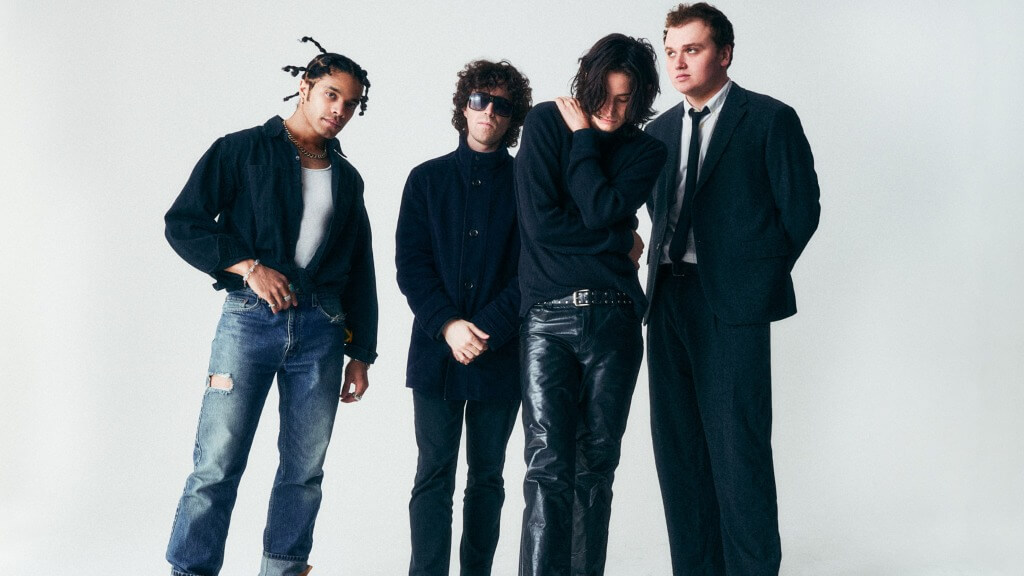
There are a lot of up-and-coming bands in New York. Turn any street corner in Ridgewood or the Lower East Side, and chances are you’ll bump straight into one. The story is usually the same: met in high school, started taking it more seriously a few years in, played their first gigs at spots in the area. Nautics, at least on paper, isn’t much different. Bassist Van Cameron and drummer Levitt Yaffe had been friends since pre-school, but it wasn’t until Van took a class with frontman Kenzo Repola that the band finally came together. The final member, Kitt Flamer-Calder, started out as the band’s producer and ended up as their guitarist.
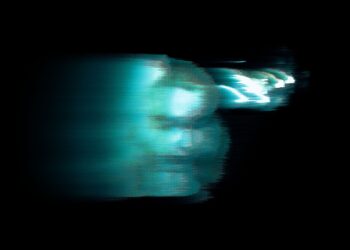
For a band that still hasn’t put out a debut record, Nautics has already racked up serious mileage, their live show presence long since earning them gigs at NYC staples Mercury Lounge and Bowery Ballroom. They recently signed to Bright Antenna Records, and earlier this month, they opened for Evening Elephants at the official Gov Ball After Dark show. Today, they add another line to their resume: “bum-a-cig,” their latest single, which has been in the works since December. The track starts out sparse—a driving, light percussive beat under fuzzy guitars and Kenzo’s half-mumbled, confessional delivery, like he’s inventing the words on the spot (which, as it turns out, is exactly what he was doing)—before erupting into a full-blown anthem at the chorus. It’s an ode to grasping at a relationship that’s a vice in its own right, paired with a fittingly retro, early-2000s-style video of Kenzo wandering Times Square in wired earbuds, cut-heavy and glitched-out. There’s something irresistibly catchy in it.
Last week, I met up with Kenzo at the listening room and tea house Silence Please in the Lower East Side—which was, ironically enough, incredibly loud. We walked around the outskirts of Chinatown for a bit, searching for somewhere actually quiet to set up shop. I bought a new phone case after losing mine earlier in the week; Kenzo categorically refuses to clothe his naked phone in a case or even a screen protector, preferring to raw-dog life like a maniac. On one street, he pointed out a restaurant he used to work at—or rather, beneath. He spent a whole summer up to his ears in fiberglass in some poorly insulated basement, with no previous experience working with fiberglass to speak of (“I lied a little bit in the job interview,” he laughed). We eventually settled into a tan wooden bench outside a little cafe to chat about the creative process, Nautics as a whole, and the strange intimacy of bumming a cigarette. The following interview has been edited for length and clarity.
–>
Paste Magazine: You didn’t initially want to be in a band. Did you always want to create in some capacity, though?
Kenzo Repola: For sure. When I was, like, one year old, I was already drawing and making things out of hot glue and cardboard and paper-mâché. I was always making stuff. That was my window into communicating ideas very early on. Words just don’t do feelings justice sometimes.
Nautics came into being when you were all about sixteen, after you saw a group of your friends play at Webster Hall at the old Marlon and realized you might enjoy being in a band after all. What was it about that moment that made it click for you?
Honestly, I was just super introverted and shy and anxious. But the person I saw that performed was also kind of nerdy and awkward, and I just saw him transform onstage. I saw him make friends and I saw the community around him—I saw the infinite potential of how someone could transform through this world of music. I was just like, “I want that. I want friends. I want to feel confident.” And it worked pretty well. I’m still anxious, but pretty confident now, and I have a lot of really nice friends and community.
So it was kind of a crash course in self-confidence, then.
Yeah, and trying to be a cool guy.
What’s a cool guy to you?
A cool guy wears skinny jeans and a cool t-shirt. [laughs] I don’t know. Cool guys, I think, are people who are able to be their authentic selves and communicate that clearly and kindly to others.
How did music become your vehicle for that authenticity and communication?
I think it did because it’s a very collaborative effort. Not only in the aspect that it’s collaborative as a band, but it’s also collaborative with a community and an audience. I think it brings a lot of different people from different walks of life together. Everyone in the audience is as much a part of the show as we are, down to the person at the bar and the person in the front row and the person making out with someone in the corner—we’re all in this show together. It’s a beautiful thing, and I’m just grateful to be a part of it. My main goal for the people in my audience, honestly, is I hope that they make a friend. Hopefully, we create an environment at our shows where people can feel not only confident but also welcoming to each other.
Speaking of live shows, do you actively make music with an eye towards how it’ll play onstage?
I mean, there’s the first part of, like, “How are we going to perform this live as a four-piece where it feels like a real, in-the-moment band?” But I think, more importantly, it’s about feeding off the energy of the crowd when you create a song, even in the studio. There’s an energy to our live shows that doesn’t translate one-to-one with a recorded track, and we know that, but maybe there’s something that we can play around with in the recording track to make the listener feel present. I know recording live is a very good process for a lot of bands and they get a lot out of that, but for us, sometimes I listen to live recordings and I’m like, “This actually sounds not as live as something that’s super produced, super manufactured We don’t want to just track a live recording, we want you to feel like you’re making the song with us. Whatever tricks we do in production, recording, engineering—it’s all to try and reverse engineer the concept of being in the room with us and the energy that that encapsulates. I’d rather you feel like…when we’re live, you’re with us live, and when we’re in the studio, you feel like you’re part of the band.
So your single out today is “bum-a-cig.” What is your philosophy on bumming cigarettes? Is it something that you can and should do with strangers? Is it sort of a faux pas?
I mean, I have asthma, so I actually don’t even smoke, especially nowadays. I do get asked for cigarettes a lot because I look like I’d have cigarettes on me constantly. But there’s this, like, awkward confidence that has to come with asking someone for a cigarette, for a vice—it’s this weird communication of “Hey, I’m addicted. Are we both addicted to the same thing?” And it is a weirdly beautiful moment of connection through this vice. It’s so specific to cigarettes, too; no one ever goes up to a stranger and says, “Hey, can I have a sip of your Aperol Spritz?” I think we should start doing that. Well, I do that at parties sometimes, actually.
The way that “bum-a-cig” came to be was very in-the-moment—the vocal tape on there is the only one that’s ever existed, and it’s mostly riffing off of just phrases that came to mind. I treated the song almost like how someone would treat freestyling, probably: I had phrases sort of locked into the bank, and then connections happened in the moment. That’s why there’s a lot of mumbling and stumbling through phrasing. Honest to God, I played the track and hit record and it just came out of me—I was like, “I could smoke a cigarette.” It was probably mostly because of how ubiquitous the phrase is in my life, but it also kind of represented this idea of reaching out for a vice you’re needy for.
The forbidden fruit, the apple in the garden.
Exactly. It’s a very needy phrase, but also a weirdly socially acceptable one, in a way that transcends whether or not you actually know someone personally. It’s kind of the same thing as going up to someone on the street and saying, “I need a hug.” But you don’t want to say “I need a hug,” so you say “I need a cigarette”—you say, “Please can we have this one moment where we touch hands and I hold your lighter and you light my cigarette for me and sometimes we do the thing where the two cigarettes kiss in order to light each other?” It’s something I’m constantly surrounded by, this weird almost-intimacy, so it ended up just vomiting out of me.
Is this free-association-esque approach your typical process for writing songs?
It changes from song to song. I think we sometimes track more as a full band in the moment, sometimes we do stuff just as a bedroom demo. I think now, Van and I do a lot of demos for our songs, just sitting cozy together in the same chair, looking at a laptop or on Van’s bed with a microphone. We’re trying to be more spontaneous with the process of creation, and that’s been really exciting. I think it’s made the music more about discovery and trying things, rather than having some sort of set intention where we know what we want it to be the second we record. Now we’re just finding the song as we go, and that allows it to be a little more alive for us.
Do you usually start with lyrics or instrumentation?
I’ve barely ever started with the lyrics, ever. I think, in my Notes app, I have a backlog of stuff that came to me or were things I said that I want to use somewhere. Like the name of a song or something. I just bank it and trust that it’ll come out later. I kind of treat it as painting—I use the words to paint the picture, but I buy all the paint before.
You also literally paint, right? What’s the relationship between visual art and music for you?
I think, for us as a band, all art forms intersect. We really love movies and television and going to museums and reading books. David Lynch is my favorite artist, generally speaking. He’s my inspo, both as an artist and just as, like, a guy, too. I’m sure he was nuts or whatever, but the way he thinks about creating and how it’s so ever-present and his whole life, how he just breathes it, is something that I feel very deeply. I always feel very at peace when I see other people who have been successful with that attitude—not only successful monetarily, but emotionally. All I do is chase ideas, and I think he was the same way.
But our whole band has always been really creative—Levitt writes, Kitt does a lot of stuff with music but also is just constantly thinking of stuff in terms of sound, Van’s a really good photographer and artist. It’s exciting to see that emotion can transcend all types of mediums. I think that’s part of our mindset as a band: hopefully, if it’s not the music a listener likes, it’s the visuals; if it’s not the visuals, it’s the live show; if it’s not the live show, it’s the lyrics. We try to make everything as important as everything else, because we realize that one little aspect can change someone’s perspective on something, can make them feel seen. I just hope some aspect of what we do can reach someone. I hope that our music inspires people to paint and to read and to talk to their friends and to kiss someone and to dance.
Is there any music you feel really inspired by right now?
As a band, I think we all just come from different backgrounds, so it’s a bit of a melting pot of influences. Right now, I personally am loving a lot of the pop girlies. I love Addison Rae, I love Slayyyter. Kesha’s great. I haven’t listened to all of the new Olivia Rodrigo album yet, but I like what I’ve heard. There are a lot of women in pop music that are taking a lot of influences from a lot of different perspectives, and that’s really cool.
I’m also enjoying a lot of noise stuff. There’s this album called Throat [by Little Women] that I’ve been listening to a lot; they probably have, like, six monthly listeners on Spotify, but it’s super cool. Each song is like “Throat I,” “Throat II,” “Throat III.” It’s awesome.
The band in general, though, really comes from all over. A lot of us listen to, like, hip-hop and reggae. We really like Fred Again, or for an indie band, we love Bloc Party—that’s a band we all agreed on early on. But as you go on, your music taste changes and shifts, you know?
Since tastes do change over time, how do you feel about Nautics’ earliest songs now? Do you think fondly of them? Do you still respect them?
God, we have so much old stuff. So many demos that nobody’s ever heard from when we were sixteen—and nobody will ever hear, because they’re bad. Just garbage. The best thing that can happen to you as an artist is to be a little embarrassed of what you made last year. I think you should constantly be striving to be better. You listen to your old music and analyze it and see how you can grow from that. But at the same time, with those old demos, at a certain point you’ve been doing it so long that it’s no longer embarrassing, it’s more just a nice timestamp of a moment in life where you felt something. It’s like a diary entry from ten years ago.
How do you think you’ll feel about “bum-a-cig” in a year, then?
Well, I hope I’m embarrassed by it—I’m saying that jokingly! Really, though, I hope it marks a shifting point of us as a band, as people making stuff together.
In what direction?
I want us to really hone in on this sort of spontaneous and collaborative energy. I hope we get even better at that process, even more symbiotic as a group. It’s like the first Iron Man suit. This is Mark I. And hopefully by next year, we’ll have, like, Mark 34 or something. I don’t know that much about Iron Man, actually. Levitt knows more about Marvel stuff, ‘cause he’s a nerd.
And you’re not a nerd?
No, no, I am. I was just more of a Doctor Who kid. Van and I literally became friends in early high school because I overheard him talking about Doctor Who with someone, and I interrupted the conversation to give my opinion. I don’t know if this is cool or not, but I just really liked that it was a show about meeting people who are different from you, making friends with them, and trying to solve problems. It was really important to me in learning how to operate as, like, a person in the world. And that’s kind of what my life is now: solving problems and making friends.
Casey Epstein-Gross is Associate Editor at Paste and is based in New York City. Follow her on X (@epsteingross) or email her at [email protected].