For those eager to keep up with the best in contemporary drama, I have good news: Great work is headed our way.
The two best plays I saw last year, Bess Wohl’s “Liberation” and Branden Jacobs-Jenkins’ “Purpose,” back-to-back winners of the Pulitzer Prize for drama, are part of the Geffen Playhouse’s unmissable next season. And Center Theatre Group announced that “John Proctor Is the Villain,” Kimberly Belflower’s bewitching modern riposte to Arthur Miller’s The Crucible,” has a place at the Mark Taper Forum next spring.
This season has featured several recent Pulitzer Prize-winning dramas, including Jackie Sibblies Drury’s “Fairview” (in a Rogue Machine Theatre production at the Matrix), Sanaz Toossi‘s “English” (at the Wallis) and Eboni Booth’s “Primary Trust” (at the Mark Taper Forum).
At a time when drama has come to depend on celebrity leads and commercial hype, this bounty of understated excellence is heartening. But it’s also made me hungry for more.
Always on the lookout for new plays, I’ve compiled a list of works that I’ve read for award consideration or seen elsewhere in the last year that deserve Los Angeles productions. I recommend these scripts to artistic directors and literary managers still fighting the good fight. Smart, entertaining and surprising, they offer reassurance that adventurous playwriting is not only alive and well but branching out into uncharted territory.
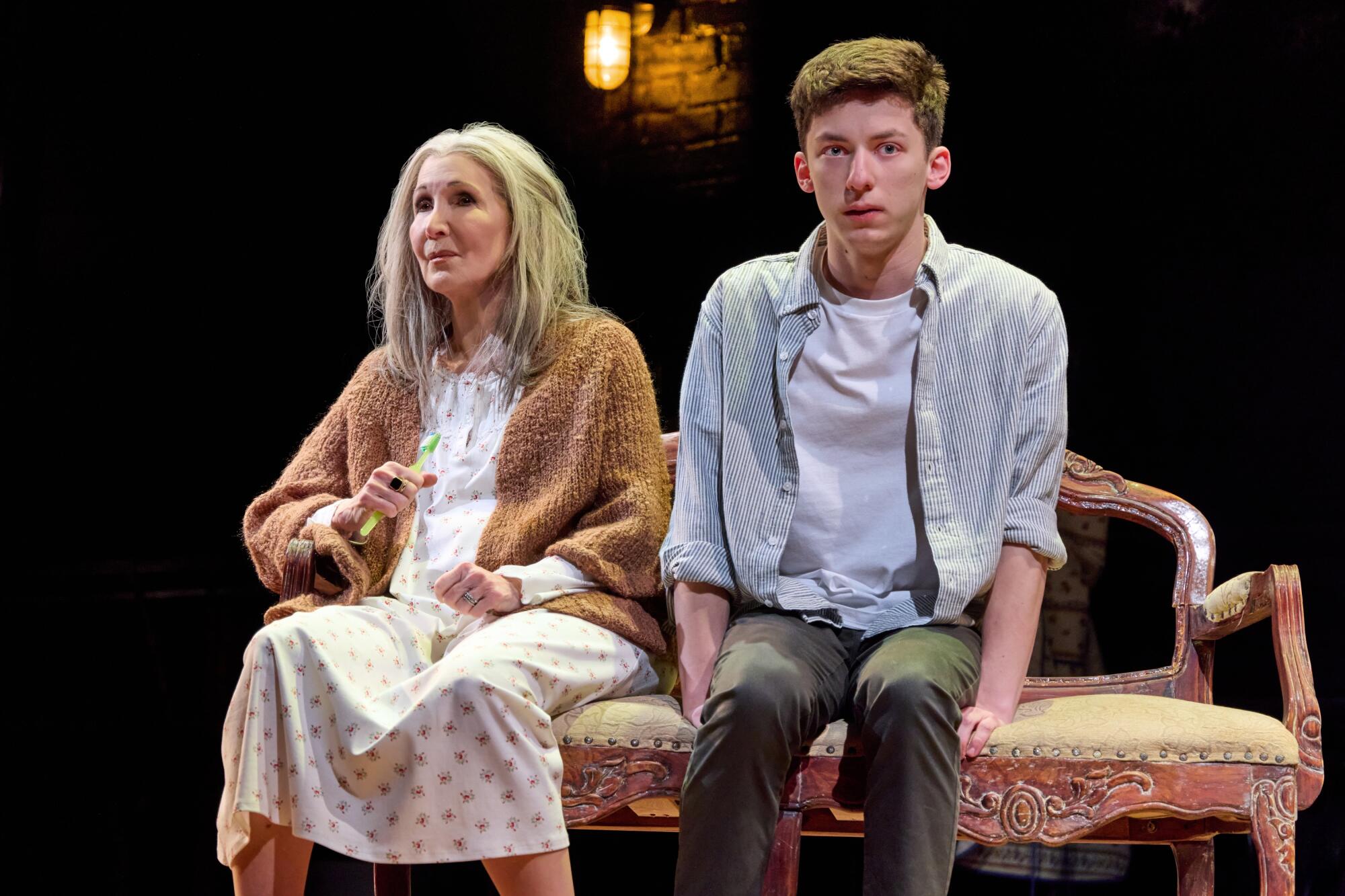
Joanna Gleason and Andrew Barth Feldman in Manhattan Theatre Club’s production of “We Had a World” by Joshua Harmon.
(Jeremy Daniel)
‘We Had a World’ by Joshua Harmon
Family strife is front and center in Harmon’s personal drama, a portrait of an artist as a young grandson. The grandmother in the spotlight, a dyed-in-the-wool New Yorker named Renee, exposes Joshua to the joys of the Big City when he visits from the suburbs. She’s like an Auntie Mame, only her version of extravagance is peanut butter sundaes at Serendipity 3, a course at the Metropolitan Museum of Art and tickets to see Diana Rigg on Broadway in “Medea.”
Joshua is in heaven, but he finds himself caught in a long-standing feud between his mother, Ellen, and his grandmother, whose drinking problem has resurfaced. A memory play of quiet complexity, “We Had a World” is a moving meditation on the challenge of appreciating our imperfect yet irreplaceable loved ones in the time that’s available.
Author of “Bad Jews,” “Significant Other” and “Prayer for the French Republic,” Harmon has written a work that may seem uncharacteristically modest in scope. But the drama, which had its world premiere off-Broadway at Manhattan Theatre Club’s NY City Center Stage II, is extremely supple in its construction. And the emotional crux of the story maps onto larger concerns, such as how to properly mourn a world that’s rapidly disappearing through the depredations of climate change, a passionate cause for Joshua, whose elegiac love for his grandmother has heightened his sense of the transitory nature of existence.

John McCrea as Prince George; Mihir Kumar as Dev Chatterjee in “Prince Faggot.”
(Marc J. Franklin)
‘Prince Faggot’ by Jordan Tannahill
An audacious fairy tale about a prince who happens to be the first openly gay heir to the throne in British history, the play took a cast of queer and trans performers in New York on a vertiginous meta-theatrical ride, inviting them to imagine a fictional version of Prince George of Wales in 2032 as a sexually liberated twink. Tannahill doesn’t pull any punches; nor did the thrilling production, which pulsated with the feverish energy of an after-hours club under the direction of noted playwright Shayok Misha Chowdhury (“Public Obscenities,” “Rheology”). A brilliant ensemble, which included downtown eminence David Greenspan, injected the royal family with radical swagger.
While meticulously crafted, “Prince Faggot” isn’t for the faint of heart. But there are unusual rewards for an intrepid company willing to test the boundaries of political and artistic morality.

Oghenero Gbaje, left, and Essence Lotus in “Bowl EP” by Nazareth Hassan at the Vineyard Theater in Manhattan.
(Carol Rosegg)
‘Practice’ and ‘Bowl EP’ by Nazareth Hassan
Sometimes a talent comes along that renders old paradigms obsolete. Hassan is such a talent. Reading these two new plays this year, I was struck by the stylistic vigor and structural fluidity. Playwriting for Hassan is a new form of jazz.
I served on the Pulitzer jury that chose “Bowl EP” as one of the finalists for this year’s drama award (won by “Liberation”). The play, which had its premiere off-Broadway at the Vineyard Theatre, is a freewheeling love story, set in a skate park in the middle of an urban wasteland. Two rappers, one trans, the other bisexual, trade lyrics in their frenetic pursuit of an elusive, authentic sound that can release them from the shame of a world that affords so little space for their identities.

Ronald Peet in “Practice” by Nazareth Hassan at Playwrights Horizons.
(Alexander Mejía, Bergamot)
“Practice,” which had its premiere at Playwrights Horizons, is a more epic work that closely tracks the perverse power dynamics of an avant-garde theater troupe. Determined to stretch the possibilities of contemporary performance, the company blows past the limits of acceptable process in an off-kilter “psycho comedy.” Art isn’t easy, as Sondheim famously put it, but must it be so cult-like and self-punishing?
I’ve not yet seen productions of either of these plays, and I wonder who in L.A. would have the temerity to tackle them. But Hassan, an insurgent dramatist with a lyrical voice like no other, is shaking up the art form in ways that can’t be ignored.

Will Brill, from left, Tamara Sevunts, Andrea Martin, Raffi Barsoumian and Nael Nacer in “Meet the Cartozians” by Talene Monahon.
(Julieta Cervantes)
‘Meet the Cartozians’ by Talene Monahon
Another finalist for the Pulitzer Prize for drama this year, “Meet the Cartozians,” a play in two acts set 100 years apart, looks at the racial politics of our immigration system through the Armenian American example. The first half, which takes place in 1923-24, revolves around Tatos Cartozian, a prosperous rug merchant living with his family in Portland, Ore. After his citizenship is revoked, he is conscripted to be part of a legal challenge contending that Armenians are “free white persons” and therefore eligible for naturalization given existing law. Tatos and his family are coached to perform “white identity” in a comedy that would be outrageously hilarious were it not inspired by historical events.
The second act takes place in 2024 in Glendale, where community members have gathered to be part of a reality TV star’s public embrace of her heritage. The luminary in question isn’t a Kardashian, but she might as well be. What begins as a history play transforms into a sharp-eyed satire about the cost of assimilation in a society where money, power and white privilege remain stubbornly intertwined.

Alana Raquel Bowers, from left, Andy Lucien and Crystal Finn in the 2026 production of “Cold War Choir Practice” by Ro Reddick.
(Maria Baranova)
‘Cold War Choir Practice’ by Ro Reddick
This shape-shifting play, shot through with music, is set in and around a roller disco in Syracuse, N.Y. The year is 1987, the Cold War is raging and Reaganomics is leaving poorer communities behind. Meek, a 10-year-old Black girl, is grappling with her fears of nuclear Armageddon as more prosaic domestic concerns kick into high gear. Her right-wing, Washington power-broker uncle, a Clarence Thomas figure, rekindles old disputes when he brings his sickly white wife to be looked after during the holidays. Reddick loads her genre-blurring tale with outlandish intrigue involving Soviet spies, a capitalist cult and a roving choir that doubles as a Greek chorus. The play, which won the Susan Smith Blackburn Prize this year, entices on the page despite seeming overstuffed and curiously decentralized. But it was helpful to see Knud Adams’ nimble production after it transferred to MCC Theater — an ideal introduction to a startlingly original playwright at the dawn of a path-breaking career.

David Greenspan in a “I’m Assuming You Know David Greenspan” by Mona Pirnot.
(Ahron R. Foster)
‘I’m Assuming You Know David Greenspan’ by Mona Pirnot
A solo show that Greenspan himself performed at Atlantic Theatre Company, this eccentric play was one of the most unexpectedly delightful works I read all year. Inspired by the sensibility of a tantalizingly idiosyncratic writer-performer, the play offered Greenspan the opportunity to star in a Greenspan-esque work not of his own devising. Pirnot pays homage to a queer maverick who has kept a safe distance from the mainstream. But she’s also examining the precarious economic plight of artists similarly pursuing their own alternative paths in the American theater. Not afraid of being too inside baseball, she turns a spotlight onto the backstage realities of an endangered cultural scene that, by the evidence of this play alone, is too wonderful to abandon.

Laurie Metcalf and Micah Stock in “Little Bear Bridge Road” by Samuel D. Hunter.
(Julieta Cervantes)
‘Little Bear Ridge Road’ by Samuel D. Hunter
After seeing “Little Bear Ridge Road” on Broadway in the fall, I immediately requested a copy of the script, wanting to spend more time with the hauntingly unresolved characters. The gaps in the story are as compelling as the personal details.
Ethan (played by an excellent Micah Stock), a gay man on the lam from his past, has arrived at the home of his aunt, Sarah (given life in a vintage Laurie Metcalf performance), a crotchety, isolated nurse in rural Idaho, to settle his dead father’s affairs. There’s too much family trauma to make this a sentimental reunion. But forced to watch hour after hour of escapist television together during the dark days of COVID, they can’t help but attend to old wounds even as they open new ones. Metcalf, finding the hidden emotion in Sarah’s burned out inner life, delivered a stripped-down tour de force. As Ethan, Stock was as perversely alienating as he was poignantly alienated. I doubt whether this production, impeccably directed by Joe Mantello, could be equaled. But these two figures, created by one of our most keenly observant writers, deserve to be interpreted anew. Hunter’s drama, named best play this year by the New York Drama Critics’ Circle, marks an important addition to the playwright’s voluminous body of work, which includes “The Whale,” “Grangeville” and (coming to indispensable Rogue Machine in September) “A Case for the Existence of God.”
‘ The preceding article may include information circulated by third parties ’
‘ Some details of this article were extracted from the following source www.latimes.com ’