It was a full Circuit moment.
Bruce Springsteen and E Street Band played a majestic version of “Born to Run” Sept. 15, 2024 to 35,000 on Asbury Park’s beach at the Sea Hear Now festival. The performance of the song took place a few short blocks from the site of the former Circuit on Ocean Avenue and Kingsley Street where “beyond the Palace hemi-powered drones scream down the boulevard.”
In 1975, the song “Born to Run” was a declaration of independence. In 2024 it had become, in the context of the E Street Band’s “Letter to You” tour, a statement of survival and fortitude.
“In many ways it’s about reinvention and how to find the strength and courage to become the person that you need to be,” said Peter Carlin, author of the new “Tonight in Jungleland: The Making of ‘Born to Run.’ ”
“Born to Run,” the single, was first released to radio stations in the fall of 1974 as a desperate attempt to save Springsteen’s major-label career.
Springsteen, a Freehold native, was on the verge of being left behind by the record industry. His first two albums for Columbia Records, “Greetings from Asbury Park, N.J.” and “The Wild, the Innocent & the E Street Shuffle,” were not chart-toppers and pressure was mounting from label executives for a hit.
“Born to Run” delivered.
The song generated enough excitement to enable a third album from Springsteen on Columbia — “Born to Run,” which was released on Aug. 25, 1975. The song continues to hold a special place in the hearts of Springsteen fans and has been adaptable enough over the last five decades to match the mood and the moment for generations.
A sneak peek at ‘Born to Run, which bucked the trend and won
“Born to Run” was written in 1974 in a bungalow at 7½ West End Court in the West End section of Long Branch. In an era of progressive rock and singer-songwriters, “Born to Run” bucked the trend with a turbo-charged spark of rock ’n’ roll roots, thanks in part to a Wall of Sound effect that’s a nod to Phil Spector and a Duane Eddy-style guitar twang. Springsteen, guitar and vocals; Garry Tallent, bass; Ernest “Boom” Carter, drums; David Sancious, keyboards; Danny Federici, organ; and Clarence Clemons, sax, played on the track and Springsteen and Appel produced it.
It would be the only E Street Band song Carter would record. He and Sancious left to form the progressive jazz trio Tone.
The song references Springsteen’s two Jersey Shore worlds with Highway 9, which abuts Freehold, and Asbury Park’s Circuit, shown here in a season of disillusionment. It’s the post-Vietnam, Watergate world with high unemployment and long gas lines.
“Dread — the sense that things might not work out, that the moral high ground had been swept out from underneath us, that the dream we had of ourselves had somehow been tainted and the future would forever be uninsured — was in the air,” said Springsteen of the song in his “Born to Run” memoir. “This was the new lay of the land, and if I was going to put my character on the highway, I was going to have to put all these things in the car with them. That’s what was due, what the times demanded.”

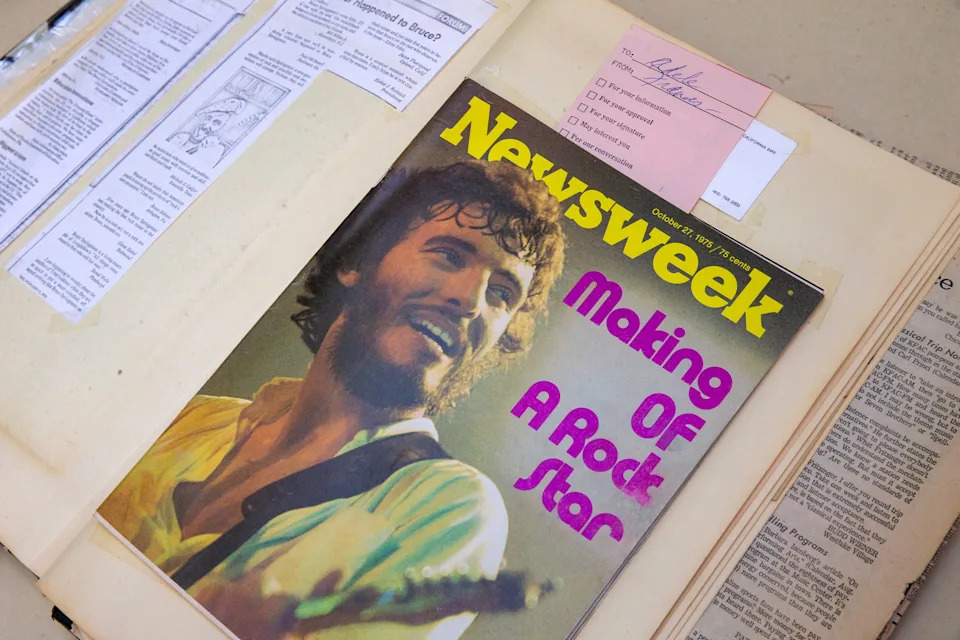
Detail of a page from the scrapbook of Adele Springsteen, mother of Bruce Springsteen, which includes a copy of the Oct. 27, 1975, Newsweek magazine, at the Bruce Springsteen Archives and Center for American Music at Monmouth University in West Long Branch.
Yet, the dread is contrasted by love and hope via Wendy, and the flash of courage to break free.
Springsteen manager Mike Appel sent out a few copies of the song to deejays and other industry types to generate interest.
It worked.
The deejays loved it and Allan Clarke, formerly of the Hollies, recorded it and almost released it before Springsteen’s version came out.
Clarke’s version didn’t pre-date the Springsteen version, which peaked at No. 23 on the Billboard Hot 100 chart. The song was in steady rotation on multiple radio formats and it affirmed the dedication Springsteen fans felt for their Boss. Five years later, the track received consideration for New Jersey state song in 1980 after DJ Carol Miller started a petition drive on New York City’s WPLJ-FM. The assembly passed a resolution but it died in the Senate.
“The irony is people were like, ‘it’s a death trap, it’s a suicide rap, we got to get out while we’re young,’ they said wait a second, this song is about escaping New Jersey,” said DJ Rich Russo, host of the freeform “Anything, Anything” show. “I’ve always taken it a different way. Most people from New Jersey move somewhere else in New Jersey. For example, the town I grew up in wasn’t that great of a town — I moved to the next town. Bruce escaped from Freehold to Holmdel to Rumson. It’s about getting out of lesser place to a better place in the same state.”
After ‘Born in the U.S.A.,’ fans were introduced to ‘Born to Run’
After the breakout success of “Born in the U.S.A.” in 1984, a live video of “Born to Run” was released in 1986 to promote the “Live 1975–85” album. The new fans were introduced to the older songs.
“It was muscle Bruce doing his best song with people in the crowd going nuts and him running like he does,” Russo said. “It was a great, great video.”
A video where Springsteen imparts an egalitarian message — “Remember, in the end, nobody wins unless everybody wins” — at the beginning of the performance. The message was contrary to much of the pop culture in the big ’80s where everything counted in large amounts.
A year later Springsteen featured a stripped-down acoustic version of “Born to Run” on the Tunnel of Love tour.
“It’s reflecting back on what was then only 14 years earlier at the time,” Carlin said. “It seemed like an incredible expanse of time and he sang with wistful sense of a battle waged and won a long time ago. He was in his 30s at the time and evolved again when he started playing in again in 1992 in was back in the whole electric setting.”
Alas, without the E Street Band. Springsteen toured with what fans call the Other Band in ’92 and ’93. Crystal Taliefero sax on “Born to Run” had a more jazzier interpretation of the run than what Clarence Clemons had played.
The Big Man, and the rest of the E Street Band, reunited in 1999. “Born to Run” became a vow of unity from the stage.
“On the reunion tour you got it back and you got it back with Steven (Van Zandt), who was back with the band and you had Clarence and it brought it back to the ’75, ’78 and ’81 versions,” Russo said. “There’s never going to be a Bruce Springsteen setlist where that song doesn’t work. That’s always going to work, no matter what’s the theme of the setlist, that song is always going to work because no matter what frame of mind he’s in, no matter what frame of mind the audience is in, that song is transcendent on so many different levels that it doesn’t matter.”
The interpretations of “Born to Run” are growing. During the 2025 Super Bowl, viewers heard R&B musician H.E.R. sing “Born to Run” in a Dove commercial. The spot was called “These Legs” and a toddler-aged girl was shown running down a sidewalk to celebrate female athleticism.
Fifty years later, “Born to Run” certainly has legs.
“To me it gives you a feeling that anything is possible, the song has such a thrilling feeling,” said Neptune recording star Nicole Atkins. “My song ‘Maybe Tonight,’ that was my first song that gave me that thrilling feeling. That is something you don’t want to lose when you get older. If you can keep that magic feeling, you can be young for the rest of your life. You just got to pay attention and look out for it, stay curious and anything can happen.”
‘Born to Run’ 50th anniversary
Here are some events, exhibits and performances around the 50th anniversary of “Born to Run.”
“Tonight in Jungleland – The Making of Born to Run” by Peter Ames Carlin. Doubleday. www.peteramescarlin.com.
Springsteen in Long Branch, 8:30 a.m. to 4:40 p.m. Monday-Friday, Long Branch Arts and Cultural Center, 577 Broadway, Long Branch. www.longbranch.org.
Bruce Springsteen Archives & Center for American Music “Born to Run” anniversary main event, Saturday, Sept. 6, Pollak Theater, Monmouth University, 400 Cedar Ave., West Long Branch, campus of Monmouth University. Sold out. springsteenarchives.org.
Bruce Springsteen Archives & Center for American Music Tuesday Night Record Club, Tuesday, Sept. 2, Monmouth University’s Great Hall Auditorium, 400 Cedar Ave,. West Long Branch or via Zoom discussing “Born to Run.” Free. Registration is required at springsteenarchives.org.
Bruce Springsteen Archives & Center for American Music, rare footage from the making of “Born to Run” and from Springsteen’s 1975 “Born to Run” tour, hosted by filmmaker Thom Zimny, Friday, Sept. 5, Pollak Theatre, Monmouth University, 400 Cedar Ave., West Long Branch. $50. springsteenarchives.org.
Eric Meola “Born to Run” photo exhibit, Saturday, Sept. 6, through Thursday, Dec. 18. Rechnitz Hall’s DiMattio Gallery, Monmouth University, 400 Cedar Ave., West Long Branch. springsteenarchives.org.
“Born to Run” academic conference, Sunday, Sept. 7, Pozycki Hall, Monmouth University, 400 Cedar Ave, West Long Branch. $100. springsteenarchives.org.
Subscribe to app.com for the latest on the New Jersey music scene.
Chris Jordan, a Jersey Shore native, covers entertainment and features for the USA Today Network New Jersey. Contact him at [email protected]
This article originally appeared on Asbury Park Press: Bruce Springsteen ‘Born to Run’ 50th anniversary: What the it means to fans
‘ The preceding article may include information circulated by third parties ’
‘ Some details of this article were extracted from the following source www.yahoo.com ’