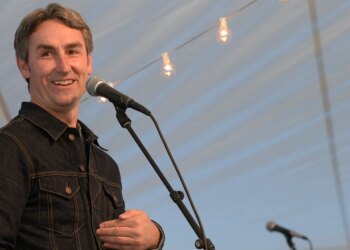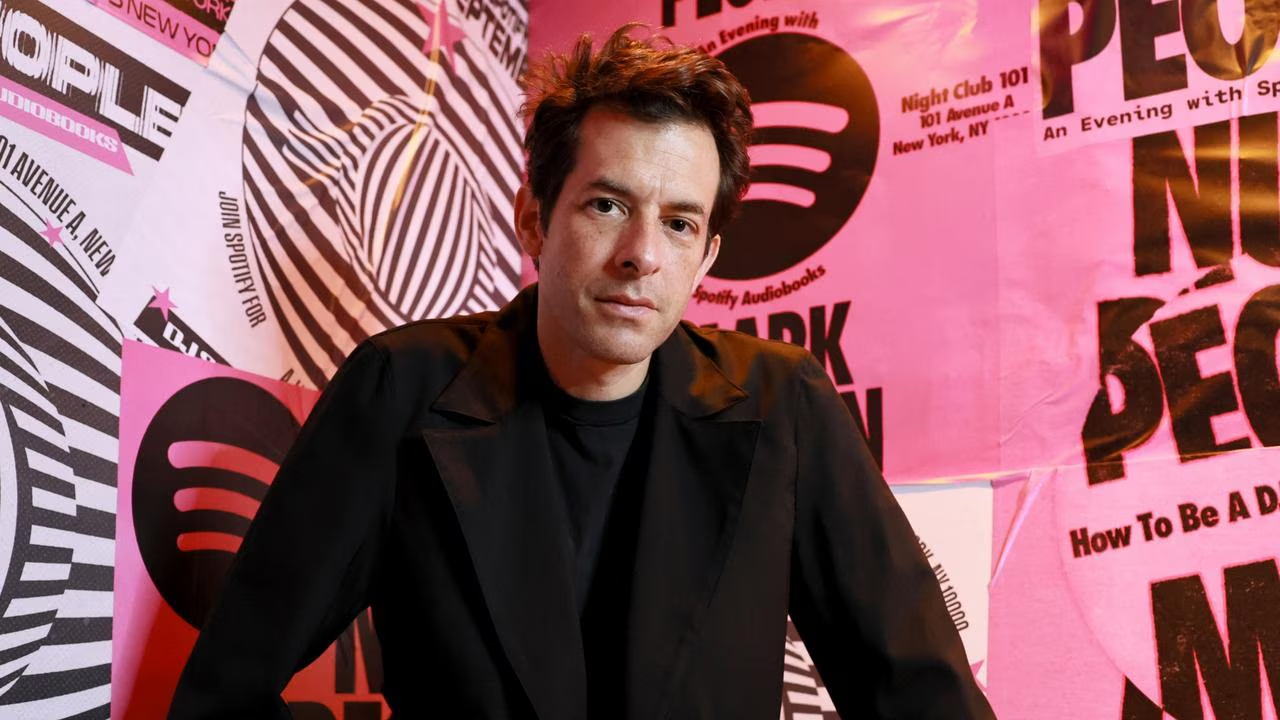
Nine-time Grammy-winning musician, songwriter, DJ and producer Mark Ronson knows he is going to have his work cut out for him when his daughter reaches her teenage years.
Ronson, who won Grammys for producing Amy Winehouse’s Back To Black, his 2014 hit single Uptown Funk with Bruno Mars, co-writing Shallow with Lady Gaga and the Barbie soundtrack, is also the father of two daughters with his wife of four years, Gracie Gummer.
The oldest, Ruthie, is two and features at the very end of Ronson’s new memoir Night People, which recounts his early days as a trailblazing DJ in the clubs of New York City in the 1990s golden era.
Ronson, now 50, was still childless when he started writing the book three years ago but as he delved into his own wild teenage adventures with music and drugs – and started his family – he began to ponder just how confessional and raw he would be, knowing they might read it one day.
“My daughter wasn’t even born when I started the book, but by the time I was finishing it, she’s two and I’m thinking, ‘God, I’m going to have no leverage when she’s 14 and comes home late’,” Ronson says over Zoom call from his New York home.
“She’ll be like, ‘Dad, you are doing heroin when you were 18’ or whatever it is. But I had this talk with (actor) Dax Shepard on his podcast and he just said something that really resonated with me.
“He was like, ‘I don’t want to have any secrets from my kids by the time they’re that age’.
“And maybe that’s foolish, but it definitely resonated with me. But yes, I’m going to have some explaining to do.”
Ronson doesn’t pull too many punches in the new book, which focuses on the years before the hits and collaborations that made him a global star. Inspired by the countless people – particularly from Gen Z – who had approached him asking what it was like to be in the middle of the thriving Big Apple club scene before the era of social media, widespread VIP and bottle service and celebrity DJs, when regular punters could potentially rub shoulders with the likes of Jay-Z, Biggie Smalls, Prince or Mariah Carey.
“I started to think I’ve done enough damage to my brain that if I don’t start to write these things down they will be gone forever,” he says.
“I don’t know if anybody wrote the story of the gigging DJ. What it’s like only on the way up and not when you’re on the festival stage playing to 50,000 people, but when you’re just night in night out doing the thing because you love it even if you’re getting paid 50 bucks and two drink tickets and playing on some nights for seven people.”
Ronson interviewed hundreds of friends and former colleagues for the book to create as vivid a picture as he could from more than 30 years ago. Not only was his own memory a little hazy, but often he was stuck in a tiny DJ booth when the real action was unfolding on the hip and heaving dancefloors. Along the way, he was reminded of embarrassing encounters with celebrities, learned that a club owner once called his mother to make sure he had permission to be there because he looked so young and reconnected with people he hadn’t seen or spoken to for years. And while he said he didn’t “set out to write a super personal book about drugs and addiction and compulsion”, he soon realised that to accurately portray the sometimes hedonistic scene then “I had to talk about my own demons as well”.
While Ronson emerged more or less intact from his hard-partying DJ days and went on to much bigger success, he was sensitive to the fact that many others didn’t and had to work hard to win their trust for them to share their stories, particularly the ones who had fallen on harder times.
“I wanted to tell everybody’s story in a really positive light,” he says. “Obviously I was lucky all those times I was doing drugs. There’s this sense that I was definitely really driven and my eyes were on the prize of music so that I wasn’t going to fully throw everything away but you don’t know. You can have one bad night that it’s beyond your control, take the wrong thing. So, I consider myself lucky, and I’m very grateful to have made it out of there.”
With an extraordinary and privileged background like his – London-born Ronson’s stepfather is Foreigner guitarist Mick Jones and he recounts stories of Robin Williams tucking him into bed and Michael Jackson being at a sleepover at his childhood friend Sean Lennon’s house – a certain amount of name-dropping was inevitable for a memoir. Ronson says he tried to be judicious about it and reveals that he was actually “hyper aware of his background” when he was first starting out.
“I tried so hard to play it down that I was from this fancy family up-town, with my stepdad a rock star and all of this stuff,” he says. “I thought it wouldn’t make people just not want to f— with me or think that I was not legit. But nobody really cared. That was all in my head. All people cared about in that scene was if you rolled up and you rocked the party.”
Ronson has been a regular visitor to Australia over the years – he caught up with his friend and sometime collaborator soul singer Daniel Merriweather in Melbourne earlier this year – and music and artists from these parts have helped shape his career. INXS was a formative early influence – he recalls teaching Lennon how to play the guitar riff to Devil Inside – and helped him find the funk and R&B that would become an integral part of his sound as a DJ and producer.
Similarly, AC/DC provided him with a crucial moment when he shockingly dropped the legendary Back In Black riff in the middle of a Biggie Smalls track in a hard-core hip-hop club, knowing he was flirting with career suicide – and flying bottles – by doing so. Thankfully, the crowd went nuts.
“That set me apart as a DJ because I became known as the guy who plays hip-hop and Biggie and Rufus and Chaka Khan – but also AC/DC and Joan Jett,” he recalls. “This was before the mashup era so that AC/DC Back In Black drop was so instrumental in me carving out my path.”
That audacious choice also led to his first proper gig as a record producer for Nikki Costa, an American soul singer who based in Melbourne at the time, on her 2001 album Everybody Got Their Something. Many of the basic skills he would take to studio sessions to produce artists from Adele and Winehouse to Lily Allen and Miley Cyrus, he learned from Costa’s Aussie husband and former member of Noiseworks, Justin Stanley.
“That gig was everything,” Ronson says. “I learned from watching Justin how to mic drum kits. I learned how to collaborate and make proper records from sitting with Nikka and Justin in a room for 18 months as we figured out what that sound was.
“And I learned how to use Pro Tools by staring at the back of Justin’s head. I mean everything I learned in those early days was really in that room with them.”
The art of being a DJ has changed out of sight in the three decades since Ronson first started out on the decks. Advances in technology have made some of the hard-learned physical skills of cuing, scratching and beat-matching a whole lot easier and the advent of streaming services has done away with the need to lug around crates of rare vinyl records.
It’s also given rise to the “celebrity DJ”, a name initially given to Ronson once he started spinning at high-profile fashion events and star-studded crowds, but has now seemingly spread to any model, influencer or sports person with a love of a crowd and a passing interest in music. While Ronson says has mixed feelings about the term and while he embraces the technology, he also is grateful for the skills he learned in how to work a room doing it the old-school way.
“I was doing all the fashion gigs … so it’s hard to complain about it,” he says.
“Now every Real Housewife, every Jersey Shore member, everybody’s a DJ. Certainly, it’s easier starting out now.
“Are there incredible DJs that are just as good as the DJs for my generation? Of course, but it does make it easier.
“I think the first (celebrity) DJs that really came along that didn’t have to have talent but it was because they were famous from TV. I remember going to a party and – obviously she put in the hours to become a talented technical DJ afterwards – but I saw Paris Hilton with two iPods or something at a club and I was like ‘okay this is where we’re going.’”
Mark Ronson’s Night People is out now.
‘ The preceding article may include information circulated by third parties ’
‘ Some details of this article were extracted from the following source www.news.com.au ’