As Amber Maze stood in front of a tall white building in Prague just over two years ago, she texted a friend a photo with the message: “Guess where I am?”
Frank Grunwald, who then lived in Geist, immediately called her. He told her how his father, a physician, kept an office on the first level of that building and that their family’s apartment was on the second. He recalled how, as young boys, he and his brother would stand on the balcony, giggling and dropping water balloons on passers-by and how their dad reprimanded them.
Maze heard laughter in Grunwald’s voice as he related a flood of memories from the happy part of his childhood — before the Nazis took Czechoslovakia in 1939, before the Grunwald family was forced from their home into the Theresienstadt ghetto-labor camp. Maze and her colleague Philip Paluso planned to incorporate many of those stories into their then-in-progress documentary about how Grunwald survived the Holocaust.
Before Maze and Grunwald got off the phone on that June day, she asked about his recent doctor’s appointment. Grunwald told her he’d been diagnosed with stage four cancer.
“It was very surreal for me to be standing in front of his home and to be hit with the reality that I’m probably not going to have my friend for much longer,” said Maze, producer and co-writer of the documentary.
Two months later, on Aug. 30, 2023, Grunwald died at age 90 before Maze and Paluso finished their documentary. That film, “Sweet Lorraine in Auschwitz,” will hold its world premiere Oct. 12 at the Heartland International Film Festival, telling the story of how Grunwald survived the Holocaust.
‘Music was the thread that connected’ the Grunwald family
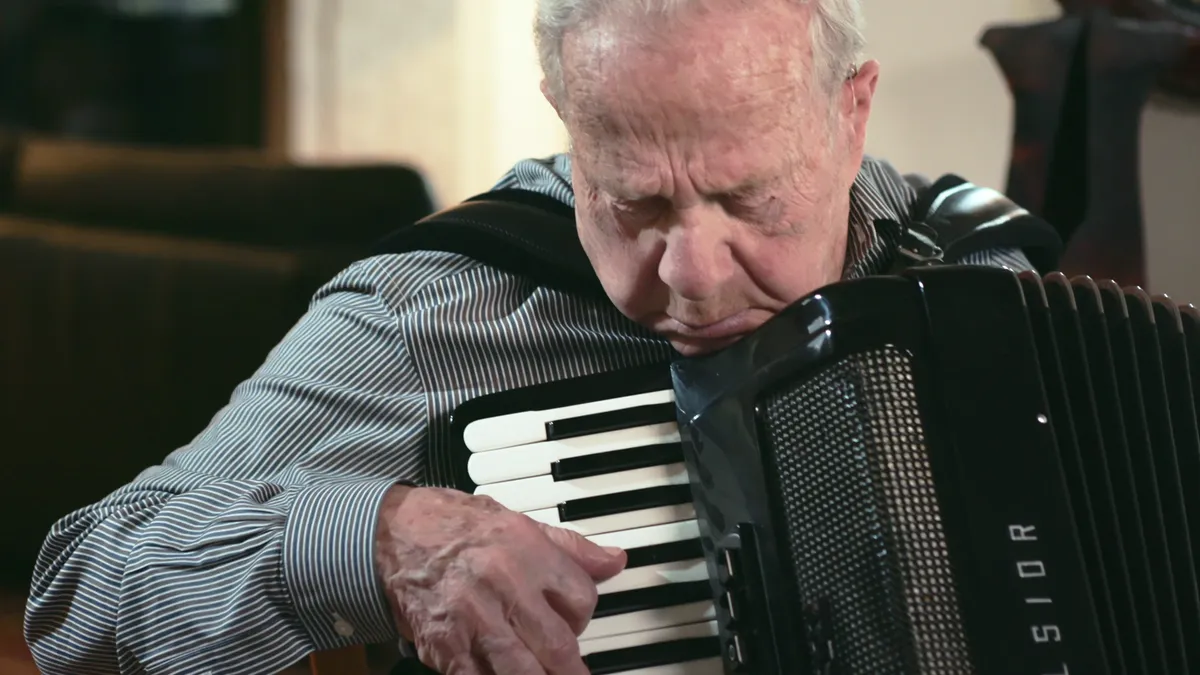
Before the Nazis seized their home, Kurt and Vilma Grunwald were accomplished classical pianists who played Chopin so well it was “like listening to a live concert,” their son Frank Grunwald says in the documentary. Frank and his brother John loved American jazz, which they played on the accordion and piano, respectively, after hearing Irving Berlin and Eubie Blake on recordings. Frank’s favorite was Cliff Burwell’s “Sweet Lorraine.”
“That family was very close-knit, and music was the thread that connected them in addition to family love,” said Paluso, the film’s director, co-writer and cinematographer.
After the family was forced into Theresienstadt, Frank and John would sing their favorite tunes together when they could. Later, at Auschwitz, Frank escaped a death sentence from the infamous Nazi doctor Josef Mengele. But John did not, and Vilma accompanied her oldest son to the gas chamber so he would not die alone in July 1944.
The Nazis housed Kurt and Frank separately and eventually sent his father elsewhere. Without his family, the 11-year-old boy increasingly turned to music and memories to survive.
How a concert led to the documentary
The impetus for the documentary came from an October 2021 concert at the Indiana History Center that raised money for an Indianapolis Jewish Community Relations Council initiative to educate people about the Holocaust and combat hatred, bigotry and antisemitism. Grunwald played accordion as part of an ensemble, weaving in the American jazz tunes that sustained him and mixing in spoken reflections on his life.
Maze helped the musician craft the vignettes he would share and Paluso filmed the concert.
“It was really at that moment at the end of the concert that everybody was just sort of clamoring for more,” said Maze, who is also the director of strategic outreach and communications for the Indianapolis Jewish Community Relations Council, which executive-produced the project. “We heard a lot of … ‘I really wish that we got to see more of Frank’s story, hear Frank play music.'”
Paluso and Maze conducted in-depth interviews with Grunwald, and the filmmakers traveled to Europe to see where he grew up and the camps where the Nazis held him. Central to the documentary is Grunwald’s love of music and how it helped him survive the Holocaust’s horrors.
‘A place that was full of hope’
Toward the end of the war as the Nazis faced imminent defeat, they dragged Frank and other prisoners on death marches across Europe.
“When you stand in the shadow of those buildings at Auschwitz and you imagine what must have been just … absolute horror,” Paluso said. “You can hear the ghosts.”
Starving and thirsty, Frank passed dead bodies in the snow and encountered other prisoners hungry enough to eat a dog and a rotten fish. Frank played his favorite melodies in his head, wondering whether he would survive.
In the documentary, Galit Gertsenzon, the director of the Zeigler Jewish Studies Program at Ball State University, says Frank told her that music “made me feel that I was in a different place with different people, in a place that was full of hope.”
Finally, in May 1945 in Gunskirchen, a subcamp of Mauthausen in Austria, Frank encountered American soldiers who rescued him and the other survivors. Kurt later found his son in a dormitory in Austria. In 1951, they immigrated to New York. Frank relocated to Indianapolis in 1987 for his job and later taught strategic design and creative thinking at Purdue University.
A plan bring the documentary to classrooms
“Sweet Lorraine in Auschwitz” will have three in-person screenings at Heartland. The filmmakers then want to present it at other festivals for about a year. After that, Maze and Paluso want to bring the documentary to classrooms with an accompanying curriculum of lesson plans.
The goal for today’s audiences, Maze said, is for people to be inspired by Grunwald’s story and to speak out against bigotry and hatred, especially in an era of rising antisemitism and Holocaust denial.
“We haven’t learned the lessons that we promised ourselves that we would learn in 1945 and ’46 at the end of the war,” Maze said. “There is so much division and polarization and dehumanization that is occurring in the U.S., in Europe, in Asia, in Africa, everywhere and that’s because we’ve lost sight of the humanity within the other. And when that happens, that makes atrocities all that much easier to perpetrate.”
If you go
What: “Sweet Lorraine in Auschwitz” at Heartland International Film Festival
When and where: 1 p.m. Oct. 12 (Tobias Theater at Newfields, 4000 N. Michigan Road); 4:45 p.m. Oct. 16 and noon Oct. 19 (both at Alamo Drafthouse, 3898 Lafayette Road). Also available to stream from noon Oct. 9-11:59 p.m. Oct. 19.
Buy tickets: heartlandfilm.org/festival
This Indy newsletter has the best shows, art and eats
Contact IndyStar reporter Domenica Bongiovanni at 317-444-7339 or [email protected]. Sign up here for the newsletter she curates about things to do and ways to explore Indianapolis. Find her on Facebook, Instagram or Twitter: @domenicareports.
‘ The preceding article may include information circulated by third parties ’
‘ Some details of this article were extracted from the following source www.indystar.com ’