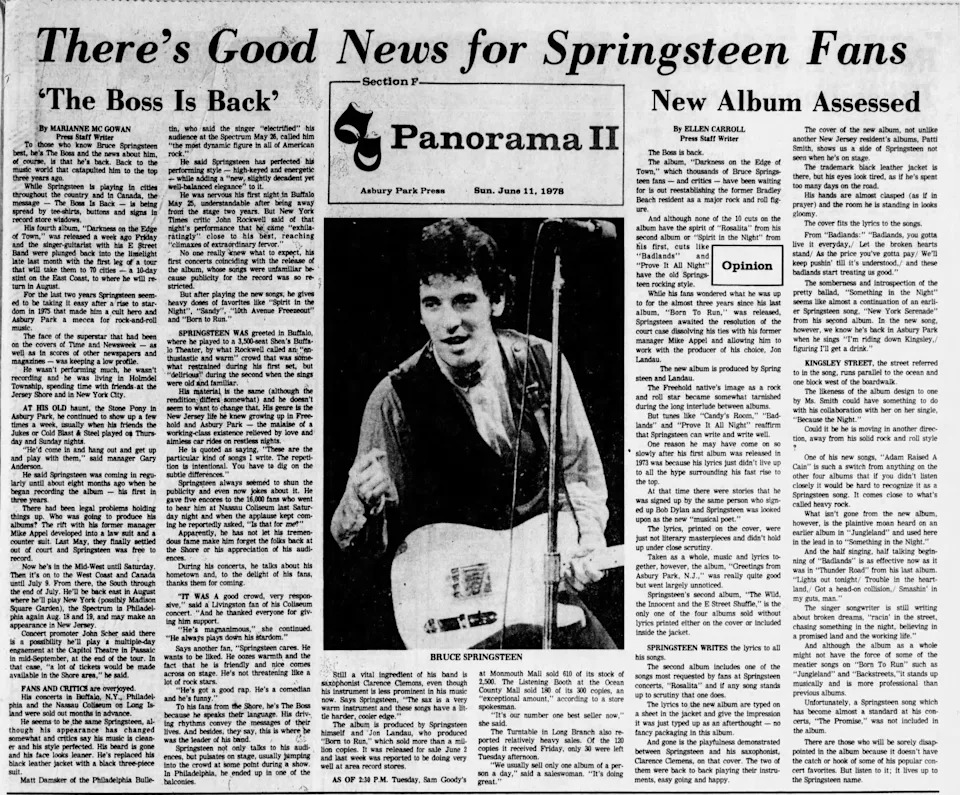
Editor’s note: The following story originally appeared in the Asbury Park Press on June 11, 1978.
The Boss is back.
The album, “Darkness on the Edge of Town,” which thousands of Bruce Springsteen fans — an critics — have been waiting for, is out, re-establishing the former Bradley Beach resident as a major rock and roll figure.
And although none of the 10 cuts on the album have the spirit of “Rosalita” from his second album or “Spirit in the Night” from his first, cuts like “Badlands” and “Prove It All Night” have the old Springsteen rocking style.
While his fans wondered what he was up to for the almost three years since his last album, “Born To Run,” was released, Springsteen awaited the resolution of the court cases dissolving his ties with his former manager Mike Appel and allowing him to work with the producer of his choice, Jon Landau.
The new album is produced by Springsteen and Landau.

This story and review on “Darkness on the Edge of Town” was in the Asbury Park Press on June 11, 1978.
The Freehold native’s image as a rock and roll star became somewhat tarnished during the long interlude between albums.
But tunes like “Candy’s Room,” “Badlands” and “Prove It All Night” reaffirm that Springsteen can write and write well.
One reason he may have come on so slowly after his first album was released in 1973 was because his lyrics just didn’t live up to all the hype surrounding his fast rise to the top.
At that time there were stories that he was signed up by the same person who signed up Bpb Dylan, and Springsteen was looked up as the new “Musical Poet.”
The lyrics, printed on the cover were just not literally masterpieces and didn’t hold up under close scrutiny.
Taken as a whole, music and lyrics together, however, the album, “Greetings from Asbury Park, N.J.,” was really quite good but went largely unnoticed.
Springsteen’s second album, “The Wild, the Innocent & the E Street Shuffle” is the only one of the four albums sold without lyrics printed either on the cover or included inside the jacket.
Springsteen writes the lyrics to all his songs.
The second album includes one of the songs most requested by fans at Springsteen concerts, “Rosalita,” and if any song stands up to scrutiny that one does.
The lyrics to the new album are typed on a sheet in the jacket, and give the impression it was just typed up as an afterthought – no fancy packaging in this album.
And gone is the playfulness demonstrated between Springsteen and his saxophonist, Clarence Clemens, on that cover. The two of them were back to back playing their instruments, easygoing and happy.
The cover of the new album, not unlike another New Jersey resident’s album, Patti Smith, shows us a side of Springsteen not seen when he’s on stage.
The trademark black leather jacket is there, but his eyes look tired, as if he’s spent too many days on the road.His hands are almost clasped (as if in prayer) and the room he is standing in looks gloomy.
The cover fits the lyrics to the songs.
From “Badlands;” “Badlands, you gotta live it everyday,/ Let the broken hearts stand/ As the price you’ve gotta pay/ We’ll keep pushing’ till it’s understood,/ and these badlands start treating us good.”
The somberness and introspection of the pretty ballad, “Something in the Night,” seems like almost a continuation of an earlier Springsteen song, “New York Serenade” from his second album. In the new song however, we know he’s back in Asbury Park when he sings “I’m riding down Kingsley,/figuring I’ll get a drink.” Kingsley Street, the street referred to in the song, runs parallel to the Ocean and one block west of the boardwalk.
The likeness of the album designed to one by Ms. Smith could have something to do with his collaboration with her on her single, “Because the Night.” Could it be he is moving in another direction, away from his solid rock and roll style?
One of his new songs, “Adam Raised A Chain,” is such a switch from anything on the other four albums that if you didn’t listen closely it would be hard to recognize it as a Springsteen song. It comes close to what’s called heavy rock.
What isn’t gone from the new album, however, is the plaintive moan heard on an earlier album in “Jungleland” and used here in the lead in to “Something in the Night.”
And the half singing, half talking beginning of “Badlands” is as effective now as it was in “Thunder Road” from his last album. “Lights out tonight/ Trouble in the heartland,/Got a head-on collision,/ Smashin’ in my guts, man.”
The singer songwriter is still writing about broken dreams, “racin’ in the street, chasing something in the night, believing in a promised land and the working life.”
And although the album as a whole might not have the force of some of the meatier songs on “Born to Run” such as “Jungleland” and “Backstreets,” it stands up musically and is more professional than previous albums.
Unfortunately, a Springsteen song which has become almost a standard at his concerts, “The Promise,” was not included in the album.
There are those who will be sorely disappointed in the album because it doesn’t have the catch or hook of some of his popular concert favorites. But listen to it; it lives up to the Springsteen name.
This article originally appeared on Asbury Park Press: Bruce Springsteen: Darkness on the Edge of Town review
‘ The preceding article may include information circulated by third parties ’
‘ Some details of this article were extracted from the following source www.yahoo.com ’