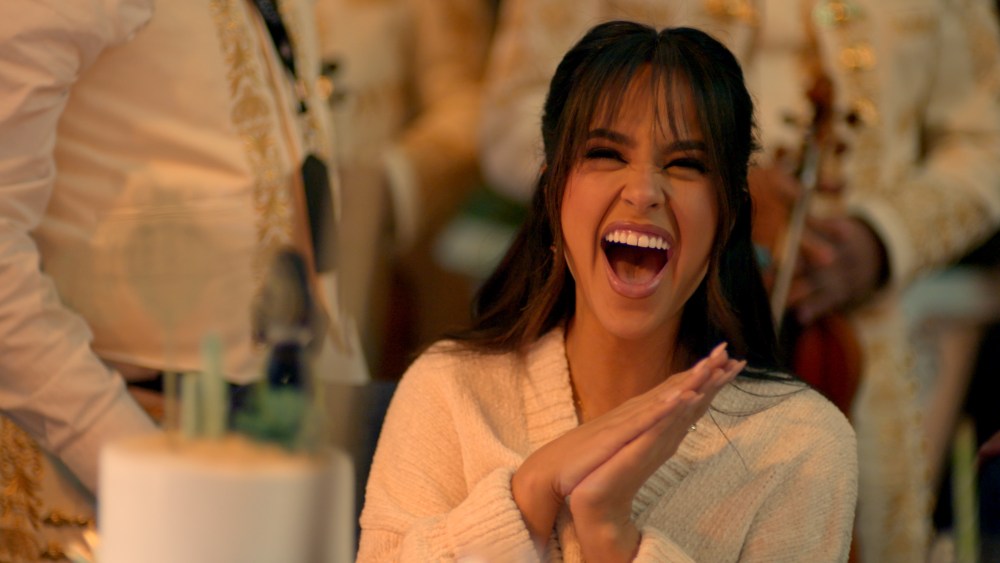
“Rebbeca,” a new documentary centered on Mexican-American singer and actress Becky G, isn’t simply a highlight reel of her achievements. Yes, it offers an up-close view of the star’s ascent — from her exhilarating first headlining tour to the bold creation of her música mexicana album “Esquinas.” Yet what emerges is a deeper story of a young woman confronting the past and reclaiming her power through personal reckoning, family lineage and forgiveness.
“Rebbeca was saved by Becky G,” she tells Variety. “Becky G was how I survived and how I protected myself and my family. She gave me the strongest sense of security when I needed a form of escapism.”
Directed by Jennifer Tiexiera and Gabriela Cavanagh, and executive produced for Live Nation Studios by Ryan Kroft and Michael Rapino, the film includes the first truly open conversations between Becky and her family regarding her father’s struggles with addiction and the moment she became the family’s primary provider at just nine years old. The singer also addresses (if indirectly) her ongoing record deal with Dr. Luke’s Kemosabe Records, which she signed early in her career. While never naming the producer, she urges young artists to get a good lawyer before signing any years-long contracts.
Below, Becky G dives into how “Rebbeca” came to life, why now is the moment she’s ready to reveal her truth, and the fun music shaping her next chapter.
Had you been presented an opportunity to do a documentary before? Why was now the right time?
Yes. There’s such thing as a great opportunity — but the wrong time.
You can only meet others as deeply as you’ve met yourself. I was still working through a lot, subconsciously. I lived so much of my life in a state of fight or flight that it wasn’t until I got a little further into my personal journey that I finally accepted it was something I could do. There’s a lot I still haven’t accomplished, which is wild to say out loud, because I’ve had such a long career, but I think there’s a benefit to seeing the middle of someone’s journey.
Who or what helped you reach that conclusion?
There’s someone I really want to mention who helped me so much — Karol [G]. The year we started filming, she was already playing stadiums. I remember talking to her about it, and she told me: “B, you’re doing clubs. You close your eyes, open them — you’re doing theaters. Close your eyes, open them — you’re doing arenas. Close your eyes, open them — you’re doing stadiums. If I did it, I know you can do it too.”
After we wrapped filming, I went on my second headlining tour and sold out my first arena. It felt like divine alignment. I’m so grateful I trusted my gut and captured myself in that moment.
Your family is incredibly candid in this film about financial hardships, your father’s addiction and your childhood. How did you prepare to have such difficult conversations on camera?
My sister used to say to me during family therapy, “For so much of your life, you walked ahead of us, and now we want to walk alongside you.”
We almost got to practice surrender with the film… where I was like, “I don’t have to be anything else other than myself.” And I had never really gotten to that point with myself… being a child actress, performer, singer and being in an industry that has no problem telling you who you should be. I feel a strong sense of pride when I watch the film, because I know I did it for no other reason than finding freedom.
What made Jennifer Tiexiera and Gabriela Cavanagh the right directors for this project?
You’re only as great as the leaders you have around you. The people behind the camera that help curate that safe space. As Latinas themselves, [Tiexiera] and [Cavanagh] were crucial in navigating something like this where there can be a lot of opinions and you run the dangers of over-producing. So many of these moments were literally just me, [Tiexiera], [Cavanagh] and a handheld camera. My mom recorded a lot of the home video that makes up a large chunk of the the film, so the fact that I’m seen through a mother’s eyes — through a cultural lens as well — throughout most of this film is golden.
What did it feel like to watch your parents in this film? They acknowledge how much pressure they put on you at such a young age.
Some never get that… that’s also a reality. It’s almost like this unspoken permission that we’re waiting for when we carry the sacrifices and the burdens or the suffering of generations before us. We wear it with so much pride.
It does give us grit and tenacity to go through life and appreciate it for what it is. It’s also learning that it’s okay to save a little bit for yourself. That is what you’re seeing in this film. You really come to understand that Rebbeca was saved by Becky G. After all these years, Rebbeca will pay it forward for Becky G — that’s where I’m planning to take my artistry next.
Speaking of the music, where are you with upcoming releases?
Without saying too much… my regional album “Esquinas” took me back to parts of myself I had buried. I needed to make peace with those pieces. I used to run from them with so much shame — thinking there was something wrong with me, or even with life itself. I thought if I just worked harder and became more successful, maybe I could outrun it all. But “Esquinas” gave me the chance to lean in and rewrite that narrative in my own mind.
You could say [my single “Boomerang”], which came after, was my first time playing with the colors of what followed such a cathartic release. Like, why can’t I do a Spanish song with Dylan Brady?! I’ve made pop music before, and fusion pop–reggaeton too, but returning to it after some much-needed healing felt like discovering a whole new world. And now, it’s just been fun to create from that place.
‘ The preceding article may include information circulated by third parties ’
‘ Some details of this article were extracted from the following source variety.com ’