The most fulfilling thing for a teacher is to witness a former pupil taking flight in a direction that the teacher had guided her along, however briefly. Yet, as a teacher, I don’t think one should claim undue credit, for I believe that a young person who succeeds in her career of choice always had the spark within, which only needed some fanning at the right age to ignite.
Arunima Dasgupta was my student at Jadavpur University, like hundreds of others, but she joined our theatre efforts on two productions that I directed in 1998-99, becoming part of a closer circle interested in the performing arts. Brecht’s Man Is Man specifies a three-woman jazz band, which I was delighted to put together, especially since Arunima learnt drums under Nondon Bagchi — another teacher — and her part included some funny lines as an actor, too. For my next production, Euripides’ Iphigenia, I cast her in the singing-dancing chorus, a large presence in Greek tragedy, which she naturally grounded as percussionist, wielding a headless tambourine.
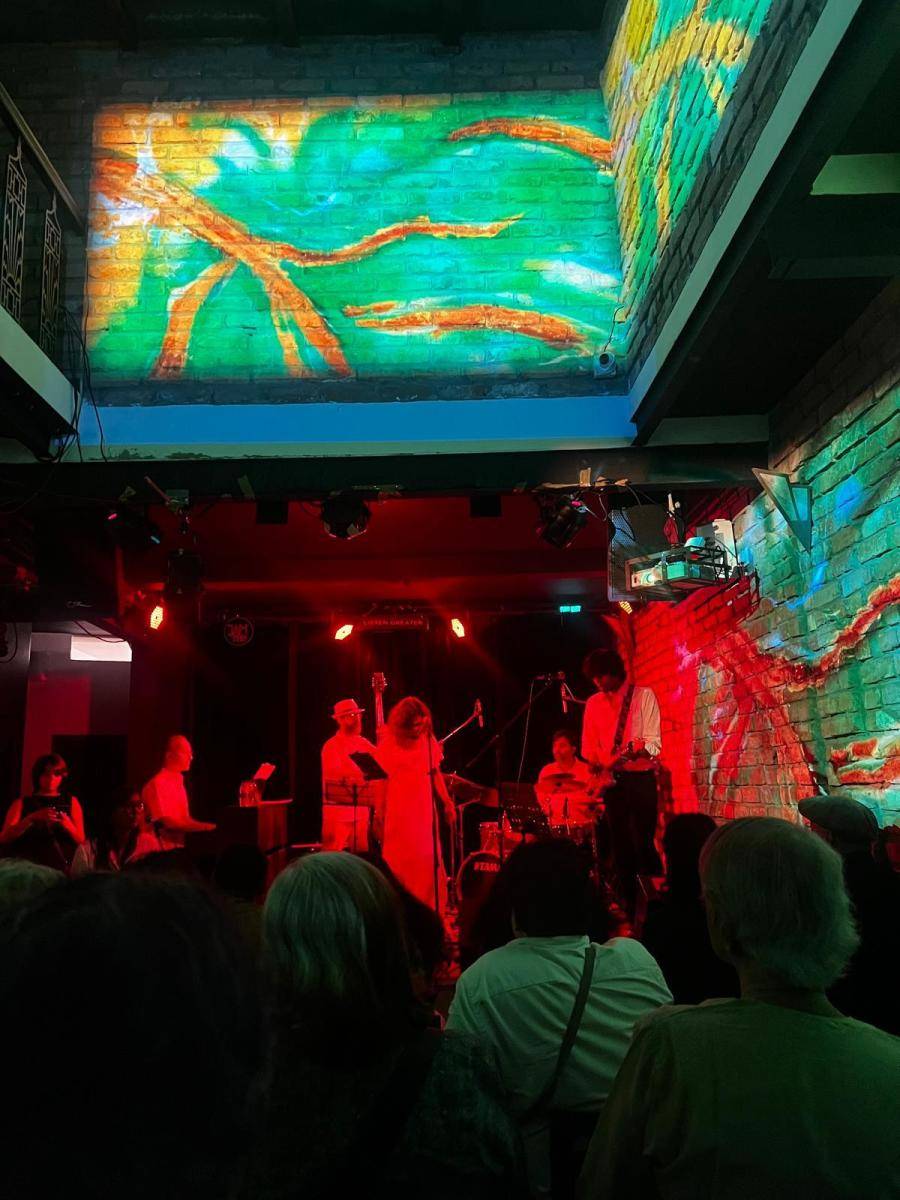
Then Arunima left campus like all have to for the big bad world outside, bravely opting for music as a profession, gradually but surely making a name in the Saturday Night Blues Band that electrified Someplace Else and other places elsewhere, and more recently, in Fender & Friends and Disco Inferno. Out of the blue, she invited me with family to her Faerie Tale, “a musical in a pub”, at Skinny Mo’s. A novel idea for Indian rockers, who rarely venture into ambitious concept concerts, it is not a theatrical musical but more an art event incorporating her paintings, a narrative using her own poetry and a set list of songs curated by her to fit the storyline, and a quartet backing her lead singing.
Such triple artistry has eminent precedents, of course: we only have to remember one of Arunima’s role models, Joni Mitchell, singer-poet-painter, or Miles Davis and Bob Dylan. We entered Skinny Mo’s and saw the mostly small-sized paintings hung on a wall, abstract images convoluted or distorted, like the artist is trying to work out who and where she is.
The swirls, serpentine twists and turns, are almost musical, variations on a theme, the brightness of colours struggling to break through darkness. Uttaran De’s animations of the art projected on the walls created an immersive experience not found at regular gigs. Then, when we hear the trajectory of the songs, we realise that Arunima’s artwork reflects it.
Faerie Tale is in three chapters: “Dependance” (deliberately punning on dance), subtitled “The Child”, “Addiction (The Girl)” and “Recovery (The Woman)”. It traces the journey of a girl through life, her friendship with a boy, the heartbreak of love gone sour, and the aftermath of self-restoration, captured in Arunima’s only original song, Reflection in Chapter 3, whose chorus goes:
When I look in that mirror
I can only see a stranger
Pick up the pieces
Won’t you help rearrange her.
Four of her poems intersperse the 17 songs and reveal her fluency with imagery, the objectivity of which often works better at expressing emotions than the subjective confessional mode. Thus, in Chapter 1’s Grasshopper’s Song:
The ladybird she knows
It’s almost time for the big feast;
But the grasshopper,
He is kind;
He will sing her to sleep.
Also in Chapter 1, the poem Want does a similar thing:
… jackals cry for carrion flesh,
But the she wolf she pines only for
The fair hands of the moon
She can never possess.
In Chapter 3, the poem Silence finally attains a sense of peace:
When there is comfort in the lack of conversation,
There lies the true language of love.
Since the poetry and songs convey her themes so well, Arunima could delete the duplication of the narration’s stress on achieving self-realisation towards the end.
The show underway at Skinny Mo’s
Time to examine the songs, belted out passionately in Arunima’s resonant timbre. 13 of 17 came from the turn-of-the-millennium blues-jazz repertoire of Bonnie Raitt, Diana Krall and Norah Jones. But what struck me was that the three ladies themselves composed only five of these songs (Raitt’s Circle Dance, Krall’s The Girl in the Other Room and Jones’ Come Away with Me, Sunrise and What Am I to You). Add the very appropriately chosen You’ve Got a Friend by Carole King — in a bringing-the-house-down surprise duet featuring Tanya Sen’s simply awesome tremolo — and Joni Mitchell’s Black Crow (in Krall’s version), plus Arunima’s Reflection, to total eight. In other words, men wrote over half the playlist, ironically even the great 1930s standards associated with divas: My Man’s Gone Now by Porgy and Bess composers Gershwin and Heyward, and Why Don’t You Do Right by Delta bluesman Kansas Joe McCoy.
This made me think, as a director, I would have pushed Arunima to select songs exclusively by female lyricists, to go with her gynocentric theme. No, I’m no man-hater, but such a decision would make Faerie Tale 2.0 truly innovative, if not unique. It would also match the amazing progress of women singer-songwriters in this century to top-of-the-line visibility, from the 1970s when such icons as King and Mitchell numbered a small minority. Just to paint this broader picture, I present, in order of descending age: Beyoncé, Taylor Swift, SZA, Cardi B, Charli XCX, Ariana Grande and Olivia Rodrigo, who have stormed the bastions of male-dominated music, each with her brand of confessional songwriting.
True, they occupy the pop-hip-hop end of the spectrum, away from Arunima’s forte (and their liberal sprinkling of 4-star vocabulary hurts my delicate ears). But as her old prof, I shall suggest the following classic albums more attuned to her style, to expand her range and versatility. Going back to 1984, avant-garde performance artist Laurie Anderson’s Mr Heartbreak. Moving to her favoured period, Raitt’s Luck of the Draw (1991), the R&B of Meshell Ndegeocello’s Peace beyond Passion (1996), Cassandra Wilson’s original ballads on New Moon Daughter and Travelling Miles (1996-99), and alternative pioneer Björk’s Vespertine (2001). Closer to now, Adele’s torch songs on 21 (2011) and jazz vocalist Esperanza Spalding’s Radio Music Society (2012). What variety, all writing about love, loss or betrayal, and resurrection.
Arunima has a fine accompanying band, suited to power the jazz-blues technique of backbeat and improvisation. Young Berklee- and Berlin-trained guitarist Aditya Majumdar launched solos demonstrating a greater vintage than his years. We found him waving towards us; I didn’t recognise him at all, and felt certain he had someone known to him behind us. Lo and behold, he came up to my wife later to reintroduce himself to his schoolteacher, who last saw him when he was three feet tall. Another teacher moment!
The rhythm section of veteran bassist Mainak “Bumpy” Nag Chowdhury and drummer Premjit Dutta gel with energy; Bumpy told me proudly that he was inaugurating his new Stagg upright electric double bass, an impressive instrument indeed. Pianist Shonai seemed more comfortable in the rhythm section than a bona fide improviser who could loosen up and let go. Bodhisattwa Ghosh, the director, contributed musical inputs and recorded the poems’ voice-overs and ambience, but he should raise the treble sound mix to allow the lyrics greater comprehensibility. The narrator of the prose links, acclaimed screenwriter Arpita Chatterjee, needed more drama and modulation (I can tell her like it is, for she’s another student of mine!).
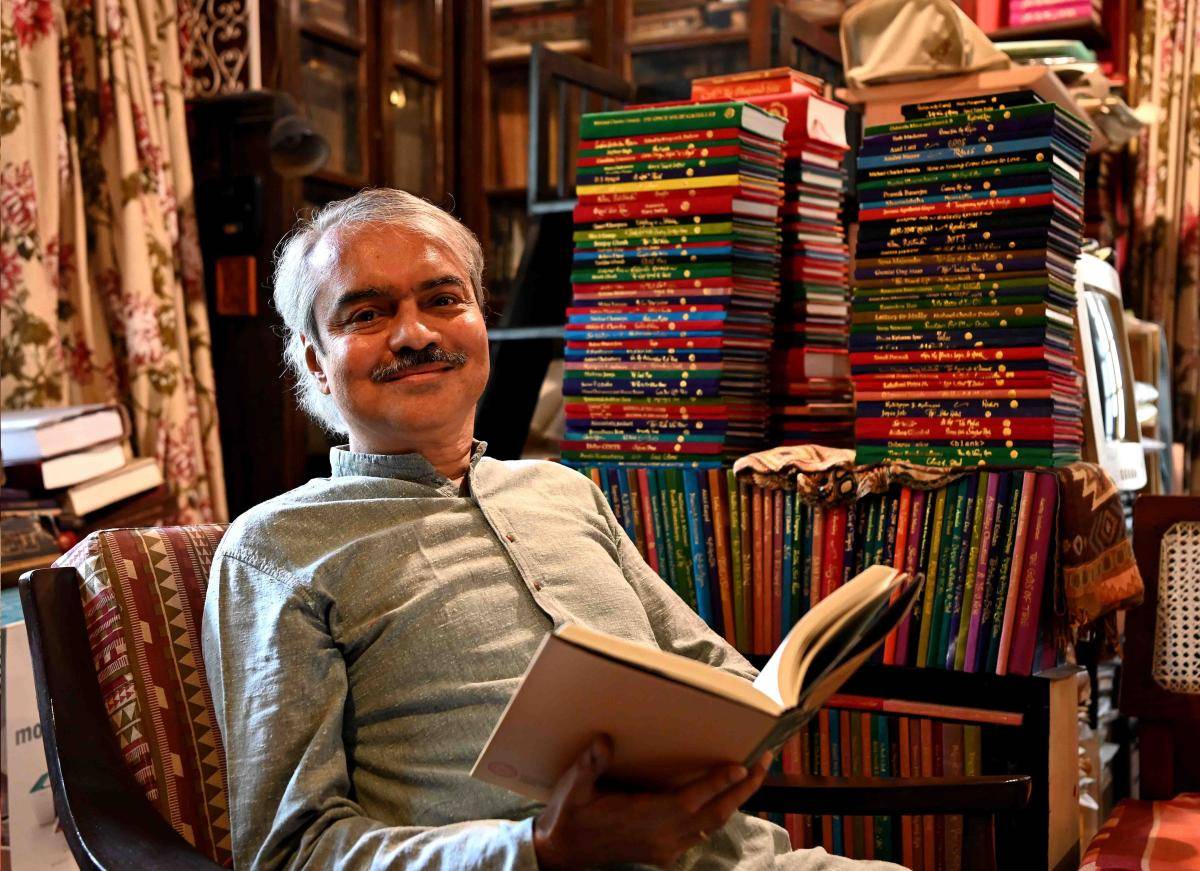 Ananda Lal
Ananda Lal still nurses his huge hoard of LPs, cassettes and CDs that he started collecting in the 1960s. He reviewed rock and jazz for The Telegraph in the last century and wrote research essays on Indo-jazz and Indian influences on Western music. He taught a course on the poetics and politics of rock in JU.
‘ The preceding article may include information circulated by third parties ’
‘ Some details of this article were extracted from the following source t2online.in ’