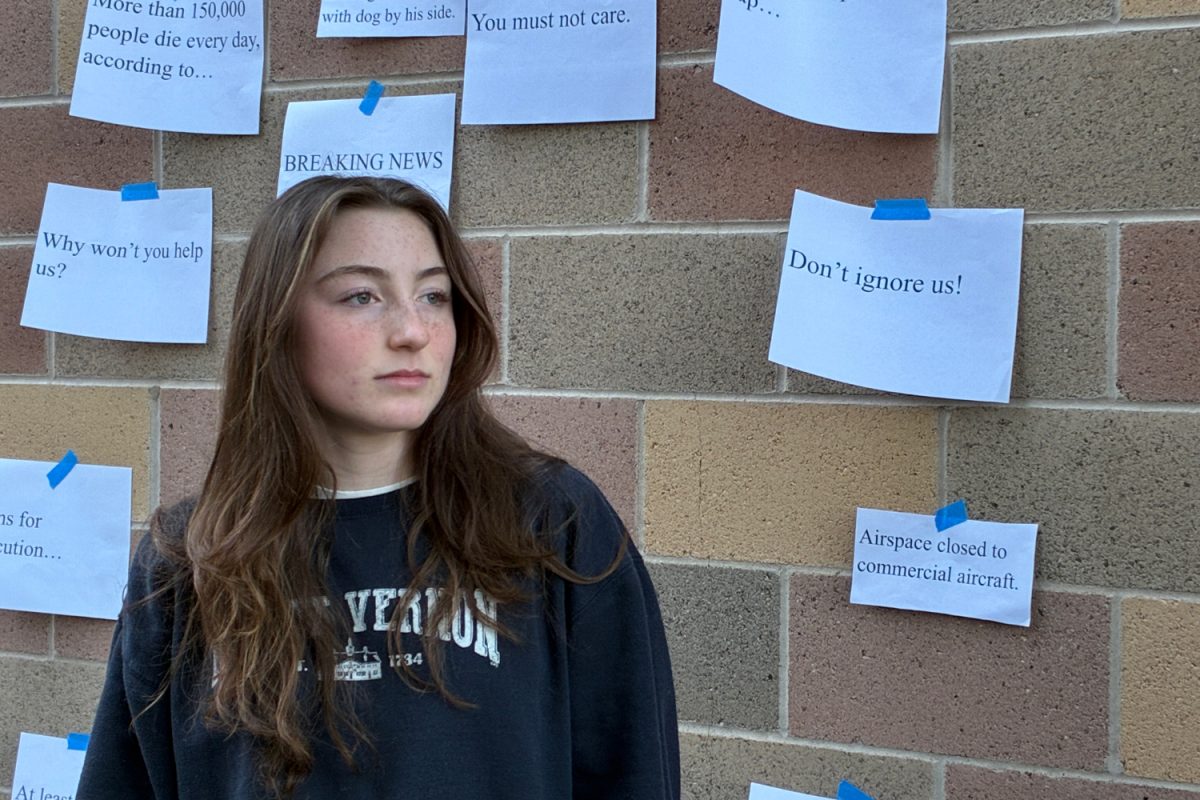
Following a dramatic increase in popularity over the last decade, social media has redefined the news standard.
Traditionally, platforms such as the Associated Press (AP) and Reuters have set the expectations for news since their inception in the mid-1800s: accurate, fast, and accessible to the public. Yet, according to the Pew Research Center, more than 20% of Americans currently use social media as their primary source of news.
Although social media has long existed as a form of communication, it is predominantly used for entertainment. While platforms such as TikTok and Instagram have become the pinnacle for alternative learning and encouraging challenging conversations, they were not designed to be our daily dose of tragedy.
So what does it mean for us if we get all of our news from social media?
According to the American Psychological Association (APA), media overload, whether through social media or traditional news platforms, has detrimental impacts on mental health. As the gravity of daily newsworthy reports increases, it has become incredibly common for people to associate news with a spike in anxiety, depression, and an overall sense of being overwhelmed. A 2022 study published by a professor of psychological science and his colleagues at the University of Vermont determined that exposure to news on social media is directly linked to increased depression and post-traumatic stress disorder (PTSD) symptoms.
Unfortunately, I am not surprised that this is our reality. The digital world has become the trademark for younger generations, with almost half of teenagers saying they are online nearly constantly, according to the Pew Research Center. With the amount of time many spend online, news reports are impossible to avoid, and while social media can be a convenient way to stay informed, constant exposure quickly becomes overwhelming. Instead of responding by turning off our phones, we often turn up the volume and shut off our brains.
That is to say, we have become desensitized to tragedy. One reel may showcase the newest game, and the next will feature live footage of a bombing in a distant country. The degree of separation created by traditional news platforms is absent in modern digital media, forcing us to absorb the most tragic parts of reality without any warning.
The harm of consuming news through social media is not only in its volume, but also in the ease with which emotion can influence it. While news platforms can be relied upon for accuracy, social media is first and foremost an open form of communication, since anyone can use it.
On these platforms, it takes mere seconds to convey an opinion, and when emotions are high, opinions are often exaggerated. Although exaggerations may begin as a method of communication, they are also the simplest form of fabrication. Over time, this cycle overwhelms our ability to process tragedy with clarity and sustained empathy.
Therefore, it is unsurprising that this version of media is incredibly effective at gathering support since shocking news is honey for sympathy. Now that isn’t to say that exposure by force is never beneficial. Social media has challenged people to confront the painful realities of our society, fostering empathy and motivating them to take positive action.
Yet, our current use of social media has turned individual versions of reality into a messy amalgam of opinion and fact; discerning between them, it seems, is harder than ever. And because of our reliance on social media platforms, we will only become more comfortable being exposed to these harsh realities, blurring our definitions of right and wrong, until one day, tragedy might become our primary form of entertainment.
‘ The preceding article may include information circulated by third parties ’
‘ Some details of this article were extracted from the following source scotscoop.com ’