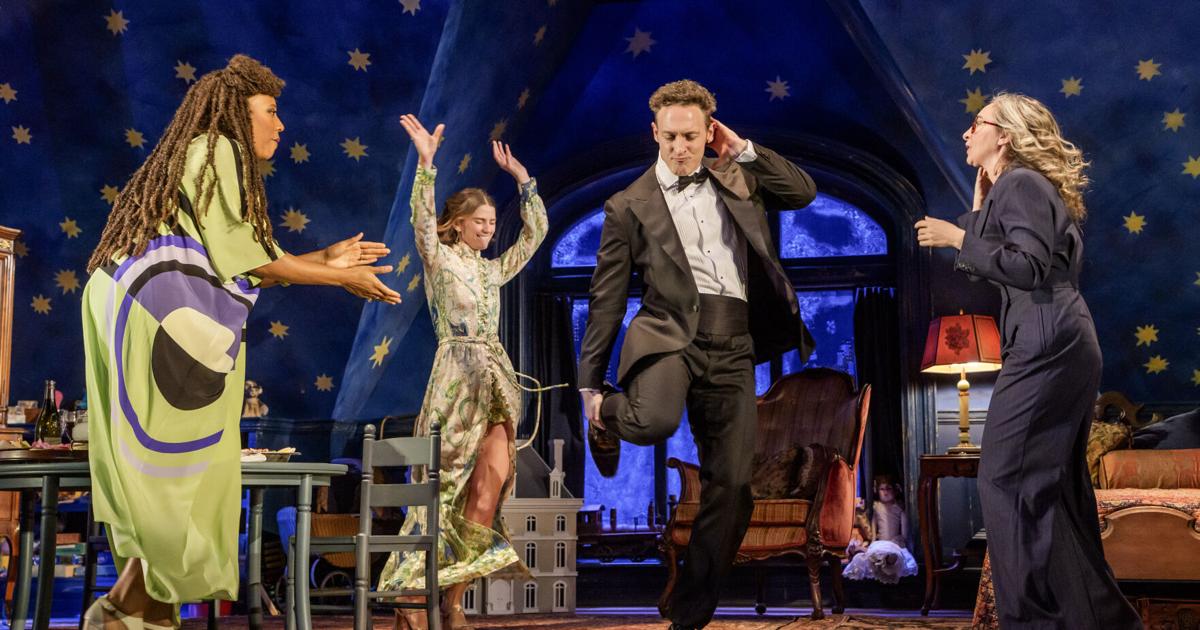
If you love the 1938 romantic comedy “Holiday,” directed by George Cukor and starring Katharine Hepburn and Cary Grant, you may have qualms about the updated version of Philip Barry’s 1928 play Goodman is staging as part of its centennial season.
I do.
Billed as “adapted” by the late Tony Award-winning playwright Richard Greenberg (“Take Me Out” and many others), this “Holiday” is basically a new work built on the bones of the old one. It’s smart, witty, timely and relevant, but doesn’t really contribute much to our understanding, and its multitude of topical references are likely to become outdated as quickly as one can say “AI.”
The main reason for Goodman’s choice may be rather whimsical. Barry’s play, which the theater has produced several times, is almost a century old, so why not reinvent it for its centennial? Greenberg was the perfect person to take on the type of characters and milieu familiar to him; his death was a tragedy that left some questions unanswered (like why he makes Linda the older sister when in the play and movie, she’s younger than Julia).
Robert Falls, Goodman’s artistic director for 35 years, returned to direct a script that’s very much in his wheelhouse with its large cast and distinctive characters. He’s assembled a talented ensemble and, as always, the staging is impressive, starting with Walt Spangler’s sets of a Fifth Avenue mansion’s serene, cream living room and fantastical attic playroom with its blue-painted starry sky.
Set around New Year’s 2020, just before the pandemic, Greenberg’s story follows the outline of Barry’s but changes the details. Before the action begins, lawyer and self-made man Johnny Case (Luigi Sottile) has met and become engaged to Julia Kincade (Molly Griggs), an entrepreneur he met on a visit to a wellness spa out west, a gift from friends who thought he was working too hard. Because she was using her professional last name, he didn’t realize Julia was one of the ultra-rich “Setons” until he comes to lunch, where he meets her free-spirited sister Linda (Bryce Gangel), an artist who lives in Red Hook, Brooklyn, and works with children, though she returns frequently to the family home to make sure their alcoholic, substance-abusing younger brother Ned (Wesley Taylor) is okay.
A clash of values emerges as Johnny is interrogated by Seton patriarch Edward (Jordan Lage, looking like Daddy Warbucks). Johnny explains that he wants to make a big pile of cash, which he’s well on his way to doing, then take a “holiday” from work to really live, even if he isn’t sure yet what that means. Julia and Edward don’t get it; Linda and Ned do.
Greenberg enhances the arguments — and opportunities for humor — with characters on both sides. Lunch guests also include the Seton children’s insufferable cousin Seton Cram (Erik Hellman, hilarious) and his even worse wife, Laura (Alejandra Escalante), while welcome guests at the New Year’s Eve party are the lesbian couple — fundraisers Nikka Washburn (Christiana Clark) and Susan Held (Jessie Fisher) — friends separately to Linda and Johnny. Rounding out the group is the young private chef Walter (Rammel Chan), who unfortunately believes Edward’s suggestion that they start a restaurant together.
Everything comes to a head at the New Year’s Eve party, which has turned into a gargantuan affair (mostly downstairs and unseen), despite Julia’s promise that she would let Linda throw her a small gathering of just the closest friends and family. While Johnny’s sympathy for Linda and failure to fully support Julia’s position creates a rift between them, the real focus is on Linda’s heartbreak over the loss of her mother and desperate desire to hold onto something of her own. Ned, the truth teller of the siblings, talks about the loss with a moving mix of bitterness and poignancy, and Taylor’s performance here and elsewhere is the highlight of the evening.
The other performances are generally solid, and Sottile’s Johnny has his moments. But the whole evening comes across as a little flat, and all the mentions of modern technology don’t help. In fact, even though Johnny and Julia had their phones confiscated at the spa, I found myself wondering why they didn’t Google each other as soon as they got home. They could have avoided a lot of disconcerting surprises.
On balance, Goodman’s “Holiday,” which may be New York-bound, strikes me as an interesting exercise but maybe not worth all the effort. The movie has so many star turns and such wonderful sets and costumes, I’d almost rather watch it again, much as I love live theater.
‘ The preceding article may include information circulated by third parties ’
‘ Some details of this article were extracted from the following source www.hpherald.com ’