Theater review
Please know that I say this as a committed and lifelong lover of musical theater, but adapting any story into a musical rarely makes that story less hokey, no?
In the case of “The Notebook,” a musical adaptation of the 1996 novel by Nicholas Sparks (and a 2004 film starring Rachel McAdams and Ryan Gosling), the tumultuous love story of Noah and Allie, who should have been divided by class and circumstance, has been reduced, like an oversimmered sauce, to its syrupiest self.
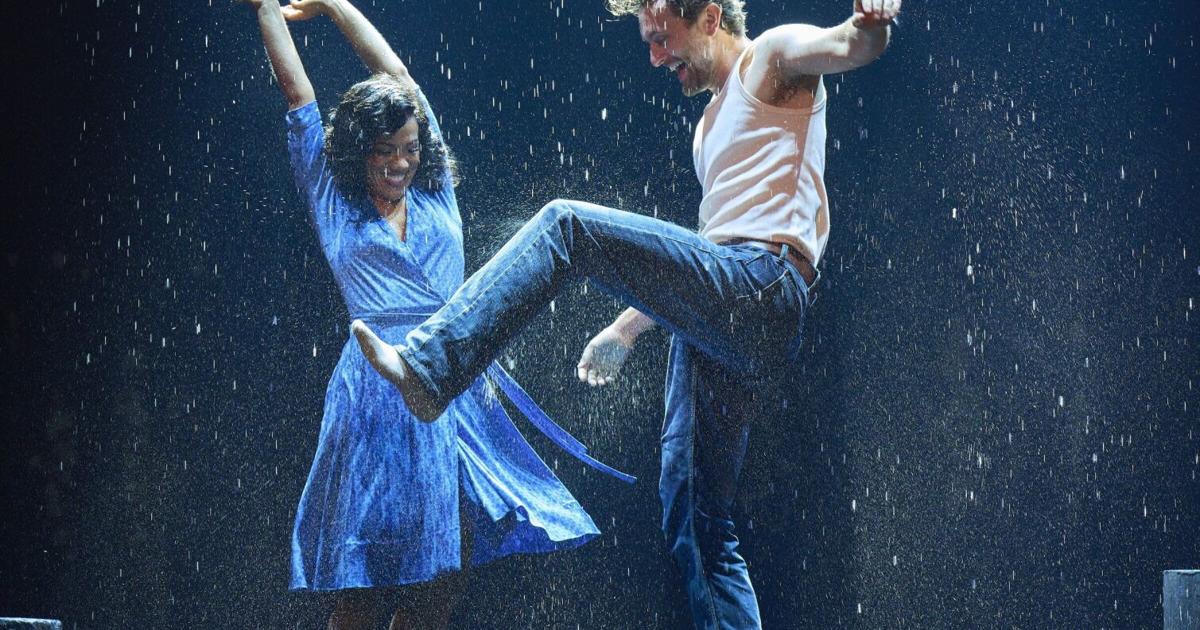
As adapted by playwright Bekah Brunstetter and composer Ingrid Michaelson, this “Notebook,” which debuted on Broadway in 2024 and is currently showing at the Paramount Theatre, has been reset to align more closely with the generations alive today. Noah fights in the Vietnam War rather than in World War II, so it’s the 1960s when teenage Allie and Noah (Chloë Cheers and Kyle Mangold) meet and fall hard for each other one summer.
But the story begins, instead, near the end, as older Allie (Sharon Catherine Brown) and older Noah (Beau Gravitte) look back on their lives together with the help of a book Allie wrote to remember their love story as dementia erodes her memory. (Brown and Gravitte also deliver the strongest performances in the show, providing a warm and welcome anchor.)
They (and thus, we) watch teenage Noah and Allie meet and bam — fall in love, no hesitation, no friction or questions asked. We watch their young adult selves (called “Middle Allie” and “Middle Noah” in the script) reconnect after 10 long and longing years spent apart after upper-class Allie (Alysha Deslorieux) went off to college and working-class Noah (Ken Wulf Clark) went off to fight in Vietnam.
By having older Allie and Noah on stage most of the time, observing the proceedings of their younger selves, Brunstetter and Michaelson (along with directors Michael Greif and Schele Williams) have turned the piece more squarely into a memory play, which, in a story about dementia, is a tricky and potentially fascinating thing.
Brunstetter, a talented playwright who also spent several seasons with the TV drama “This Is Us,” knows well how to work in flashback. But more and more throughout the show, all three couples appear on stage at once, a visual representation of the passage of time and the way our former selves are always alive in us — “How’d I get from you to me?” Middle Allie sings to her teenage self — which is a piece of theatrical symbolism that’s most effective when used sparingly.
Though this show clocks in slightly longer than the film, it somehow manages to tell much less story, both literally and emotionally, and is not helped by Michaelson’s songs that do little-to-no narrative work.
I’ve been a fan of Michaelson’s folk-pop songwriting in years past, but the talents of a singer-songwriter don’t always translate into a strong, cohesive and compelling musical theater score. There was so much looping and repeating that it seems like Michaelson wrote about 45 minutes of music and lyrics for the two-plus hour show, which theoretically holds some narrative import for the swirling memories of an Alzheimer’s patient but practically restrains any forward momentum.
We barely get to know Allie and Noah as people, let alone understand why they love each other, the forces that conspire against them. The same can be said for the other characters that give this story its texture: Allie’s meddlesome, regretful mother; Noah’s thoughtful, autodidactic father; Allie’s fiancé Lon, who needs to be an appealing option to make Allie’s choice to return to Noah a difficult one, but in this version was so unimportant he could have been played by a cardboard cutout.
The story has its shimmering moments — “where do we go, when we go?” the Noahs and Allies sing near the end — but ultimately the couple’s only adversary is time, which is, unfortunately, not a particularly compelling dramatic foil here.
Also lacking was any sense of the ostensibly undeniable chemistry these two feel for one another. When middle Allie shows back up at the house Noah built for her after 10 years apart, she sings, “In that shirt, in those pants/I wanna rip ’em off/With my teeth,” and it’s just ersatz horniness, the epitome of telling instead of showing, and reminded me how much Gosling and McAdams’ acting talents did to elevate the source material in the film. Musicals are all about singing the things you cannot say, but sometimes subtext is better left to the imagination.
‘ The preceding article may include information circulated by third parties ’
‘ Some details of this article were extracted from the following source www.yakimaherald.com ’