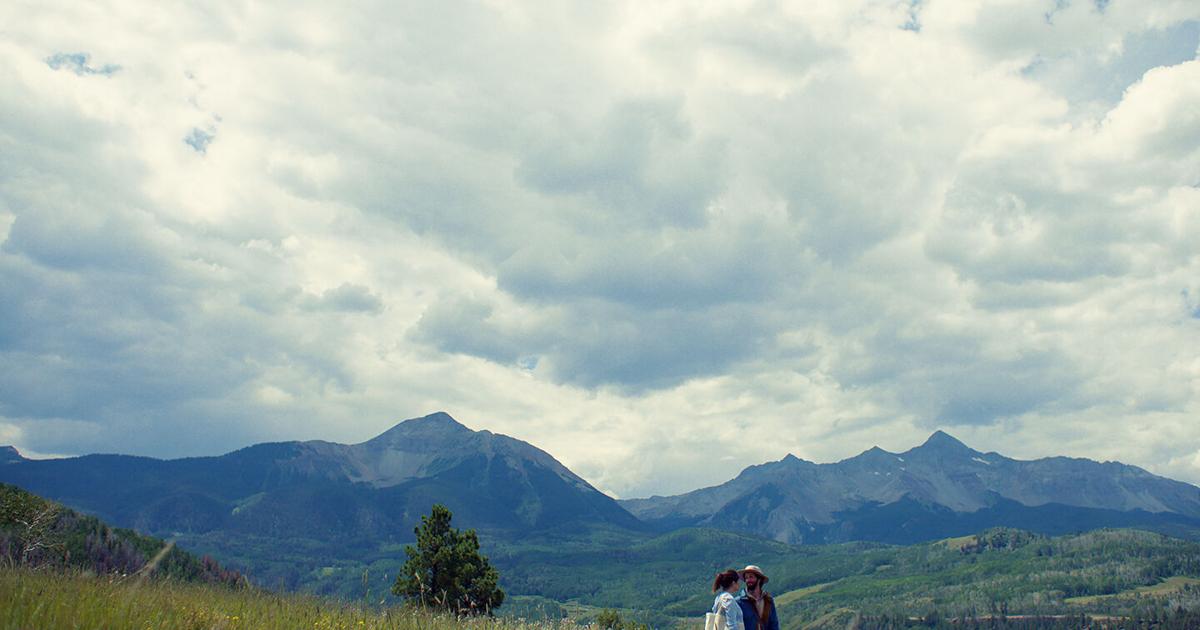
With Mt. Sunshine and Mt. Wilson in the distance, a couple forages for mushrooms on a summer day in Carlos Cagin’s film “Foragers,” which will have its world premiere at Aspen Shortsfest. It plays Wednesday at 4 p.m. at the Wheeler Opera House.
Aspen Shortsfest is an international affair. Twenty-five different countries are represented in the lineup.
“Community Theatre” follows the stories of members of a seaside community in Scotland. “Sand Dog” takes place in the ghettos of Africa. “Mango Seed” tells the story of Chinese immigrants in Australia.
There also are several homegrown Colorado films in the program. “The Meloneers” turns the lens on the proud high school wrestling heritage in Rocky Ford, a community best known for the quality of its melons. “Gatorville” takes place in the rural town of Mosca and follows two siblings living in an alligator sanctuary.
A third Colorado film, “Foragers,” will have its world premiere at Shortsfest on Wednesday at 4 p.m. It follows a much more familiar narrative — two people set out on a hike together and over the course of the stroll they open up and begin to unveil sides of themselves they’d previously kept hidden. Secrets are revealed and by the end of the day the nature of their relationship has completely changed from when they set out on their sojourn.
“Foragers” is the directorial debut of Carlos Cagin, a native of Telluride, which is where “Foragers” was shot. The film follows a daylong hike between Asher and his girlfriend Mikaela, a couple in their 20s, as they forage for mushrooms on a summer day.
Cagin said there is something about a long day spent hiking in nature that tends toward more deeper conversations.
“When you have a lot of time and space and are walking around these eternal landscapes that have been there long before us and will be there long after us, it leaves a lot of room for existential thinking and sets the mood for the big question,” he said.
Asher has brought Mikaela to his hometown in the mountains to meet his parents, a scenario that can’t help but bring up questions about their future as a couple. Those answers become less clear over the course of the 13-minute film.
Surrounded by cinema
Growing up, Cagin learned how to forage for mushrooms. He also was exposed to cinema on multiple levels.
Telluride is home to Mountainfilm and the Telluride Film Festival, which are both widely regarded as two of the greatest film festivals of their kind.
“For all the things that are great about Telluride, it can be pretty secluded and isolated from the world,” Cagin said. “I think those two festivals really felt like the world came to me. It really ingrained this idea that movies and filmmaking were a way to connect outside the box canyon, and I think that really drew me to film in a big way.”
Just as influential as what he saw on the screen were the moments between screenings such as chance encounters with filmmakers, like sharing a gondola ride with Guillermo del Toro. Those encounters helped demystify the industry and make a career in film feel tangible.
The reality of pursuing a career in the film business was further enhanced by the fact that Telluride is considered by many as the nation’s most creative and dynamic high alpine filmmaking community. The town has generated a wealth of filmmakers whose films have played all over the world.

Carlos Cagin was born and raised in Telluride where he was inspired by the town’s film festivals and active filmmaking community. He represents a new wave of Telluride filmmakers that are making narrative films.
Between last September and the end of April, three new films by filmmakers whose roots can be traced to Telluride will have played festivals in the Roaring Fork Valley. Max Silverman’s film “Rebuilding,” about a man trying to put his life together after a wildfire destroyed his family’s land, played at the Aspen Film Festival in September. Cagin’s film is playing Aspen Shortsfest. And longtime Telluride resident, photojournalist and award-winning filmmaker Ben Knight will screen his film “Best Day Ever” (which has been racking up awards around the world) at 5Point in a few weeks.
Still another Telluride film, Brent Englund’s film “When Dishwashers were Kings,” which looks back on the halcyon days of the 1990s in Telluride, is planning an Aspen screening in the coming months.
In short, more films that have roots in Telluride have been made in the last year than most ski towns have yielded in a decade.
Shift from nonfiction to fiction
Cagin is the son of Marta Tarbel and Seth Cagin, journalists who over 30 years published The Telluride Times Journal and later the Telluride Watch. Due to his parents’ background in journalism, Cagin was initially drawn toward documentary film.
After graduating from Phillips Exeter Academy in 2007, Cagin enrolled at New York University with plans to pursue a degree in journalism, only to find himself navigating an industry in flux. As digital media reshaped the news landscape, he gravitated toward an interdisciplinary focus on “New Media and Globalization,” exploring storytelling across different platforms. A professor named Yamane Demissie became Cagin’s mentor.
After graduation, Cagin spent much of his time working on a media literacy initiative, including a pilot program in South Africa where he taught students to create documentary films. The experience reinforced a core belief that filmmaking could bridge cultural and geographic divides.
Years later, Cagin’s NYU mentor Demissie encouraged him to apply to film school and Cagin returned to NYU’s graduate film program at Tisch.
There, Cagin shifted his focus to narrative storytelling. “Foragers” is his third film and his thesis project. “This is the first one I feel like I can stand behind,” he said of “Foragers.”
After years of looking outward toward global stories set in distant locations, Cagin turned to his hometown of Telluride to tell more intimate stories.
“There’s something about coming back home and asking, ‘What’s my connection to this place?’’’ he said. “And how can I share it with people, rather than thinking about how to get content from other parts of the world back to the valley? I really wanted to try shooting something in Telluride for all its challenges and the opportunities that it allows.”
The story in “Foragers” draws loosely from Cagin’s personal experience, particularly his familiarity with foraging and the rhythms of life in the mountains. While Cagin has brought a girlfriend back home to meet his family before, the emotional fireworks that the couple in “Foragers” undergo on the hike are fictional.
Cagin was getting over a breakup when he wrote “Foragers.” The project provided some catharsis, which he hopes might rub off on audiences.
“I wrote this from a place of really being stuck on something, psychologically and emotionally,” he said. “The process of making the movie helped me unstick it. Hopefully people are able to take something from the film and realize that there are these things that happen to us in our lives that can be challenging or traumatic, but we can find a way to accept them and find our place in the world and then move on in a positive way.”
‘ The preceding article may include information circulated by third parties ’
‘ Some details of this article were extracted from the following source www.aspendailynews.com ’