Movie review
So you want to make a film adaptation of a literary classic. What path do you take in tackling it?
Perhaps, out of a well-intentioned reverence to the text, you hew as close as possible to the original writing, staging key scenes and lifting memorable dialogue already familiar to readers. Alternatively, perhaps you attempt to directly confront the source material, holding it up to the light to see what may emerge between the words on the page. Or, if you’re director François Ozon, the prolific, often provocative French filmmaker behind everything from “Swimming Pool” and “Time to Leave” to the recent “The Crime Is Mine,” and you’re adapting Albert Camus’ 1942 novella “The Stranger,” you say: Why not do both?
The result is a film that’s both incredibly faithful to the acclaimed book and also quietly radical in how it expands on many of its existing ideas. It follows the same broad strokes of the story, centering on Meursault (Benjamin Voisin), who seemingly doesn’t care about anything in the world as he goes from dealing with the loss of his mother to shockingly taking the life of a stranger in French-occupied Algeria in the 1930s. But it also proves new in ways that burrow into your subconscious. Yes, “The Stranger” is about a man who is frighteningly passive about nearly everything around him as he merely drifts through his own life. However, Ozon’s film is anything but lifeless. With each subtle yet significant addition, it proves cracklingly, urgently alive in a way most other literary adaptations could only dream of.
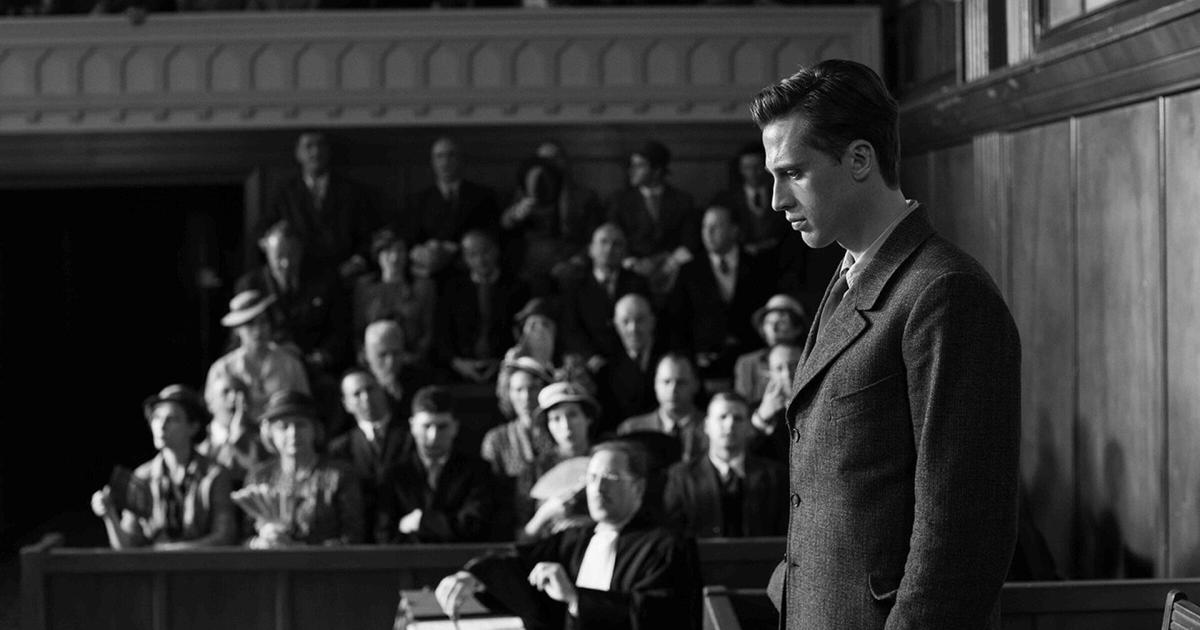
Ozon’s latest is a vibrant vision of casual yet disquietingly haunting historical nightmares. Shot in beautiful black and white by cinematographer Manu Dacosse, the monochrome visuals contain mesmerizing depths, and a growing menace. From the opening moments when we are shown archival footage of 1930s Algiers, it becomes clear Ozon is seeking to genuinely wrestle with the text, its place in history and what its late writer might not have seen.
Eerily chippy narration informs us of how the city of Algiers was once a “small, ancient town,” though it is “now so much more!” as “France has opened it up.” Now, it all seems more “Parisian,” ensuring tourists are able to indulge in the beauty of the locale while not having to think about the Indigenous Algerians who remain a present part of the bustling city.
The juxtaposition between the words and the images we’re seeing sets the stage perfectly for our introduction to Meursault as he is led into jail. Though this is a film about him, it’s also about the context he is swimming in and in which Camus was writing. Meursault’s first words — “I killed an Arab” — are delivered without even a hint of remorse, lacking any acknowledgment of the humanity or personhood of who he killed. Ozon’s film then becomes about putting this on trial and asking why it was that the book’s protagonist is seemingly punished not for taking the life of another person, but for not sufficiently playing along with how he could get away with it. It confronts the dark absurdities of this process while finding small slivers of humanity that Camus himself may have overlooked.
Complimented by Fatima Al Qadiri’s evocative score, which rises in at key moments and instills the film with a growing dread, “The Stranger” is a living, breathing evocation of the source material and an effective expansion on it. Its closest modern equivalent is something like the underrated recent William S. Burroughs adaptation “Queer,” but something more ambitiously revisionist is at play here. Even as a couple of moments start to feel like they’re only going through the motions of staging certain scenes, Ozon always finds his way back to something more complicated and alive that’s all his own. Much as Camus did with his captivating prose, you feel the heat radiating in the air, just as you do the coldness forever etched in Voisin’s uncaring visage.
It’s faithful to the book without being overly devout, asking a multitude of deeper, more probing questions while reflecting on the same unsettling and existentialist ones that the book did. By the time it closes with its unexpectedly mournful yet gently searing final frames, reinterpreting and expanding on the enduring source material one final time, it names all that Camus did not.
‘ The preceding article may include information circulated by third parties ’
‘ Some details of this article were extracted from the following source www.yakimaherald.com ’