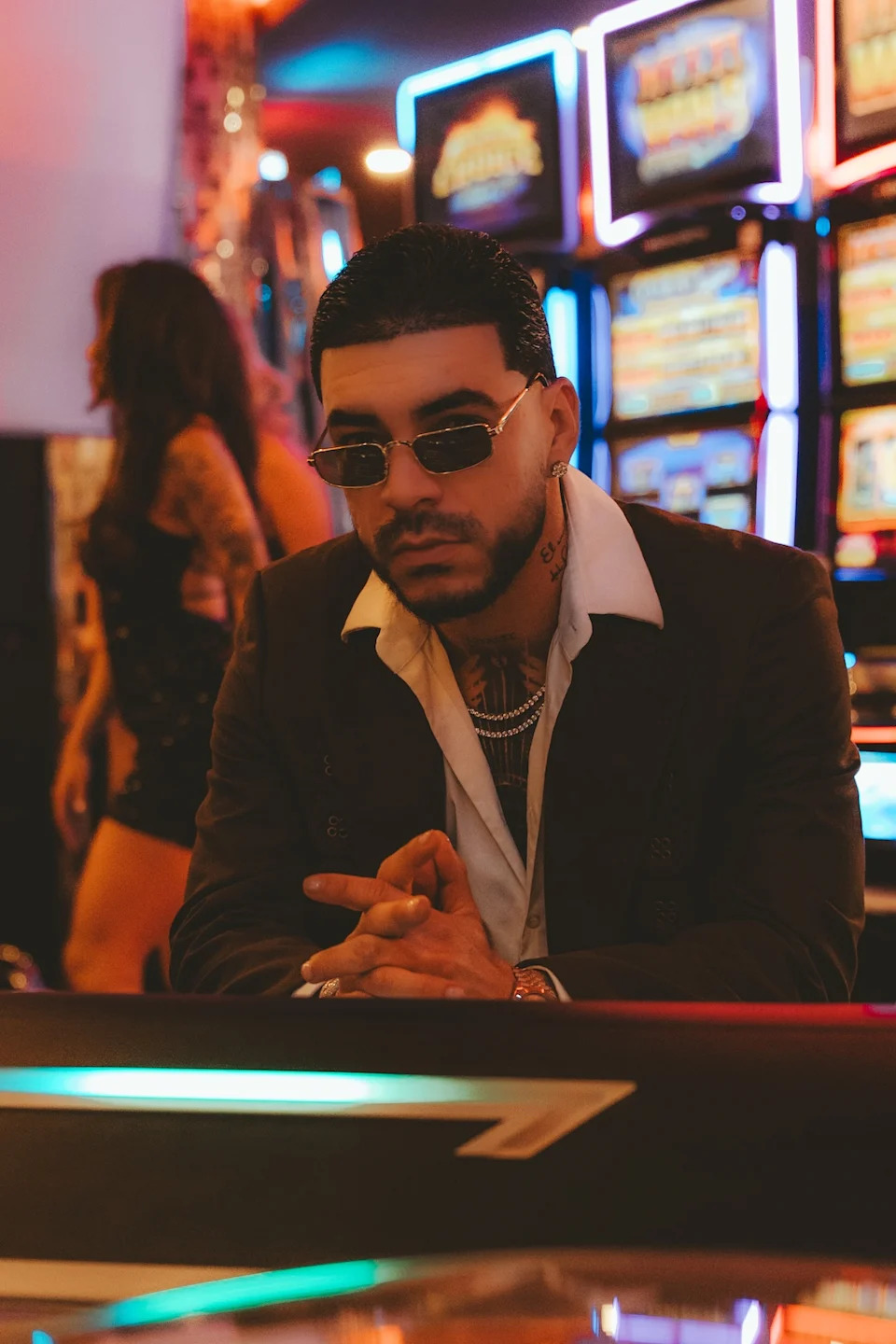
Following the past year of a grueling world tour, Ryan Castro has come home. The Colombian superstar sold out Medellín’s Estadio Atanasio Girardot on April 25, with 47,000 fans waiting to dance to his unique mix of reggaeton hits and dancehall smashes. That rare blend of street and Caribbean culture is also reflected in Castro’s style, such as a necklace of icy bling tucked under his bright yellow suit. The five-hour concert was sandwiched in between performing during Karol G’s headlining set at Coachella and dropping a collaborative album, Omerta, with Medellín icon J Balvin on May 7. While there’s a lot resting on Castro’s shoulders, he always sees the most important moments in his career as something that’s bigger than him.
“I’m not putting on a Ryan Castro concert, but I’m putting on a concert for the people from the barrio [hood] and people that are fighting for their dreams,” he tells SPIN from backstage at the Estadio Atanasio Girardot. “It’s a party for the city that raised me and has supported me since the beginning of my career. I’ve worked a long time to make this moment happen.”
More from Spin:
(Credit: El Skinny)
Before becoming a global phenomenon, Castro was born and raised in the barrio of Medellín. The music that he grew up on was reggae, rap, and dancehall from Panama and Jamaica. The first songs that Castro performed were by Panamanian reggae acts like Kafu Banton, El Roockie, and Baroni One Time. In a stark contrast to the massive stage at the Estadio Atanasio Girardot, he started his music career at 17 by singing in city buses around Medellín. That’s how Castro also earned his nickname as “El Cantante del Ghetto,” or the singer of the ghetto.
“I really pushed myself to sing on the bus because of the sounds of the traffic of the people,” he recalls. “I also pushed myself to sing well because I had to capture people’s attention on the bus. I had to break the stigma that people singing in the streets were drug addicts or bad people. I learned a lot from that stage in my life that I still apply to my concerts today. No matter what people say, it’s more difficult to sing on a moving bus than in a stadium.”
As Castro was starting to make his mark in Medellín, the city was becoming Colombia’s reggaeton capital with the success of artists like J Balvin, Maluma, Karol G, and Feid. The first one from that elite group to collaborate with Castro was Feid in 2021, with their hit “Monastery,” which boosted both their profiles in Colombia. A year later, J Balvin took Castro under his wing and put him on a global platform when they performed “Nivel de Perreo” at the MTV Video Music Awards. Maluma and Karol G soon tapped him to add hit-making verses to their song. Castro maintains a strong bond with all of them. J Balvin, Maluma, and Feid were also among the 17 special guests at his homecoming concert.
“It’s an honor, honestly, to have collaborated with them because I grew up watching them,” Castro says. “I grew up looking to them as examples to follow and hard workers. They inspired me a lot to do what I’m doing now. To have friendships with them and get advice from them helped me achieve my dreams and see that I’m in this game with them, too.”

J Balvin and Ryan Castro. (Credit: El Skinny)
While being a pillar of Colombia’s reggaeton scene, Castro also blazed a trail for himself as a pioneer of the country’s dancehall takeover. Not only are his music and flow shaped by Medellín, but also his roots in the Caribbean island of Curaçao. For a number of years as a teenager, Castro moved to Curaçao to be with his mother, who had relocated there when he was a child. While living the island lifestyle, Castro also picked up words from the local Papiamento language. One of his famous call-outs, “Awoo!” is actually a friendly greeting from Curaçao. In his albums Sendé and Hopi Sendé, Castro leaned heavily into reggae and dancehall while paying homage to Caribbean heritage. He has also collaborated with legends of the genres like Shaggy and Sean Paul, who joined Castro to perform Kybba’s fiery “Ba Ba Bad” remix during the concert.
“I want to put more of Curaçao on the map,” Castro says. “That’s the idea. I want to take advantage of my moment to keep giving back to the island that’s given me so many beautiful things. I don’t only represent Medellín, but I also represent the island of Curaçao. I’m very happy that people are learning words in Papiamento from my songs because that’s part of my essence and my culture. For people to learn those words, sing them with me, and make them feel like they’re a part of my universe, I’m very proud.”
A few days before his concert at the Estadio Atanasio Girardot, Castro performed during weekend two of Coachella. Karol G brought out J Balvin and Castro during her headlining set. She described Castro as a representative of Colombia’s “new era” of reggaeton. Castro took center stage and performed his recent smash “Sanka,” which is Papiamento slang for ass. “That was a very special moment for me because I have a great friendship with Karol G,” he says with a smile. “I had so much fun seeing all the Latino and American people in the crowd having a great time when I came out. I’m very grateful to Karol G for inviting me, and that’s also given me the motivation to make Awoo-chella happen one day.”
Now Castro’s latest album, a collaborative project with J Balvin, is his most ambitious yet. The only other artist J Balvin has made a joint LP with is Bad Bunny in 2019. With reverence, Castro says, “Now that Balvin has chosen me to make an album with, I feel like he sees something very special in me. He sees my talent and that I’m original. I’m very proud and to say that I have an album with him is a dream come true.” The title of the album, Omerta, is taken from an Italian code of honor among associates who have each other’s backs. Castro and J Balvin see it more as an expression of their brotherhood. The two artists masterfully fuse their genres of reggaeton and dancehall in songs like the alluring “Pal Agua” and the club banger “Tonto” featuring DJ Snake.
“We had a lot of fun making this album,” Castro adds. “Uniting our worlds was very awesome because culturally we have so much in common. I have my DNA that’s very island and Caribbean, and [Balvin] now lives more in New York and that big city life. We have musical tastes that are very similar. We agreed on a lot of ideas that we both really liked and songs that we’re comfortable singing, performing, and dancing to.”
Castro and J Balvin also shot a short film for Omerta that features one of Colombia’s biggest stars in Hollywood, Sofía Vergara. That may signal where Castro is hoping to go next in his career. “To be acting alongside Sofía and let myself be guided by her, it was a pleasure,” he says. “That moment was a big step for me towards acting. Maybe I’ll do movies and things like that in the future, but what’s most important for me is to cross borders with my music.”
To see our running list of the top 100 greatest rock stars of all time, click here.
‘ The preceding article may include information circulated by third parties ’
‘ Some details of this article were extracted from the following source www.yahoo.com ’