“With less than 24 hours before the much-anticipated Louisiana World Exposition is set to open, the event seems nowhere near completion.” That’s what I heard as I walked through the designated media room, now a part of the Ernest N. Morial Convention Center, on May 11, 1984, the day before the fair was to open.
During that afternoon, there had been a tour for the members of the press. It was supposed to be a joyous moment, but it was mostly a disaster. Laptops had not yet come into existence. I overheard one radio journalist on the phone, yelling his report to be broadcast by his station.
What was being said was not good: “Nowhere near completion.” From what we saw, the reporter was right. On our media tour, we walked past ladders from which painters were applying brush strokes that might not even be dry by the next day. In the background was the cacophony of drills and hammers. This was the noise of panic.
As the tour ended, we were directed to a room where the fair’s executive director, Petr Spurney, addressed the group. (One of the mysteries of the fair that flabbergasted editors was why Spurney did not have a second “e” in his first name.) There was no brush stroke that could cover the disorder that everyone was seeing.
I will always remember Spurney’s words that afternoon: “Do not judge us by what you see today, judge us by what you will see tomorrow.” Those in the media walked away yakking that opening day would be a disaster. There seemed to be no possibility that, during the evening when they were exploring the French Quarter, back at the fair site, a miracle was happening.
I don’t know how, but when the fair opened the next day, Spurney was proven right. The fair, at least what was visible, was ready and sparkling.
A postcard from the 1984 World’s Fair in New Orleans
Back then, celebrity.land delivered TV news continuously in half-hour segments. All day long, the opening story sent to the world showed a monorail racing above a fairground packed with festive people.
In the background, the “gondola”— a line of hanging glass-enclosed capsules that moved slowly above the river from one bank to the other — dominated the view. Slightly frightened passengers were seeing the Mississippi River below as no travelers ever had.
After all the trepidations over constructing and financing a World’s Fair, opening day was a moment of joy. It was a happy beginning whose success, or lack thereof, would be challenged by the press and public between that day and the closing on Nov. 11. But as Spurney might have wanted to say, “judge us by this moment.”
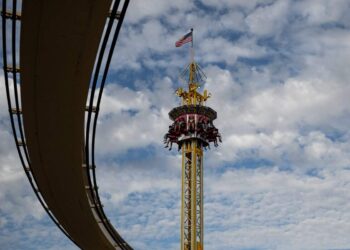
Doing so required an act of faith: A symbol of the fair was the monorail — a trainlike vehicle that ran on a single elevated track that provided the power. Monorails were respected as a forward-looking mode of transportation. Every community seemed to want one. Few ever succeeded, but New Orleans did, at least for the fair.

First-day visitors roam the site at New Orleans’ 1984 world’s fair while the monorail zips by overhead. (AP Wirephoto)
The monorail’s starting point was a depot hollowed out from the top floor of a building called the Federal Fibre Mills on nearby Fulton Street. From there, the vehicle traveled above and around the fair site, making a stop at the new “Great Hall” (destined to be the Ernest N. Morial Convention Center) along the riverfront.
I was excited to ride the monorail on Press Day. Less exciting was when it got to its Convention Center stop, and its automatic doors did not open. We were stuck. Fortunately, someone must have figured out the correct lever to pull, and the vehicle started moving.
As far as I know, the monorail never got stuck again, but that was all that I needed for the experience. I never rode the rail again, but I always admired watching the vehicle roll through and around buildings as though plunging into the future.
My greatest test of mental strength was the gondola. Passengers would climb stairs to a loading platform near the Convention Center. There, a maximum of four riders would get into a vehicle, referred to as a “capsule,” that would be pulled by a cable across the river. (If obsessed New Orleanians would squint their eyes, the sight of a line of capsules dangling from a cable might resemble the world’s largest Mardi Gras beads.)
Not being a fan of riding in a contained unit above a swift river near its deepest point, I nevertheless felt compelled to experience the gondola at least once during the fair. However, I did have another issue to contend with.

The aerial gondola, which soared over the Mississippi River, was one of the fair’s most popular attractions. After the fair closed in November 1984, it became a novel way of commuting to and from work. (Photo by H.J. Patteron, NOLA.com | The Times-Picayune archive)
On opening day, I was walking along the midway when I looked up just as gondola cars were passing. However, the system had stalled. I could see a man in one of the capsules nervously looking out and moving back and forth as though a prisoner. After what seemed like too long a delay, the system started moving again. (In the early days, there would be several “stuck in the gondola” stories.) The image of the man in the capsule stayed with me during the fair. Nevertheless, I remained feeling obligated to take the ride.
I did go to the entrance area a couple of times during the fair, but (shucks) the line was too long. I thought about trying again when the fair was reaching its last days, but the line was too short. Certainly, something must be wrong. I tried, I told myself, but I never got on board.

Seymore D. Fair, mascot of the World’s Fair
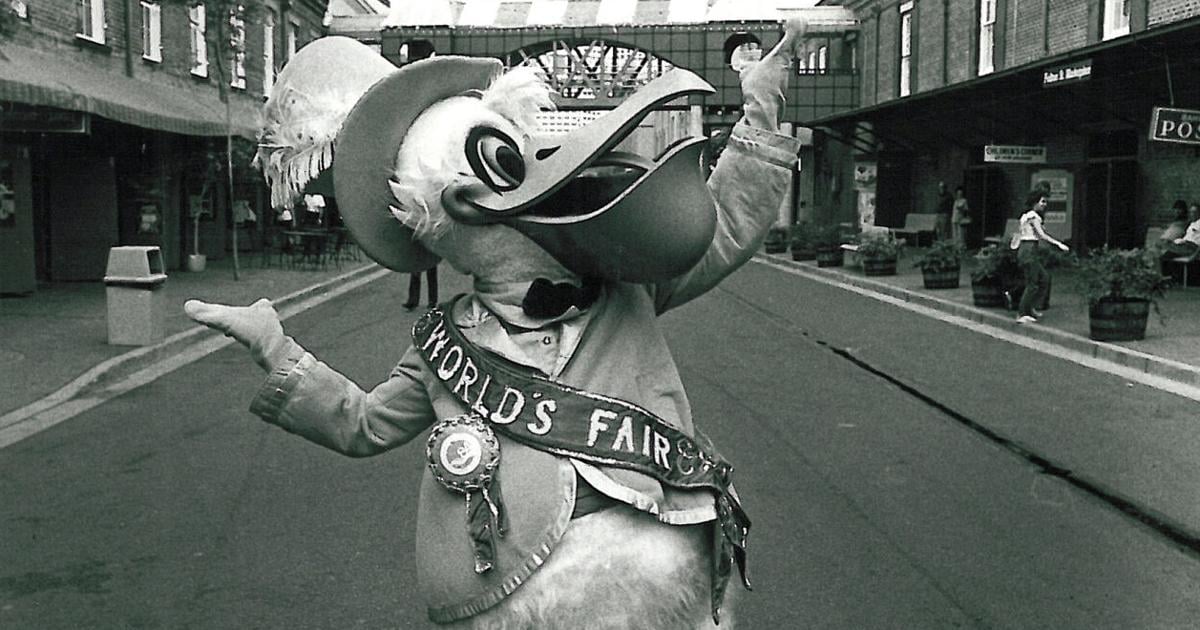
Pelicans could see the fair from above just by soaring, except for one who happened to be the fair’s mascot. His full formal name was “Seymore D. Fair.” His cartoonish costume included a blue top hat with a matching tuxedo jacket, spats, white gloves and a cane. He was a handsome bird with a smile built into his beak.
His duties as the fair’s greeter got him a lot of TV time, including an appearance on “Saturday Night Live.” He has been officially recognized as part of American lore by the Louisiana State Museum and the Smithsonian Institution.
Years later, on a Tuesday afternoon in February 2024, I last saw Seymore walking alone through the Quarter. I asked why, and he said he was having his own private celebration because the year was the fair’s 40th anniversary. To this day, I am not sure if the soul within the costume was the real Seymore or an impostor. (The day was Mardi Gras.)

Seymore D. Fair, the world’s fair’s mascot, strikes a pose on Fulton Street.
Back in 1984, since the fair honored the world, I had wanted to gain some international experience to make myself a better global man. It was at the Japanese Pavilion that I first learned to master using chopsticks, a skill that I have honed in the years since.
At the popular German Beer Garden, I learned to appreciate the music of the “Chicken Dance,” even if I did not participate in the dancing which required skilled flapping of arms. There are two famous culinary products from Belgium: one is Belgian waffles, a lighter, fluffier version of the American type, which is often sold as a vending item at fairs; and the other is Brussels sprouts, which you will not see sold at places where food is supposed to be fun, including at World’s Fairs.
Truth is, World’s Fairs have become hard to find.
Over time, the verdict for the New Orleans fair has been that “locals loved it, but it was a financial disaster.” That is true. During its run, the fair declared bankruptcy and Spurney resigned.
Events were canceled — including the promised Mardi Gras-type parade every night. In a world filled with Disney places, media saturation and rapid travel, discovering the world at a fair did not seem as exotic anymore.
Governments were also starting to back out, including the United States, which had minimal participation. President Ronald Reagan did not even bother to make the traditional head-of-state visit.
And worse yet, New Orleans is also the site of the last officially sanctioned expo in the nation.
Just to give the topic some balance, I did ask Seymore for his opinion about the fair. He thought for a moment and said, Petr Spurney style, “Don’t judge us by the problems; judge us by the memories.”
‘ The preceding article may include information circulated by third parties ’
‘ Some details of this article were extracted from the following source www.nola.com ’