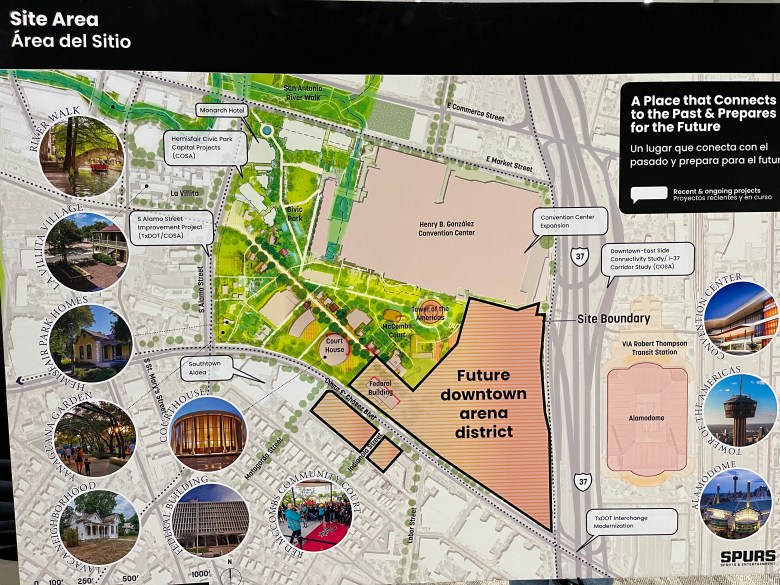
Before kicking off the first community listening session on the proposed downtown arena and sports and entertainment district, Spurs Sports & Entertainment Chief Legal Officer and General Counsel Bobby Perez said plans for the area are a blank slate.
“Nothing’s off the table. This is part of that process,” Perez told reporters before a community listening session at the Pope Francis Center on Felisa Street. “We want to hear what the opportunities are, dreams, hopes, and then we just work within the constraints of everything else after that.”
If that’s the case, the table is certainly full of ideas.
On Monday evening, San Antonio residents shared ideas and desires for a sports and entertainment district at the first of 10 planned listening sessions throughout San Antonio. More than 40 attendees wrote down everything from public art and green space to free electric trolleys and pedestrian access to a performance center and Spurs-related activities on poster boards after the event.
It’s the start of a years-long process to build a $1.3 billion arena in San Antonio’s urban core and bring the fresh-off-the NBA Finals Spurs team back downtown after more than 20 years on the city’s East Side. After getting community feedback in a series of meetings, planning and construction can begin.
The arena is scheduled to host the Spurs beginning in 2030, Perez said.
The City of San Antonio and Bexar County are set to contribute a combined $800 million to the arena after voters supported spending a combination of tax increment reinvestment zone funds and taxes targeting hotel visitors. The Spurs will kick in another $500 million for the arena itself and contribute another $1.4 billion toward building the surrounding entertainment district.
Residents wrote down everything from public art and green space to free electric trolleys and pedestrian access to a performance center and Spurs-related activities.
For a lot of San Antonio attendees, the issue boiled down to culture and accessibility. It needs to be somewhere people from San Antonio feel comfortable, downtown resident Victor Mendoza said.
“Culture has to really matter in it,” he said. “We are all Spurs fans here, but we also want to make sure we have a place where locals can have somewhere to have fun.”
Cynthia Rocha, a 36-year-old San Antonio resident who works in the healthcare industry, added that family-friendly activities are a big part of that. San Antonio is steeped in traditions and festivals that have taken place for years, she said, and she doesn’t want that to be interrupted.
“[Culture] means family, for them to be able to have a lot of family activities,” she said. “The majority of the time, it’s just nice having a playground.”
Another attendee, Luis Tovar, added: “Family, food, party, that’s pretty much what we’re about. … We’re hard workers, so we like to party hard.”
Attendees called for a place that’s open to all San Antonio residents. One card said the new district should be accessible when it comes to mobility and price with lower barriers to entry.
Another self-described Spurs fan, Kathy Vale, pointed to ticket prices.
“The national trend is when the new stadium is built, there are always less affordable seats and more private box seats, and I want San Antonio to be the city that breaks that trend,” she said. “I do not want to see less affordable seating in the new stadium and more luxury boxes.”
Vale said a formal citizen advisory committee should be organized to provide regular input.
“The Spurs are a private corporation owned by millionaires and billionaires, and they have a business interest to do these type of events, and it’s fine,” Vale said. “But this event does not represent the city of San Antonio’s interests — public land, public value for public good.”
That sentiment was echoed by others in the room.
Mendoza, a downtown resident, said he was glad there was an opportunity to make his opinions heard. Tovar agreed.
“We’re paying for it,” he said. “We want a say, too.”

Perez argued that no funds for the arena would come directly out of the City of San Antonio budget — though City Council is considering a bond issue to fund improvements in the surrounding area.
City leaders are also weighing raising property taxes for the first time in decades, citing rising costs, multiple funding priorities and flattening property tax revenues.
The arena will take up five to seven acres and can be used for community events, concerts and sports, Perez said. Perez said the community would have input on the other 18 to 20 acres of entertainment space, and suggested that housing, retail, dining and community gathering spaces could be among the uses.
Residents who participated in the Monday night event urged others to attend the listening sessions planned in the coming weeks.
“I can understand too how the community can have its reservations as far as coming to these meetings, but the activities really help for us to come out and speak on certain topics that they have,” Rocha said. “We should encourage a lot more people to come to the other meetings.”
The next listening session will be Tuesday night at Alamo Community College’s Dr. Bruce H. Leslie Boardroom at 2222 N. Alamo St., and the sessions will continue, with a break for the weekend, until July 23.
Each session lasts roughly two hours.
‘ The preceding article may include information circulated by third parties ’
‘ Some details of this article were extracted from the following source sanantonioreport.org ’