Christopher Nolan’s adaptation of The Odyssey, a story adapted so many times and in so many different ways that it’s hard to imagine finding a fresh way in, has far more in common with his Best Picture-winning Oppenheimer than you’d think. Maybe we should’ve taken that movie opening with a quote about Prometheus stealing fire from the gods a bit more seriously!
The Odyssey delivers everything you’d want from an epic of this size and scale, and then some. But it also functions as a spiritual sequel to Oppenheimer, continuing Nolan’s psychological examination of men reflecting on their roles in destructive moments that changed the world.
Oppenheimer was about the invention of the nuclear bomb and the torment of the scientist behind its creation at the destruction it wrought. Nolan’s The Odyssey is an anti-war epic about Odysseus (Matt Damon, in a career-best performance) reckoning with the trauma and horrors of war, and specifically how breaking Zeus’s Law — which boils down to the golden rule of “treat others the way you’d want to be treated,” with the added caveat of “because the gods are hiding among humans and you don’t want to mistreat one” — has led to the breakdown of a civil society.
After 10 years of war, King Odysseus sets sail for Ithaca, eager to reunite with his beloved Penelope (an excellent Anne Hathaway), who faces a cavalcade of suitors waiting to take over his throne and usurp his son (Tom Holland). But his journey home is far more treacherous than the battlefield, as he must face deadly monsters and vengeful gods to survive.
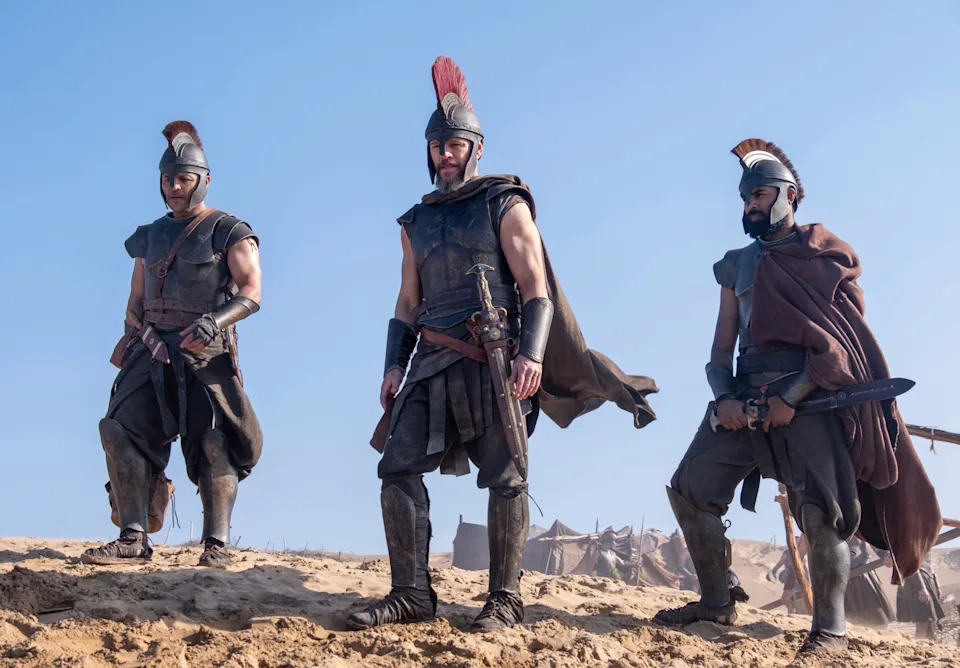
Jimmy Gonzales, Damon and Himesh Patel in a scene from Christopher Nolan’s latest. (Melinda Sue Gordon / © Universal Pictures / Courtesy Everett Collection)
Despite the trappings and budget of a blockbuster spectacle — which it absolutely is — The Odyssey is also an achingly human film. Underneath all the swords, arrows, and monsters, it’s deeply moving. It boils down to the specificity of how Nolan redefines the famous Trojan Horse sequence on his own terms and sees this deceit as ground zero for creating an unfair, cruel world; a single act of corruption that was the starter pistol for humanity to treat one another terribly. Just as we’re all living in the world Oppenheimer created, whether we like it or not, it feels as if Nolan is getting at something similar here via one of the most foundational texts of all time, which makes it even weightier and more meaningful.
Odysseus’s journey is literally perilous and full of exciting, beautifully shot set pieces, including but not limited to battle sequences, an escape from a giant Cyclops and an encounter with a witch that had this body-horror enthusiast squealing with delight and eagerly anticipating a full-on Chris Nolan horror flick. But it’s equally introspective, as Odysseus comes to terms with his own shame throughout his journey, even as he’s making life-or-death decisions for his men.
It’s also about myths, storytelling and why we continue to create legends rather than discuss the harsher realities — or even the more boring truths — of the world. Every time Nolan subverts or puts his own spin on a traditional idea from the story, like his interpretation of the gods’ appearance to Odysseus or a new take on Helen of Troy’s beauty and the war’s cause, it serves a thematic purpose. Like most modern adaptations of classic stories, Nolan’s The Odyssey is more about the contemporary world than it is ancient Greece, and you see this throughout in its depiction of how immigrants (“sea people”) are treated and the importance of foreign wars.
As for the filmmaking itself, the 70mm IMAX cinematography, which fits the full IMAX screen the entire time — a first for both Nolan and the medium — is stunning to behold. The score by Ludwig Göransson is loud, propulsive and exciting. The visual effects are a masterful blend of practical, in-camera work and digital effects; instead of creating everything with CGI, we get massive animatronic puppets. The structure is typical Nolan in that there’s a lot of cross-cutting between different time periods and arcs. The ensemble cast is terrific and also surprising; Himesh Patel stands out for having a role far larger than some of his A-list co-stars, and Samantha Morton really makes the most of her brief time onscreen.

Damon with costar Zendaya. (Melinda Sue Gordon / © Universal Pictures / Courtesy Everett Collection)
You’d think The Odyssey would have the urtext problem, something I eagerly called out when reviewing Denis Villeneuve’s Dune movies: How can one expect audiences to care about an adaptation of a story that is so foundational to storytelling, our biggest pop culture items have essentially already adapted it? Frank Herbert’s Dune is so influential that many movies and works we know as sci-fi classics, including Star Wars, have already aped its stuff and become foundational for a new generation. Nolan avoids this problem by taking the text we all know and making it undeniably his.
I’ll be surprised if I see better entertainment on the big screen all year. It’s an instant Oscar frontrunner in all categories, including Best Picture. It’s also going to be a massive hit.
The Odyssey opens in theaters nationwide on Friday, July 17.
‘ The preceding article may include information circulated by third parties ’
‘ Some details of this article were extracted from the following source www.yahoo.com ’