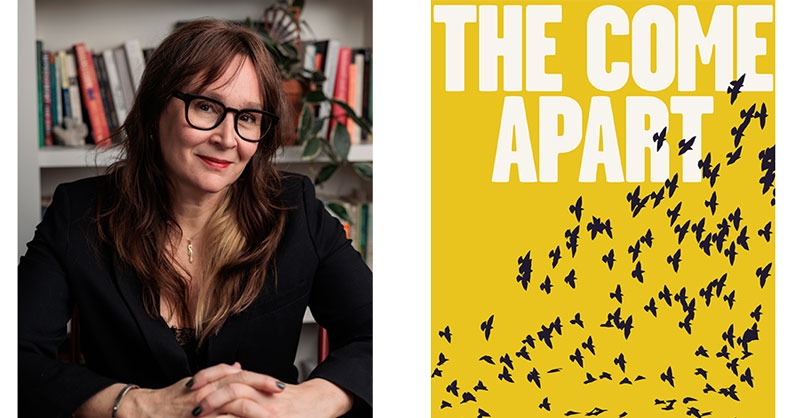
Susannah Felts has always loved music. But her time working as a reporter in Chicago between 1998 and 2006 — interning at Chicago magazine and freelancing for the Chicago Reader — never covered that beat. Instead, she primarily wrote about the arts, culture, fiction, and dining.
Now based in Nashville, Felts is finally covering the Chicago music scene — this time, by way of her fictional characters in The Come Apart, out June 15 (Northwestern University Press). The novel, set in 2009-2010 Chicago, follows working musician Maggie Corbin. Her band, which she fronts with her romantic partner Matt Turkish, releases a promising debut album, receives critical acclaim from the local alt-weekly, and scores an indie label record deal. But a sophomore slump hits, streaming services alter the traditional process, and other ordeals derail Maggie’s plans.
In addition to referencing music that was popular during the story’s setting, Felts’s novel shares descriptions that pull from her memories of living in Chicago, including sunrises on a frozen Lake Michigan and visits to Rainbo Club.
We spoke with Felts about her novel, along with the impact Chicago has had on her writing career and music consumption.
The novel explores the life of a working musician during the early aughts. How was your exploration of the Chicago music scene inspirational writing that character?
When I lived in Chicago, definitely probably the main thing I did for fun was go see bands. Same deal with my husband. I think one of the very first things I did after I moved into my apartment in Logan Square in August 1998 was to go to a show at Empty Bottle. I quickly was just like, Okay, looking at the Reader, where are the clubs? Who’s got what?
I went to Lounge Ax — R.I.P. I saw Cat Power play with the Dirty Three at Lounge Ax back in the day. That was an amazing show. Went to Metro, went to Schubas, just went to shows a lot. But I’m not a musician. So, when it came time to try to write from the perspective of a musician, I had to rely a little bit on my own sort of intuition and imagination.
Were there any Chicago bands that were a part of your research?
Yeah. So back in the day — we’re talking about ancient history now and it’s embarrassing — I was really into alt-country, and I would go see The Blacks a lot. I remember one particular show at Schubas that was amazing. I would go to see things like The Ken Vandermark 5 and Tortoise. The Rachel’s, I think I remember seeing them at The Hideout. That was an incredible show. I definitely have a very vivid memory of seeing Neko Case at the Double Door in 1999 or 2000.
I definitely want to keep tabs on the current Chicago scene now that the book is out. I wasn’t even living in Chicago in 2009, 2010, when the book is set. So that was a little tricky. It wasn’t that far from when I lived there, but it was like, well, what bands were? What was the scene like in 2009, 2010 in Chicago?
One of the sections I liked was walking along the lakefront.
It’s just such a wonderful place to be and you feel that sense of openness and expansion after the city can feel very— Chicago doesn’t really feel cramped in the way I think that maybe New York does. You get to the edge of it, and you get to the lake and you’re just like, “Oh wow, it feels like a release.” There was one night in particular when I was living there, this is after I’d started dating (now-husband) Todd. So somewhere toward the end of my years there, a bunch of us stayed up all night and I think we rode our bikes down to the lakefront and watched the sunrise and it was just such a magical time.
Another section I loved is where you described Chicago as people-busy but not frantic. Why did that seem important to convey?
When I think of Chicago and the vision of it I wanted to bring to the page, it was this idea of, it’s such an active place. If you walk outside of your apartment or your house, you’re going to come face to face with a lot of energy. People are doing things everywhere all around you and that is like a really inspiring good energy to have around you. I think as a young person, you thrive on it, you feed on it and you want to be a part of it. You want to be in the energy and contribute to it. So, when I think of Maggie, my character, I think she went there knowing that’s what she was looking for. You moved to a big urban area for that, I think. And she jumped right in with both feet and has really taken the energy in, put it back out, has worked really hard — but it’s also getting to that point that I think a lot of us get to. She’s 29, she’s about to turn 30 where she’s like, “I’m a little bit tired. I’m a little bit needing to slow down in some way. I need some quiet.”
She’s really trying to find what the next thing is. And then sometimes you’re searching for something that combines with events that you can’t control and you just kind of have to build, you have to figure out from there where you’re going. So I think that’s what that part of the book is about, just about that. Being in love with and absorbed by the creative energy of the city and loving being a part of a scene, loving being surrounded by other creative like-minded people that inspire you and motivate you to keep doing what you’re doing and collaborating with. But also feeling like, “Whoa, I need a breather.”
When you were living in Chicago, was that something that you embraced, the creative culture?
Yeah, I think so. Like I said, I wasn’t really in the music scene except as a listener, an audience member. But I was definitely heavily involved in a scene of a community of art-minded people for sure, whether they were writers, audio producers, graphic artists, painters, actors, what have you. My world in Chicago in my late 20s and early 30s was definitely like that of the creative class, just really talented, motivated people who were just doing cool shit all the time. My friend Julie Shapiro, she co-founded the Third Coast International Audio Festival. Because of her, I was exposed to a lot of people doing stuff in public radio and starting shows. Jonathan from Featherproof started a series, The Dollar Store Reading Series, that happened at the Hideout for a number of years.
People were just starting things and doing things and trying things out. It was very DIY, very from the ground up. And in the midst of that, you have this bigger kind of fancier culture of galleries and touring bands and fine dining. I remember I never actually went to Blackbird, but I remember when that was all the rage. So, you kind of have that overlay of like, here’s culture happening at this level and then here’s culture happening right below it with you and your friends.
How would you describe your strategy of mixing real-life experiences with fiction?
(Writer) Lauren Groff said that she really feels like all fiction, no matter what you’re writing, it’s at least in part autobiography. It’s a pretty bold claim, but I think I know what she means. I don’t care if you’re writing about a made-up planet with a made-up species, with a made-up weather system, whatever. You’re putting some of your desires, your yearning, your fears, that deep kind inner soul stuff into that work. I really believe that and I think that’s happening in The Come Apart.
You want things to feel real on the page. I want it to feel authentic. I think that the trick is trying to build that fictional world and give it the space it needs to be its own thing, to be fiction, to be made up, to be a thing that is not you. It’s not beholden to the facts of your life in any way. And yet there’s something beneath the surface — kind of like the water table or something — there’s the you there.
‘ The preceding article may include information circulated by third parties ’
‘ Some details of this article were extracted from the following source www.chicagomag.com ’