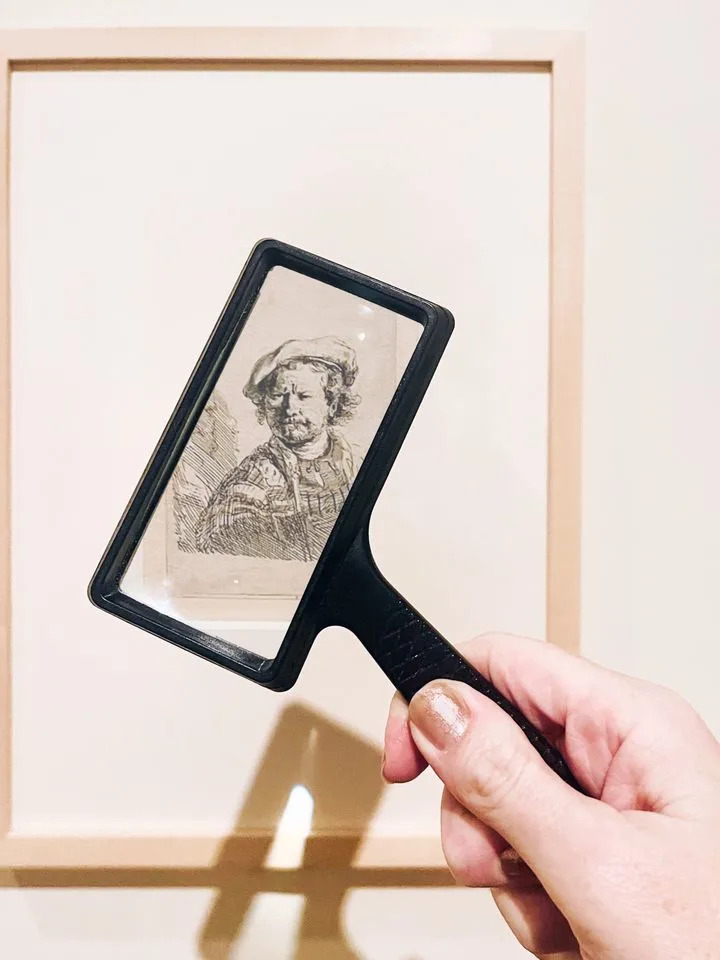
At first glance, “Self-Portrait, Wearing a Flat Cap” looks to be a pencil or charcoal drawing, impressive in its own right. Peering through a magnifying glass, however, reveals fine details in the small print measuring about two inches by three inches, or about three times the size of a postage stamp. Looking even longer, it looks almost 3-D, those details seemingly jumping off the paper. To realize the print is a result of an etching exquisitely produced on a metal plate nearly 400 years ago is mindboggling.
The print is one of a collection of 58 works making their U.S. debut in “Rembrandt: Masterpieces in Black and White ‒ Prints from the Rembrandt House Museum,” on view through January 11, 2026 at the Gibbes Museum of Art in Charleston, South Carolina. The exhibit is co-organized by the American Federation of Arts and the Rembrandt House Museum in Amsterdam.
“We are honored that the Gibbes and the city of Charleston are the first U.S. destination for the exhibition,” says Dr. H. Alexander Rich, president and CEO of the Gibbes Museum of Art. “That the show arrives here first is a big deal for the museum, especially as you don’t get many bigger or more recognizable names in the history of art than Rembrandt.”
Courtesy The Gibbes Museum of Art.
Well-known for his self-portraits and narrative paintings like “The Storm on the Sea of Galilee” and “The Night Watch,” “Rembrandt: Masterpieces in Black and White” gives art enthusiasts the opportunity to explore another of his techniques of which he was prolific, etching and printmaking.
“Whether you are a longtime admirer or new to Rembrandt’s work, this exhibition offers a chance to experience the genius of one of the most influential artists of the Dutch Golden Age,” says Pauline Forlenza, director and CEO of the American Federation of Arts.
Epcu Runia, head of collections at the Rembrandt House Museum and curator of the exhibit, says Rembrandt (1606-1669) began printmaking at an early age, “when he was about 20,” was primarily self-taught and most prolific in the 1640s and 1650s. He adds that Rembrandt was considered the most creative printmaker of the seventeenth century.
“The exhibition explores Rembrandt’s strengths as an experimental etcher, in particular his visual storytelling and focus on drawing ‘from life,” says Runia. “It shows how Rembrandt grew to be arguably the most creative print artist of the seventeenth century and highlights how his graphic oeuvre has served as a source of inspiration for artists in the centuries since.”
He also says Rembrandt constantly sought out new possibilities for creating compelling works of art, including technical solutions.
“It is interesting, for example, to look for his use of drypoint,” says Runia. “This is done by scratching directly in the plate and creates beautiful velvety lines. Usually, he uses it to add details to an etching, but there is one large print on show (“Christ Presented to the People”) which he made exclusively in drypoint. It is an expressive scene which looks amazingly modern.”
In addition to 44 of Rembrandt’s prints, “Rembrandt: Masterpieces in Black and White” features works by other artists he inspired, like James McNeill Whistler and Pablo Picasso.
“[The exhibit] not only showcases the artist’s extraordinary prints and creative influence, but also highlights the lasting significance of his techniques, which continue to inspire artists and designers today,” says Forlenza.
When visiting the exhibit, plan on taking your time to make the most of it, or what the American Federation of Arts calls slow looking.
“As the content of the exhibition itself is small-scale etchings, the manner by which our audiences will engage with the art will be novel to most museumgoers, too,” says Rich. “The show demands close-looking and fine examination of both the subject matter at hand and, importantly, the process by which the etchings were made.
“We provide magnifying glasses for our visitors, propelling them into the position not just as careful observers but also as visual connoisseurs,” he continues. “It is impossible to look at an etching and not consider how it was made. In this show, Rembrandt as masterful storyteller and Rembrandt as expert craftsman come to the fore in a wonderfully overt manner.”
Upon slow looking, Runia says visitors might discover that each of Rembrandt’s prints is a work of art in itself.
“Take the time to look at them closely and a whole world opens up to you: a world in black and white, but with enormous visual richness.
Related: The 28 Best Things To Do In Charleston, South Carolina
Read the original article on Southern Living
‘ The preceding article may include information circulated by third parties ’
‘ Some details of this article were extracted from the following source www.yahoo.com ’