Goodness knows we’ve had our fill of feral 18th-century folk musicals about fundamentalist Christian sects, featuring Mamma Mia! alumni in all-panting, all-vibrating lead roles. But Mona Fastvold, the co-writer of Oscar-winning The Brutalist, has seen fit to throw another on the pile.
Of course I’m being glib. One of the many pleasures of watching Fastvold’s ravishingly staged and thrillingly ambitious The Testament of Ann Lee (which she wrote with her husband, Brady Corbet, The Brutalist’s director) is knowing that after unearthing Ann Lee’s story she must have thought to herself: yes, this should be a movie, and one with song-and-dance numbers to boot. Lee was the Manchester-born founder of the Shakers, who emigrated to New York in the 1770s and founded a colony: not a story obviously long on razzmatazz. And yet within a short space of time, you realise Fastvold’s instincts were right.

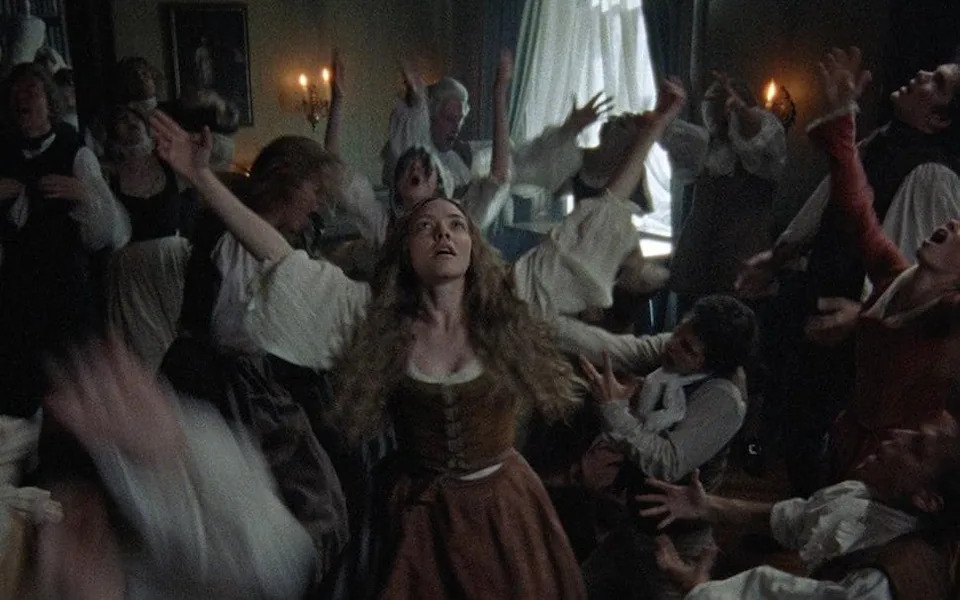
Amanda Seyfried is eerily beguiling as Ann Lee, a blacksmith’s girl who is radicalised by her early life in England’s grim industrial north
With a severe air and mostly plausible Mancunian accent, Amanda Seyfried is eerily beguiling as Ann, a blacksmith’s girl who is radicalised by her early life in England’s grim industrial north. Appalled by the ambient cruelty and squalor, and scarred by the death of all four of her children in infancy, she becomes a lay preacher whose chief interest is sex – specifically, the prohibition of it as the devil’s business.
She soon attracts a band of followers from the city’s community of Quakers, led by Ann’s benefactor, James Wardley, played by David Cale in one of the film’s many enjoyably knobbly character turns. Eventually the lot of them are setting sail for America and Edenic new beginnings, having since come to believe that Ann is no mere prophet but the female second coming of Christ him… no, herself. Her husband, Abraham (Christopher Abbott), doesn’t seem completely on board, but up against such faith, there’s not much he can do.

Amanda Seyfried (right) and Mona Fastvold at the Venice Film Festival for The Testament of Ann lee
This is a film that says “Yes, we know this is all a bit weird, but since our heroine took it seriously, so shall we.” That attitude is never more apparent than in the musical numbers – and perhaps because communal wailing and trembling were the Shakers’ signature moves, the whole impromptu bursting-into-song conceit works well. None of the songs, which feature lyrics such as “high o’er the billows we are wafted along”, could be described as toe-tappers – but are all performed with huffing-puffing gusto, with words and melodies ingeniously drawn by composer Daniel Blumberg (also of The Brutalist) from contemporaneous folk and worship music.
Comparisons to The Brutalist are inevitable – and the two do make an intriguing pair of his ’n’ hers immigrant epics, each shot on 70mm film stock and crafted with a mad single-mindedness of which their subjects would no doubt approve. The free-range majesty and fine-grained, muddy-fingernailed detail of Fastvold’s film, though, is entirely its own thing: like Ann, I was left wobbly and breathless by its grandeur and nerve.
UK release to be confirmed
‘ The preceding article may include information circulated by third parties ’
‘ Some details of this article were extracted from the following source www.yahoo.com ’