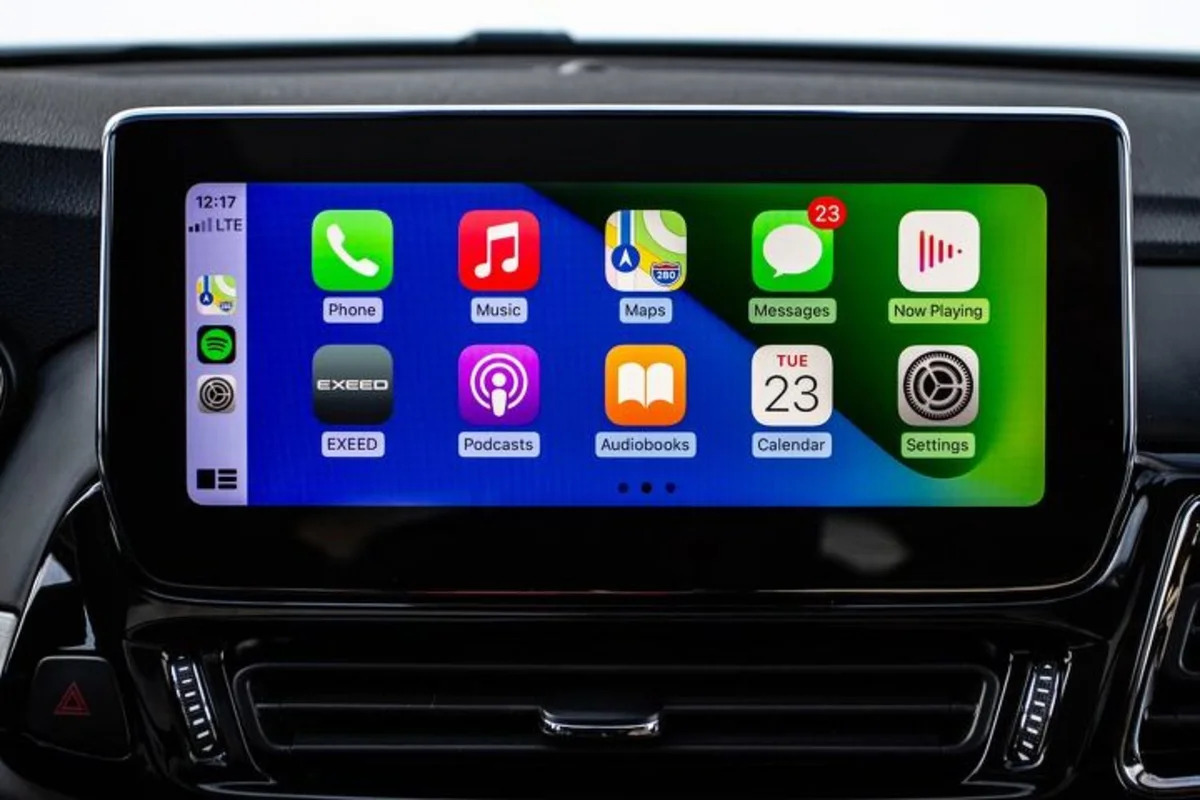
Photo Credit: Roman Vyshnikov / Shutterstock.com
Apple quietly announced at WWDC 2026 that CarPlay will let users browse and play videos directly on supported vehicle screens once iOS 27 arrives. The feature targets a clear use case for modern infotainment displays: watching video while a vehicle is parked, whether during EV charging, passenger pickup, rideshare downtime, or school pickup lines.
The timing matters. Apple revealed the CarPlay change not long after Google announced HD video playback for Android Auto. Google also demonstrated YouTube running on Android Auto inside a Kia EV at I/O 2026, while its Android division named Skoda, Volvo, Kia, and Mercedes-Benz among manufacturers supporting HD 60fps playback.
Advertisement
Advertisement
Apple’s implementation is narrower for now because it depends on app, vehicle, and automaker support. Apple explained the feature to developers in its WWDC 2026 “Rev up your CarPlay app” video, where the company described a new “video in car” capability for apps in vehicles that support it.
How Apple says it will work
The iOS 27 feature builds on AirPlay streaming, which Apple introduced for CarPlay video mirroring with iOS 26.4. That earlier version lets users mirror video from an iPhone to a supported CarPlay display by enabling AirPlay in supported apps and selecting the vehicle’s infotainment system as the mirroring target.
The iOS 27 upgrade goes further by adding video browsing and playback inside the CarPlay interface. In Apple’s developer demonstration, a fictitious “Landmark” app shows a “Videos” option at the top left of the CarPlay display. Selecting it brings up video thumbnails, a mini player with basic controls, progress indicators, remaining time, and badges for newly added or live streaming videos.
Opening a thumbnail brings up a list view with the selected video, a “Play” button, and a “+” button for adding it to a playlist. Playback then moves full screen, with controls to skip forward or backward 10 seconds, turn on subtitles, and return to the previous page.
Advertisement
Advertisement
Apple emphasized that video playback only works when the vehicle is parked. If the system detects motion, it switches to audio-only mode.
The hardware gap is the real story
The major limitation is vehicle support, not the CarPlay interface itself. Most CarPlay systems do not appear to allow iPhone video mirroring yet, even though wireless CarPlay uses AirPlay as the underlying Wi-Fi streaming layer.
Hardware requirements may also block many existing vehicles. Developers have noticed that CarPlay video mirroring only works on displays with at least 1,920 x 1,080 resolution. Many factory head units do not meet that mark. Video streaming playback also generally requires H.265 or HEVC codec support and 4GB or more of memory, which older CarPlay systems may lack.
Automakers also need to implement support so vehicles can handle the added hardware demands and confirm that the car is parked. At WWDC 2025, Apple said automakers needed to implement CarPlay video functionality for those reasons.
A quiet launch signals a longer rollout
Apple’s muted presentation signals that CarPlay video is still groundwork for developers and car companies rather than a widely available consumer feature. Based on the absence of concrete product announcements from Apple or automakers, the feature does not appear imminent for actual cars.
Advertisement
Advertisement
That still makes iOS 27 a meaningful marker for CarPlay’s direction. Apple is preparing CarPlay for the same parked-screen entertainment shift already visible on Android Auto, but broad availability will depend on vehicles that can support the display resolution, codec, memory, AirPlay, and parked-state requirements. For now, the feature is coming to the platform before it clearly comes to the driveway.
‘ The preceding article may include information circulated by third parties ’
‘ Some details of this article were extracted from the following source autos.yahoo.com ’