In the eyes of music fans, livestreaming a music festival has pretty much always been seen as a way to extend the festival’s influence out to those who couldn’t attend, whether geographically or financially.
An extra camera feed to build a little FOMO in the fan space. Nothing wrong with that?
But nowadays, we’re seeing so many festivals go bankrupt, financial backers pulling out or festivals having to cross new thresholds for supportive fundraising, just to make ends meet, as well as tickets going unsold in a particularly volatile economy. All of this leaves music festivals with the annoying predicament of having to scramble for additional revenue streams just to stay alive.
The livestream used to be a bonus gift to a festival’s global digital community, but now digital content is shifting to become one of the driving forces of the performance curation, production design, and technical foundations of a music festival existentially.
This summer, Disney+ is joining Hulu to livestream Bonnaroo, Lollapalooza, and Austin City Limits globally, expanding what had largely been a US-focused streaming offering into an international entertainment product. The broadcasts won’t simply show performances. They’ll also include artist interviews, backstage content, and festival-produced programming designed specifically for viewers watching from home.
+Read more: “Sturgill Simpson’s Taking His Alter Ego on Tour — the Risk and the Mystery Are the Point.”
It’s another sign that music festivals are evolving into something much larger than multi-day live events. They’re becoming a new type of media company.
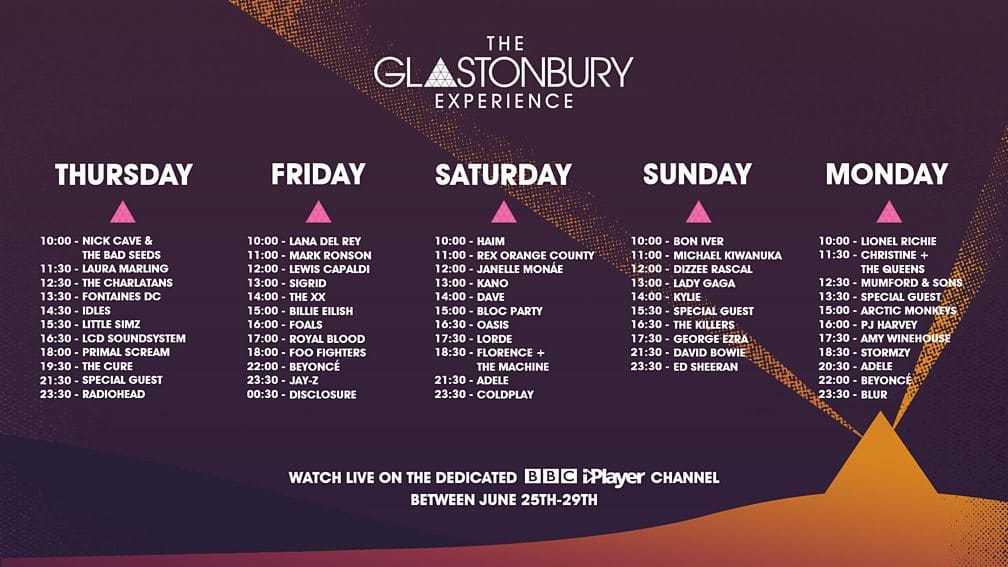
And this is just the beginning. Those three partnerships still anchor the live stage performance as the centerpiece of the event, the live audience is in the room and the artist is playing to them. This, now, is an extension of the television rights acquisition arrangement to broadcast live events, like the BBC started with the Glastonbury Music Festival in 1994.
During the COVID-19 pandemic in 2020, Glastonbury happened entirely online and on television due to lockdown measures.
According to cultural theorist Leanne Weston, writing for CST Online:
“The typical function and understanding of the BBC’s Glastonbury coverage, to stand in for “being there” is further amplified. As such, part of the cultural work performed by the 2020 coverage is to negotiate for multiple forms of loss and lack – the lack of attendance, the lack of an event, and the (seeming) lack of an alternative – offering ways for the audience to connect or reconnect with Glastonbury as a cultural site and symbol. The underlying public service imperatives of the coverage are clear, contributing to wider cultural practices that bind the nation in a time of crisis, while also reasserting its position through a re-presentation of its history, achieved through repurposed Glastonbury footage.”
Weston writes that the dominant broadcast model of the past was, and even continued to be throughout the global crisis of the COVID-19 pandemic, based on catering to “lack” — a general public’s lack of presence at what is considered to be an important shared cultural event. Those in attendance of these events are typically considered privileged, opportunistically.
But as the future is starting to reveal itself through content marketing partnerships such as these, which put forth a new criterion of privilege in paywall subscription access and thus a new understanding of what the “product” is in the transaction of entertainment consumption, we have to assume this will one day change the nature of music festivals to then cater to a digital audience first and foremost.
As Graeme Thomson writes in this piece for The Spectator: “Televising Glastonbury has changed the festival, and in turn transformed television.” I cannot imagine it doesn’t then also go the other way.
A festival that welcomes 70,000 attendees can suddenly reach millions of viewers around the world without adding a single person to its grounds, and the audience is no longer limited by venue capacity. So why would media companies continue to put the live audience at the center of an experience meant to scale to millions of viewers elsewhere?
Instead of monetizing only those who physically attend, festivals can now create value before the gates open, throughout the weekend, and long after the final encore.
That fundamentally changes the economics. Livestreams generate advertising inventory, subscription value, sponsorship opportunities, social media clips, behind-the-scenes programming, artist interviews, documentary footage, and years of archival content.
The livestream also becomes marketing for next year’s ticket sales, reminding viewers what they’re missing while simultaneously giving sponsors and artists a global audience. Every broadcast extends the life of the festival beyond a single weekend.
Yet my hope is that this shift doesn’t begin to diminish the value of being there in person, and that audiences don’t start to expect access over attendance. One of the palpable joys we all experienced in 2021 and 2022 when large-scale cultural events were safe enough to start inviting in-person audiences again, was that sense that we had been missing out on shared public space moments of standing in a crowd together, experiencing something as a group.
We’ll see how this plays out over the next few iterations of these festivals in question. Ultimately it’s a net positive that they’ve been able to survive the wave of “Blue Dot Fever” that’s been poisoning the live touring ecosystem of late, by finding a new sustainable revenue stream.
I’m just not sure I want to be able to answer the question of “what do Bonnaroo, Love Island, and The Mandalorian all have in common?” with “you can watch all of them on your couch in your underwear.”
+Read more: “How Lollapalooza’s Evolution Has Defined the Last 3.5 Decades of Live Music”
‘ The preceding article may include information circulated by third parties ’
‘ Some details of this article were extracted from the following source www.hypebot.com ’