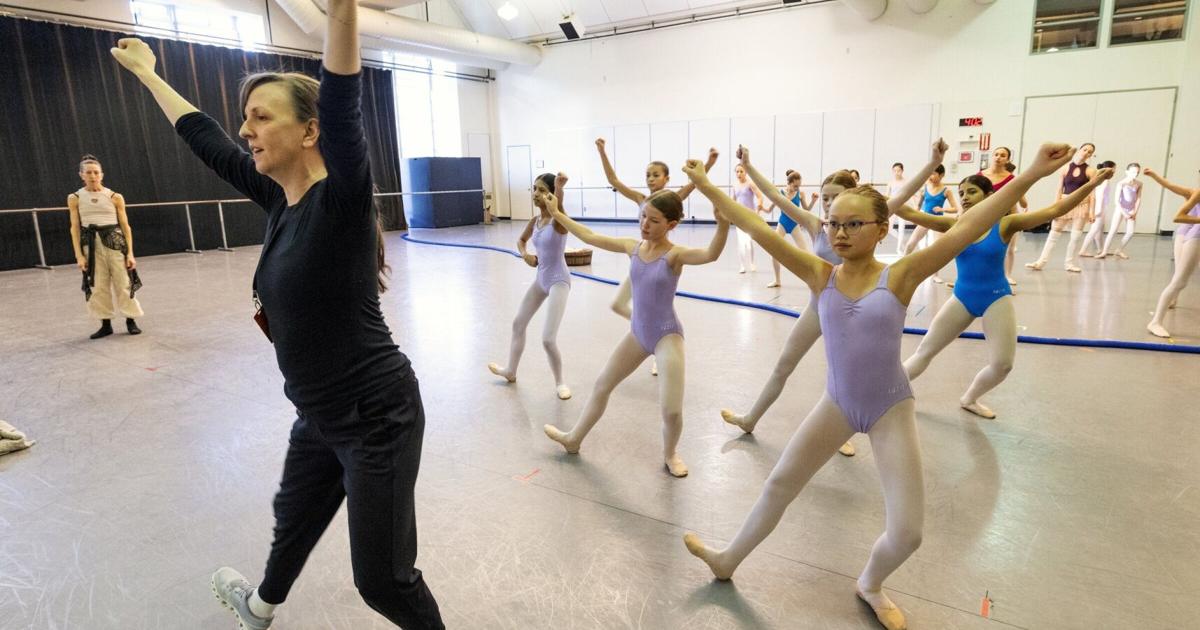
On a recent Sunday afternoon at Pacific Northwest Ballet studios, one of the young PNB School student dancers cast as a river-riding Peach in the upcoming world premiere of “Momotaro” suddenly called across the room in fright.
She wasn’t scared by the rehearsal scene: The enduring Japanese legend of “Momotaro,” also known as the “Peach Boy,” opens gently with a childless couple who discover a boy inside a gigantic peach fished from a nearby river. Nor did the student dancer show any signs of being intimidated by PNB resident choreographer Jessica Lang, though she is an A-list ballet artist customarily hired to work with premier dancers at top ballet companies around the globe.
The imminent premiere of this new ballet at McCaw Hall — “Momotaro” debuts March 21 and plays again March 28 — wasn’t stressing this student either (most dancers in the room are veterans of several PNB “Nutcracker” seasons already). Turns out the student was afraid of the backward floor roll that Lang had just asked from the crop of jolly young Peaches. Given the bulbous costumes the students were slated to wear, the thoughtful dancer was highly concerned: “But what if we get stuck down there? What if we can’t get back up?”
Lang responded cheerfully. “I’ve been told you won’t get stuck there,” she said. Then, gesturing upward toward PNB’s costume shop, she added: “My friends upstairs think you’ll be fine. But if it’s not possible, we’ll change it.”
Lang’s upbeat, responsive demeanor with the students would lead one to believe she had ample time, but she was flying to Las Vegas that night to spend 24 hours working with Nevada Ballet Theatre before the next “Momotaro” rehearsal at PNB the coming week. It’s quite unusual for a high-demand choreographer like Lang to create a world premiere for student dancers. But the “Momotaro” commission offered her the chance to create something she’d never done before: a full-length narrative ballet. And for PNB, it was a chance to create a piece that could draw in new audiences.
Given the schedule she keeps, Lang is adept at working efficiently, and over the next hour, she continued working with two casts of Peaches, coaching dozens of 11- and 12-year-olds by individual name as she sent them tumbling, twining, swirling and finally concluding with a thrusting sky-high arm gesture that Lang called “the peach punch.”
The students looked a lot more confident by the end. Smiles bloomed on their faces when Lang called out, “Great work, Peaches!”
Lang’s first full-length narrative ballet
At the top of her professional game, Lang has created over 100 repertory pieces for companies worldwide, including repeat works for American Ballet Theatre and San Francisco Opera. She’s been lauded for her impeccable craftsmanship, her strong sense of visual design and the bold new challenges she takes on year after year.
In her current three-year contract as PNB’s resident choreographer (2025-2027), Lang’s essential task is creating and setting works for the mainstage season of the professional company. Indeed, the long-awaited finale of PNB’s 2025-2026 season is an “All Lang” program running May 29-June 7.
“Momotaro” is a much less visible, and prestigious, project than she usually undertakes. Commissioned for PNB’s more modest family matinee series, the work’s budget is nowhere near the size available for a mainstage piece; the performers are all officially school students (although young adults in the professional division are, as named, truly professional-adjacent). And for all the work involved, McCaw Hall’s schedule only allows for three performances of the completed show.
But this project offered Lang two allures: To explore a personal cultural story plus have full access to PNB resources during the creation.
“It was all Peter,” Lang said, referring to Peter Boal, PNB’s artistic director. He not only gave her the chance to create her first full-length narrative ballet; he also hoped Lang and her longtime artistic (and life) partner, husband Kanji Segawa — a veteran Alvin Ailey dancer originally from Kanagawa, Japan — might consider using a Japanese folk tale as a springboard. Boal wanted something that would resonate with Seattle’s Asian community, Lang said, and “’Momotaro’ slid right out of Kanji’s mouth.”
In Japan, versions of the “Momotaro” folk tale have served as inspiration for centuries. While the boy’s miraculous arrival touches the life of just one childless couple, as Momotaro’s devotion and courage grow over time, he becomes a hero to many. For once he reaches adulthood, he declares his intention to journey to Ogre Island to confront the thieving villains who have stolen from the village for years. The three animal friends he meets along the way — each with their own skills and personality — help him become a successful and forgiving warrior-leader.
For Lang, whose husband has been her creative partner for the entirety of her career, the chance to honor Segawa’s heritage brings a huge sense of fulfillment. “He is the reason I’m doing it,” said Lang, who added that after 19 years of marriage, she understands “how beautiful and unique the culture is.”
Boal offered her “complete integration” within all of PNB’s school and company departments during the development phase — from the classrooms to the scene and costume shops, to the marketing department and more. “I wanted her to have an opportunity to touch every department in the building,” Boal said. “Jessica has really bold ideas that are ever-changing. She’s also very nurturing to every person in the room.”
For the next hour that Sunday, Lang worked with two new casts to design Momotaro’s surprise reveal: an arrival requiring students from the professional division to maneuver a wheeling, hinged platform that allowed for young Momotaro to spring free from the peach’s center. From there, Lang devised a flurry of gestures and dancing between the astonished parents and their beloved surprise. At hour’s end, she prepared to work next with the adult Momotaros on their heroic and jubilant scenes of battle and homecoming.
Throughout the rehearsals, Lang didn’t turn pages in a notebook, or seem to have anything but the music to jog her memory. Could it be possible that she was actually choreographing on the spot? Or had she memorized this endless variety of dance and gestural phrases she’d envisioned for both soloists and the ensemble?
The answer is both.
“Yes, I’m prepared,” Lang explained later. “And I’m prepared to be spontaneous … I have these images, and I write them down, or I just remember them.”
Christopher Karhunen, 19, one of the professional division students who will play the adult Momotaro, was not familiar with the folk tale before he began rehearsals, but now he said he feels a growing resonance. A former longtime student at the Grand Rapids Ballet School in Michigan, Karhunen described the deep sense of allegiance and gratitude to his parents and hometown teachers since his move to Seattle last fall. “I can almost relate to Momotaro now,” Karhunen said. “How he wants to give back to the people who raised him.”
Expanding the family matinee offerings
For audiences, the family matinee programs have always been a good deal, offering elevated student dancing performed on the same McCaw Hall stage as the mainstage series and “The Nutcracker,” all for vastly lower prices.
For Boal, the family series is essential for bringing in new ballet audiences and new school students, and he’s been steadily expanding the repertory beyond the usual children’s fare of “Cinderella” and “Snow White.” In 2024, Boal added a heralded version of “Harold and the Purple Crayon,” originally created for Hubbard Street Dance Chicago, with choreography by celebrated artists Robyn Mineko Williams and Terence Marling, and music by Andrew Bird.
Boal cites how the “sense of economy” dictated by the family series budget actually melds well with the simplicity of the “Momotaro” tale: “There’s an integrated sense of line and order throughout.”
The synchronicity between Lang’s deft, uncluttered narrative and the ballet’s bold, hand-drawn design schema enables the presence of two long dyed ropes to come alive as a flowing blue river. In another instance, the rising drum rhythms created by the young School of TAIKO students are all that’s necessary to signal the powerful physical and emotional change of scene when Momotaro and his friends arrive at Ogre Island.
Viewers of Lang’s other works for Pacific Northwest Ballet should recognize this sense of simple satisfaction and clarity. “I’m not doing anything really that different than what I would do on (the mainstage of) PNB,” Lang said. “It could very easily jump up to company dancers.”
‘ The preceding article may include information circulated by third parties ’
‘ Some details of this article were extracted from the following source www.yakimaherald.com ’