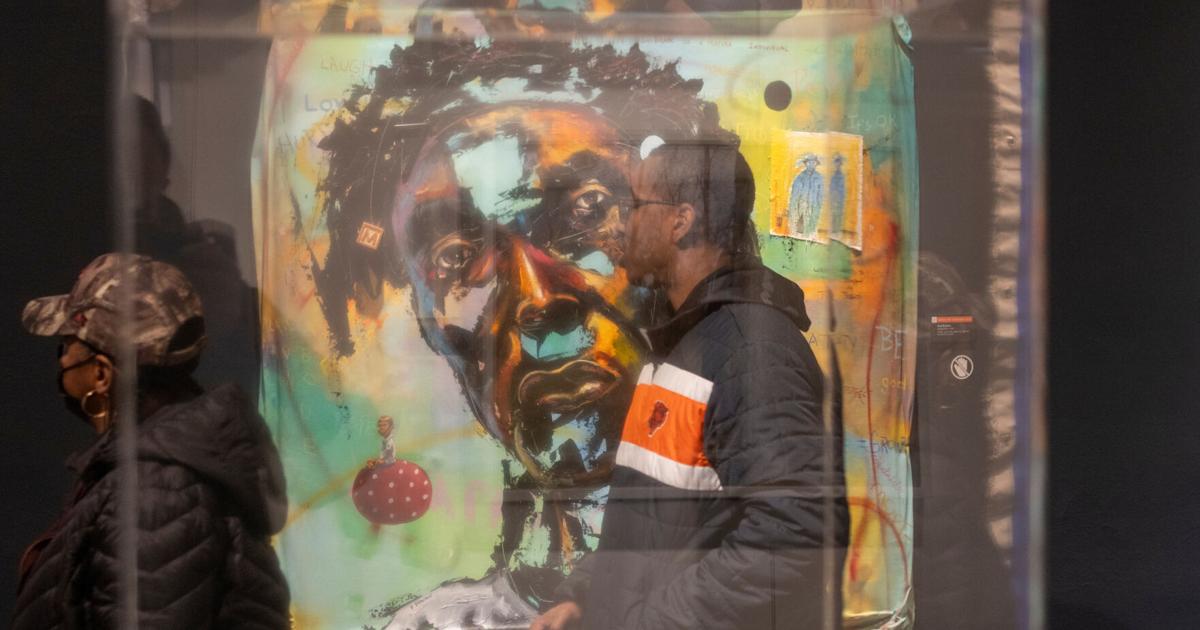
More than five decades after “Black Esthetics” debuted at the Museum of Science and Industry, the annual exhibition now known as “Black Creativity” opened last month with a juried show of professional and teen artists from Chicago and beyond.
“It’s the longest continuously running juried exhibition of Black art in the nation,” said Angela Williams, the museum’s director of design.
When “Black Esthetics” debuted in 1970, Chicago was in the midst of upheaval — reeling from the assassinations of Fred Hampton and Martin Luther King Jr., war protests, and economic disinvestment, while Black artists were building new cultural institutions of their own.
An outgrowth of Chicago’s Black Arts Movement, “Black Esthetics” was first curated by artist Douglas Williams, director of the South Side Community Art Center from 1966 to 1970. The show included dance, sound, public programming as well as an exhibition of visual arts. Among the artists whose work was presented at “Black Esthetics” were Walter Sanford, Nathan Wright — who began painting while wrongfully imprisoned — Ben Bey, and Nii-Oti. The exhibition helped inspire other collectives and spaces, including the Black Arts Guild and the Chicago Mural Group.
In 1984, the program was renamed “Black Creativity” and expanded to celebrate work by artists and thinkers working across art and the sciences. That expansive definition continues to shape the exhibition today, with selected works addressing questions of identity, memory, history, and cultural inheritance across generations.
“We went through the 1,300 images and we brought that number down to the best 100,” said Norman Teague, an artist, designer and educator from Chicago’s South Side who served as one of the jurors this year alongside Akilah S. Halley, the executive director of Marwen.
A defining feature of the annual show is its emphasis on youth artists. Two galleries on the museum’s lower level are dedicated to Chicago-area teens. In “Angels Have Bad Days Too,” Morgan Park High School student Heaven Williams depicts a genderless Black angel wrapped in white fabric against a dark sky, with wings adorned in white flower petals. White shapes hover above the figure, evoking cowrie shells, which are frequently associated with wealth, prosperity and spiritual protection across the African diaspora.
Nia Terry’s “Grillz,” on view at the Griffin Museum of Science and Industry’s “Black Creativity” exhibition.
Another teen submission, Nia Terry’s “Grillz,” won third place in the teen category. The painting zooms in on a mouth adorned with gold fronts accented by pink and blue stones. Terry, a high schooler from Racine, Wisconsin, cleverly uses light strokes of white paint to create a glossy sheen on the lips, referencing both contemporary hip-hop aesthetics and West African traditions of adornment.
In the main gallery, Chicago-based videographer Toni Daniels’ piece “Legacy on Record: Marie Henderson Out of the Past Records” centers on the cultural significance of Out of the Past Records, a longtime West Side record store. The video pairs a still image of the shop’s founder, Marie Henderson, with her narration, framing the store as both a neighborhood institution and a site of musical preservation. In doing so, the piece underscores the central role Black artists and communities have played in shaping all Western music — from blues and country to jazz, rock, disco and electronic — while paying homage to oral history as a means of cultural transmission.
Photographs in the exhibition similarly explore Black American life and reflect cultural contributions. In stevia roxanne’s “Dedicated To,” a Black woman peers from behind a tree, her long braids blending into the surrounding soil and roots. Brian Edwards Jr.’s black-and-white photograph “The Ride” captures a child riding a sheep at a rodeo, freezing a moment of exuberance and highlighting Black presence in contemporary rodeo culture.
More than five decades after “Black Esthetics” first emerged amid political and cultural upheaval, “Black Creativity” returns with new generations of artists responding to many of the same unresolved conditions that made the exhibition necessary in the first place.
“Black Creativity” is open at the Griffin Museum of Science and Industry, 5700 S. DuSable Lake Shore Dr., through April 19. General admission is $25. Chicago residents get discounted admission.
‘ The preceding article may include information circulated by third parties ’
‘ Some details of this article were extracted from the following source www.hpherald.com ’