This story originally appeared in the Asbury Park Press on Nov. 24, 1995. Shhhh …. You’re at a Bruce Springsteen concert.
Springsteen’s concerts for years have been raucous, four-hour events at arenas and stadiums, akin to frat parties.
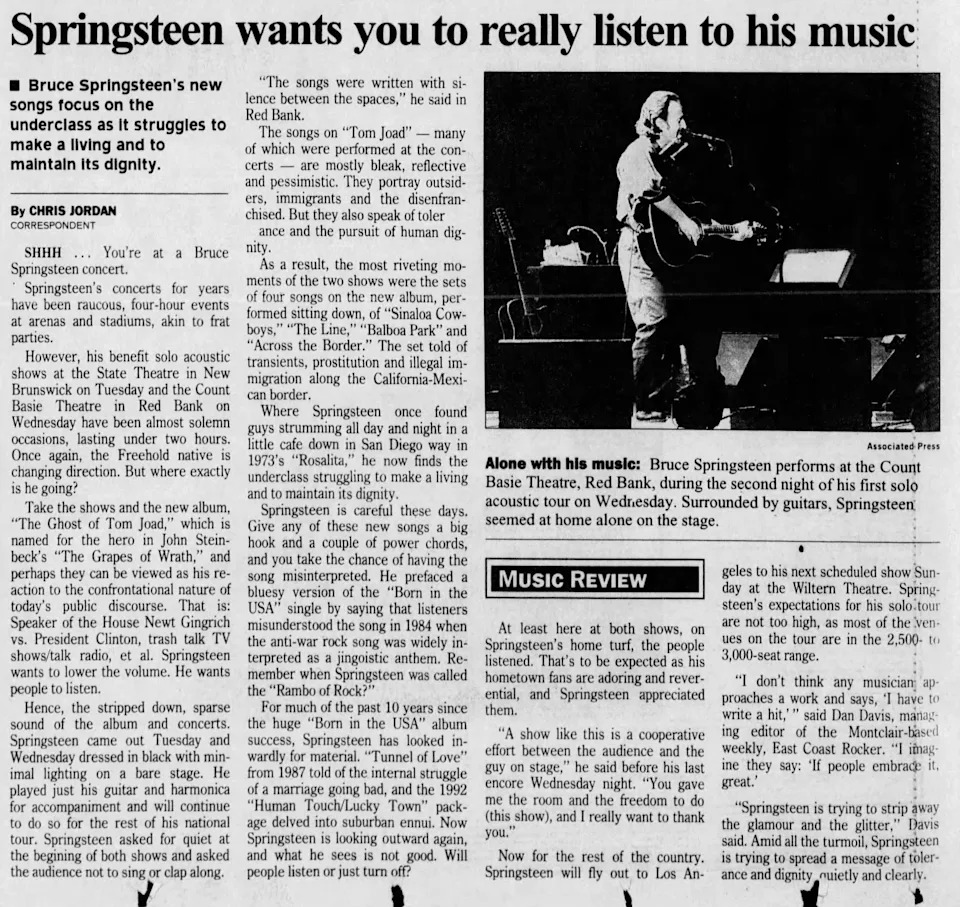
However, his benefit solo acoustic shows at the State Theatre in New Brunswick on Tuesday and the Count Basie Theatre in Red Bank on Wednesday have been almost solemn occasions, lasting under two hours. Once again, the Freehold native is changing direction. But where exactly is he going?

“Springsteen really wants you to listen to his music” appeared in the Asbury Park Press on November 24, 1995.
Take the shows and the new album, “The Ghost of Tom Joad,” which is named for the hero in John Steinbeck’s “The Grapes of Wrath,” and perhaps they can be viewed as his reaction to the confrontational nature of today’s public discourse. That is: Speaker of the House Newt Gingrich vs. President Clinton, trash talk TV shows/talk radio, et al.
Springsteen wants to lower the volume. He wants people to listen.
Hence, the stripped down, sparse sound of the album and concerts. Springsteen came out Tuesday and Wednesday dressed in black with minimal lighting on a bare stage. He played just his guitar and harmonica for accompaniment and will continue to do so for the rest of his national tour.
Springsteen asked for quiet at the begining of both shows and asked the audience not to sing or clap along.
“The songs were written with silence between the spaces,” he said in Red Bank.
The songs on “Tom Joad” — many of which were performed at the concerts — are mostly bleak, reflective and pessimistic. They portray outsiders, immigrants and the disenfranchised. But they also speak of tolerance and the pursuit of human dignity.
As a result, the most riveting moments of the two shows were the sets of four songs on the new album, performed sitting down, of “Sinaloa Cowboys,” “The Line,” “Balboa Park” and “Across the Border.” The set told of transients, prostitution and illegal immigration along the California-Mexican border.
Where Springsteen once found guys strumming all day and night in a little cafe down in San Diego way in 1973’s “Rosalita,” he now finds the underclass struggling to make a living and to maintain its dignity.
Springsteen is careful these days. Give any of these new songs a big hook and a couple of power chords, and you take the chance of having the song misinterpreted. He prefaced a bluesy version of the “Born in the USA” single by saying that listeners misunderstood the song in 1984 when the anti-war rock song was widely interpreted as a jingoistic anthem. Remember when Springsteen was called the “Rambo of Rock”?
“I think a lot of it (“Born in the U.S.A.” album and tour) was misunderstood,” said Randy Crawford, 34, of Freehold, waiting in line for tickets outside the Count Basie on Wednesday. “I don’t think people were really listening to what he was saying.”
For much of the past 10 years since the huge “Born in the U.S.A.” album success, Springsteen has looked inwardly for material. “Tunnel of Love” from 1987 told of the internal struggle of a marriage going bad, and the 1992 “Human Touch/Lucky Town” package delved into suburban ennui.
Now Springsteen is looking outward again, and what he sees is not good. Will people listen or just turn off?
At least here at both shows, on Springsteen’s home turf, the people listened. That’s to be expected as his hometown fans are adoring and reverential, and Springsteen appreciated them.
“A show like this is a cooperative effort between the audience and the guy on stage,” he said before his last encore Wednesday night. “You gave me the room and the freedom to do (this show), and I really want to thank you.”
Now for the rest of the country. Springsteen will fly out to Los Angeles to his next scheduled show Sunday at the Wiltern Theatre. Springsteen’s expectations for his solo tour are not too high, as most of the venues on the tour are in the 2,500- to 3,000-seat range.
“I don’t think any musician approaches a work and says, `I have to write a hit,’ ” said Dan Davis, managing editor of the Montclair-based weekly East Coast Rocker. “I imagine they say: `If people embrace it, great.’
“Springsteen is trying to strip away the glamour and the glitter,” Davis said. “When you play acoustic, there is nothing to hide behind. You’re getting the song at its barest essence.”
Amid all the turmoil, Springsteen is trying to spread a message of tolerance and dignity, quietly and clearly.
This article originally appeared on Asbury Park Press: Bruce Springsteen wants you to listen to the music, 1995
‘ The preceding article may include information circulated by third parties ’
‘ Some details of this article were extracted from the following source www.yahoo.com ’
![Robbie Williams Explains What Fell Onto His Microphone During Live TV Broadcast [Video] - 2oceansvibe News](https://celebrity.land/en/wp-content/uploads/2026/07/Robbie-Williams-Explains-What-Fell-Onto-His-Microphone-During-Live-350x250.jpg)