Photo: Lucia Bell-Epstein
It’s a gray summer Tuesday — the most unremarkable kind of day — and Carla Lalli has been missing out. Namely, on summer produce, which has been arriving in droves, ripe, to the Brooklyn Borough Hall Greenmarket. But Lalli has only gotten to the market once so far this season. So we are going to make up for lost time.
We are both late, which feels fitting, because I am 35 weeks pregnant and she is busy reinventing herself. She no longer goes by Carla Lalli Music. It’s the third summer since she ended her 24-year marriage, and we’re meeting because I want the scoop on the next hot parasocial divorce memoir. Technically, though, we’re meeting to look for tomatoes because Lalli writes so viscerally about them in her memoir-slash-cookbook, Food Is a Feeling, that I’ve become desperate to eat them with her. (Her ex did not like tomatoes; over time, she internalized that and began to see them as “saggy, gaggy fruit blimps,” until divorce freed her to slurp “the warm juices right from their fruit cenote.”) This is a book, by the way, that everyone dissuaded her from writing; she was told over and over again that no one would want to read a book about divorce, and her publisher offered her $100,000 less for the manuscript than her previous advance. While I wait — she texts frantically that she is parking but is stuck behind an ambulette — I wonder if this was misguided. Not only did I read it cover to cover twice in two days, but I have to imagine you will too, after having lapped up everything you could these past few months in and about Belle Burden’s Strangers, the Amanda-Kyle-West-Ciara clusterfuck, Margaret Qualley and Jack Antonoff, and God knows who else’s crumbling marriages.
So Food Is a Feeling is not a traditional cookbook at all. It is a book of personal essays about the dissolution of Lalli’s relationship with deft recipes (like the salt-and-pepper pork chops she made the night she told her kids about the split), and more than that it is a poignant and honest meditation on the power of cooking in transitional periods.
Lalli didn’t invent cooking on-camera, of course, but there was a time when so many people wanted to watch her do it that it felt like she might have. As the food director for Bon Appétit during its boom times, Lalli — along with her Test Kitchen colleagues — made food psychotically cool. Suddenly, fluency in “brothy bean” culture was a more important marker of one’s cultural know-how than being up-to-date with the “Styles” section, and watching someone spatchcock and roast a chicken beneath a second cast-iron pan felt more compelling than the latest episode of Stranger Things. Former staffers like Alison Roman caught the headwinds (at one point, Taylor Swift was reaching out to say she loved her stuff).
Lalli’s role was a sort of modern Ina-Nigella hybrid for millennials, a little older than us but youthful in spirit: mischievous, opinionated, authoritative. As Bon Appétit’s fun aunt, she racked up view counts as high as 4.6 million (“Molly and Carla Try to Make the Perfect Mashed Potatoes and Gravy”) on the illustrious YouTube channel. She seemed to give fewer fucks than someone else might have in her shoes, and it made her wildly likable.
When it all imploded, Lalli didn’t escape totally unscathed — but she did make it out with a fervent fan base. She had already published her first cookbook, Where Cooking Begins, and she left the magazine and began to produce her own videos and recipes, poised for pandemic-era success. Her second cookbook, That Sounds So Good, was published in October 2021, and Carla’s Cooking Show debuted on YouTube that same month with “Bacon, Egg and Cheese on a Biscuit.” The video racked up 444,000 views.
It worked until it didn’t. In a 2025 Substack post, Lalli detailed “the true cost” of maintaining a YouTube presence without institutional backing. She was taking sponsorships to subsidize a portion of production and bleeding money on the videos she actually wanted to make. She wrote about the person she had become, as opposed to the performer she showed the rest of us:
I’ve been doing this a long time, and as a high-summer Leo, my ego is robust, but there were plenty of times when I truly could not stand myself or my performance … In 2023, when my marriage broke up and I had to stay in (goofy, upbeat) character for the sake of my and my family’s privacy — that was brutal. I was living a lie, projecting an inauthentic version of myself. The conflict between the person in reality and the performer ate away at me.
She is unapologetically transparent now as she walks toward me at the Greenmarket in a white linen blouse and barrel-legged pants, her green jelly sandals clacking against the ground, grinning. There’s a vulnerability to her, or maybe just an acceptance. Her curls, with beautifully harsh streaks of gray, are still wet, and they frame a trove of gold hoops and studs. She doesn’t mess around with small talk; immediately, she tells me that to begin writing Food Is a Feeling, she had to start with the most painful part: reliving the worst summer of her life. “It felt insane to be doing it,” she says.
As she describes the small battles she had to wage every step of the way to write the sort of divorce memoir she wanted to, she moves with that recognizable authority, picking up a pea from a vendor’s bin and snapping off the stem end. She tastes it for sweetness. “We need to have a conversation about what this book is,” she remembers thinking after filing an early version of the recipe for a “conceptually flawed” tuna melt that comes after an essay on relapsing on pot and buying a house in the final throes of a failing marriage. The tuna-melt recipe ends with a cheeky message: “Life is booby-trapped with things we need to figure out on our own; this sandwich is one of them.”
Naturally, Lalli’s publisher questioned the logic of including a recipe for an underwhelming sandwich. “How weird would it be to give a recipe for a perfect tuna melt after that essay?” she thought. She studies a few heirloom tomatoes, hefting them one at a time to assess their give, before taking a deep sniff. “It felt like the question was ‘Are you sure you want to make a book about a messy transitional period in your life? And learning from mistakes?’”
She was sure. After years of writing flexible, service-forward recipes, Lalli had had a revelation: She wanted to flip the order of operations and focus on the emotional connection anyone can have to food with service as a secondary output. And she was especially sure that readers were ready for it.
To make it happen, though, she had to state her case. She remembers compiling links and arguments — Look how much everyone cared about Reese Witherspoon’s divorce!!! — and combating misconceptions about what the book would be. “I’m not sad, but people do go through sad stuff,” she says, stuffing beefsteak and heirloom tomatoes into an Archestratus tote before moving on to the She Wolf stand for a baguette. “What I didn’t want was for it to be pathetic, too maudlin.”
I have a hard time imagining anything she produced could be pathetic or maudlin as we climb into her SUV and the touchscreen display lights up with her username, “CutiE.” Jazz sputters back to life mid-track. (Driving, Lalli says, is her “toxic trait.” When a person is finally alone after decades of existing in opposition to other people’s needs, every bit of personal space counts.)

Photo: Lucia Bell-Epstein
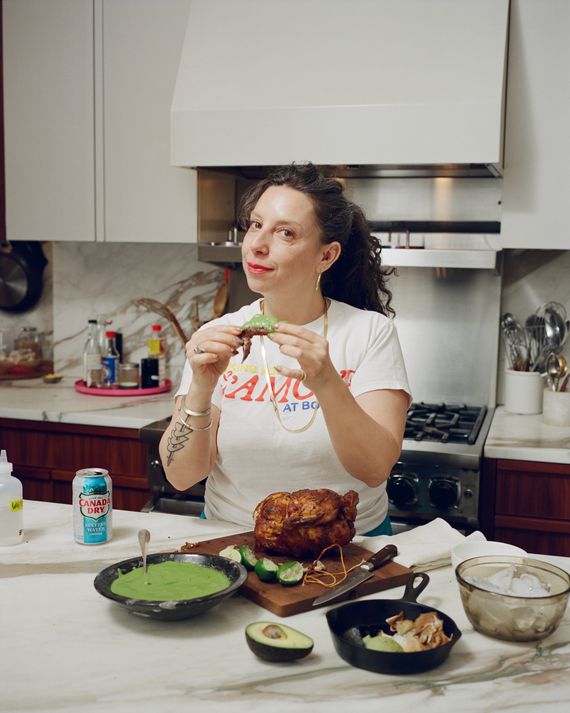
Her narrow kitchen is spectacular and soothing, not just because of the honed marble and dark woodwork, but because it reveals what — and who — is important to Lalli. A wall by the window holds pots on pegs, some especially well worn, and one shares its peg with a bunch of overripe bananas; someone has broken off the most accessible one. Two spider skimmers sit in a utensil jar, and it is clear which one Lalli favors. A sheet of paper on the counter bears her last name dozens of times over, evidence that her son Cosmo has been practicing his calligraphy to create a logo for her new apron line. Her dog, Sergeant Margaret, bounds through begging to play.
Stepping inside feels like wandering into one of the collages that appear throughout Food Is a Feeling, which her sister Nina assembled from a stack of stuff Lalli had saved: a photograph of a young Carla balancing what looks to be a burrito on her baby bump; an old menu from a restaurant where Lalli worked as an entremetier; an image of her father, who died this spring, with his glasses balanced on his forehead, reading the paper. A rejected title for Food Is a Feeling, she tells me, was Buttered Rice, which happens to be my favorite recipe in the book. The night she moved into a sublet with the desultory collection of odds and ends she’d taken with her, she cooked rice in melted butter before adding water and salt and topped it with some kale. Her sister, who was there to keep her company, pointed out that her mom always used to cook rice in butter. People obviously change, but that they also stay the same in rote and tiny ways, often by accident, is among the more resonant truths brought home by the book.
Lalli ties her hair into a bun and starts to make what she’s calling L.E.T.s: lettuce-eggplant-tomato sandwiches, which in her estimation will be “herby and smushy, with a spicy mayo situ-aish.” We start to talk about memory — are people encoding new ones anymore? She tells me about meeting her ex-husband (early in her career, when she worked in publishing); and a fortuitous phone call with her dad (he encouraged her to go back to school, and she chose culinary studies, thanks to a financial gift from an aunt in her 80s); and her time working at Drew Nieporent’s restaurant Montrachet, which she followed with a job at Rocco DiSpirito’s Union Pacific that she tried to leave (the lifestyle was punishing) before DiSpirito offered her a gig as kitchen manager. It was in that role she made her first onscreen appearance, in the early-aughts reality-television series The Restaurant. “It’s so cringe,” she says.
Then an alarm goes off. “That’s my reminder to eat lunch,” she says as she uses a Japanese knife to slice a careful slit down the stalk of a spring onion. She scores slabs of eggplant, then slices both types of tomatoes and salts little chunks, handing them to me across the counter to compare. The heirloom is good, but the beefsteak is better, firmer, and more floral.
I ask her about that post she wrote — on the difference between being a person and being a performer — and whether putting the kibosh on YouTube videos helped to resolve that tension. She sprinkles MSG on the tomato slices and begins to shallow-fry the eggplant. It soon becomes deeply burnished and smells like onion rings. She needed a break — “I just couldn’t do it any more economically, and sitting in my house hearing myself, looking at myself, I was so fucking sick of myself” — but actually, she says, she would kill to be on video again if someone were footing the bill. She loves to perform, and her resentment about having to shroud herself behind a fake smile is now gone. She is single, and she is happy, and she has thoughts about the limitations of long-term monogamy, and she is telling us about all of it.
But what about the audience and the parasocial nature of this work? Lalli is offering to teach her followers to make aïoli, not filming confessional vlogs of her darkest hours; I wonder if she thinks we ever overreach or if she worries that, by giving us the story of her divorce, we will want even more from her. But Lalli says she adores her relationship with her fans, and she still gets recognized almost every day. Just a few weekends ago, she went out dancing by herself at the Sultan Room. A 20-something kid danced up to her in the wee hours and said, sort of shocked, “Carla? You taught me to cook! I made your shrimp with kimchee last night! What are you doing here?” and they moved together to the music for a while. She stayed out until 2 a.m.
“What is the point of suffering? I used to think it was important to your moral vigor,” she says. Now she is less professionally competitive than ever, and “more interested in my own comfort and pleasure,” she tells me. “And I no longer have the instinct to take a picture of my food.” She is dating, but she never wants to live with someone again. She has, however, rediscovered the delightfulness of a crush.
I look up from a copy of her book to see that suddenly, Lalli is assembling the L.E.T.s. She is ten steps ahead of where I last left her. At some point, the onions were fried into frizzled strips, the spicy-herby mayonnaise was mixed, the baguette was lightly toasted, and her dog was mollified. That, I realize, is her gift. She made it look so easy, and she made me want to listen to what she was saying more than I wanted to do it myself.
She knows her legacy at Bon Appétit is alive in almost everything she does, not just because it was there that she learned how to make food stylish and commercial, but because of the aftermath. “The criticism made me more thoughtful, and aware of unconscious bias, and how I came off,” she says. “And it made me more comfortable now saying what I want online.” Doing so has impacted her viability for brand deals, she says, but “at the end of the day, I asked myself, ‘Would you rather make money or speak out about something so horrific it’s insane not to say something about?’” Lalli is at a point in her life at which she’s firmly okay with being disliked.
The book is a risk. The divorce itself was a risk. But if her story gives even one person “a language” for what they’re feeling, she’ll consider it a success. I open my mouth as wide as possible to bite into the baguette L.E.T. she has plated and served beside a floor-to-ceiling mirror with a Post-it stuck to it that says “may all your beans be tender.” The eggplant is insanely creamy and, impossibly, smokier than bacon would have been.
If what Lalli says is to be taken at face value — if she is to be followed, again, with that same sort of fervency she attracted in the Test Kitchen — then joy and reinvention are timeless, ageless pursuits. And what could be more worth believing than that?
‘ The preceding article may include information circulated by third parties ’
‘ Some details of this article were extracted from the following source www.grubstreet.com ’