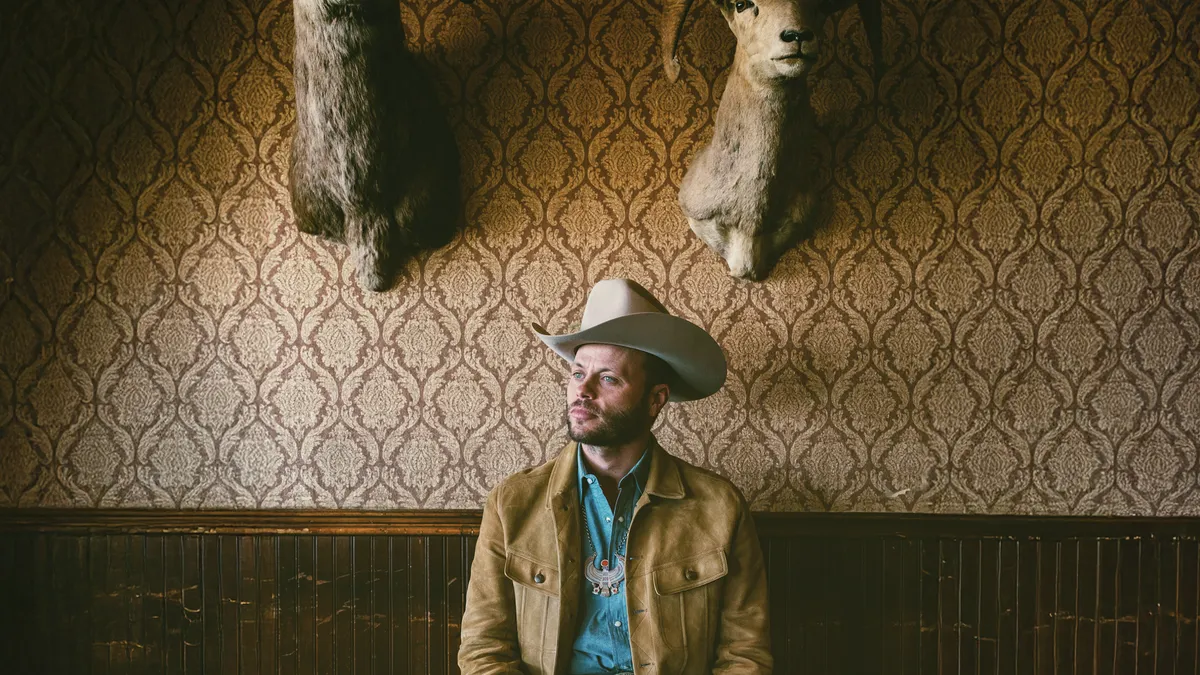
Charley Crockett has always operated outside of the system. On his new concept album “Age of the Ram,” his protagonist does, too.
The 42-year-old country-blues artist tells the legend of Billy McLane. Deep in the Wild West, McLane is a small-time cattle rustler caught in the crosshairs of the Santa Fe Ring, a corrupt group of politicians and businessmen that controlled New Mexico for nearly five decades.
The fables aren’t too far removed from Crockett’s own life.
The Texas-born singer grew up in a single-wide trailer surrounded by grapefruit orchards and sugarcane. He went from busking on the streets of New York City, New Orleans and Paris to working on marijuana farms in California and hauling pounds of ganja cross-country to fund his music career.
While still in his teens, he got involved in his brother’s multimillion-dollar stock-fraud scheme. In 2016, Crockett spent about a month in the New River Valley Jail in Virginia for a cannabis charge.
Now, he’s an Americana Award-winning and Grammy-nominated artist who released 14 albums independently before signing with Island Records in 2025. He has shared stages with Willie Nelson, Tyler Childers and Leon Bridges. He even has items currently on display at the Country Music Hall of Fame and Museum.
But how much of Crockett’s story is in “Age of the Ram”?
In a phone interview from the road somewhere between New Mexico and Los Angeles, Crockett said, “If you look close, I’m in there.”
On May 29, Crockett will headline one night of Nashville’s 2026 Music City Rodeo. His “Age of the Ram” tour kicks off on April 24.
Ahead of the show, Crockett let The Tennessean in on his latest creative project, which released April 3.
‘Age of the Ram’ completes Crockett’s ‘Sagebrush Trilogy’
Crockett has a classic country sound that blends honky-tonk vocals with worn-in, vintage crooning, and the new record uses that unique feel to transport listeners back in time.
Sounds of rolling film reels, clomping horse hooves, crackles, slams and gunshots propel the 20 tracks, which run about 45 minutes.
The album is the third and final installment of his “Sagebrush Trilogy,” a trio of concept albums that began in March 2025 with “Lonesome Drifter,” a 12-track album about a man on the road trying to find his place.
In August, Crockett dropped the second chapter, “Dollar a Day,” where a ranch hand struggles to scrape by. “Cowboys and money don’t mix,” Crockett sings in the record’s title track.
Crockett calls “The Ram” a “kind of a simple Western fiction story.”
He built a world just concrete enough for listeners to have fun filling in the gaps, kicking off with a theme track that introduces the record as a “feature presentation.” It’s as if you’re sitting in an old-timey theater while the red curtain peels back to reveal a black-and-white Western.
The main character, McLane, went from working in the cotton fields of West Texas to heading north in search of work. Cattle rustling – and typical outlaw behavior – puts him on the map. When powerful players catch his trail, the waters get murky.
With vibrant pedal steel, plucky piano and simple guitar, Crockett’s McLane visits the tavern, finds himself in shootouts and mourns the loss of a friend.
In “Diamond Belle (Country Boy),” the protagonist laments his high-risk lifestyle. And, in the standout track “Kentucky Too Long,” Crockett brings a raw Americana energy as he sings of Unclе Sam and the Vietnam War.
“Eventually he’s got everybody after him and he escapes into the Crazy Mountains where he’s going to make his stand,” Crockett said, explaining the record’s climax.
On the final track, “Cover My Trail Tonight,” Crockett sings: “You have seen behind the curtain on a ‘Dollar a Day’ / I’m trying to paint you a picture / But there’s been quite a mixture of honesty and fiction / To tell it straight.”
But we can’t give away the ending – you’ll have to listen for yourself.
Who is Billy McLane?
The album trilogy is a commercially risky feat that few musical artists have pulled off. Listener fatigue, and the challenge to maintain quality across multiple projects, are common hurdles.
The most renowned examples of previous trilogy projects include David Bowie’s “Berlin Trilogy,” Kanye West’s “College Dropout” series and The Cure’s “The Gothic Trilogy.”
But Crockett was called to the challenge, inspired by the “Dollars Trilogy,” three Italian-produced Spaghetti Westerns from the 1960s starring Clint Eastwood, as well as author Cormac McCarthy’s “The Border Trilogy” from the ’90s.
Alongside producer Shooter Jennings, Crockett tied themes together across the first two records.
“(We) were proud of it, and also left in a position of, ‘How do you follow it up?’ I was definitely intimidated,” Crockett said.
Treating each song as “its own little film” helped ground Crockett. “When I’m storytelling, I’m seeing the visual more than anything.”
Much of the creative process began on iPhone voice memos, where Crockett has about 15,000 song starts saved. “It’s a bottomless well,” he said, safely storing the lyrics that become thematic callbacks and Easter eggs across his albums.
Crockett first references McLane in the title track of his 2024 record “$10 Cowboy.”
He fleshed out his own version of the character after hearing his name in the 1963 Marty Robbins song “Old Red,” where a cowboy by the same name dies trying to break an untamable horse.
Crockett and Jennings recorded “Age of the Ram” in L.A. at Sunset Sound Studio 3 over a short time frame in October 2025. After finding the perfect chord progression for a grounding theme in the storyline, Crockett knew the work was finished.
“I think we painted a beautiful picture,” he said. “I hope people are satisfied, get to enjoy it and wonder about it.”
‘A lot of those boys turn in their saddles … I’m still in business’
Listening to Bob Dylan sing about the legendary gunfighter Billy the Kid was another inspiration for the project.
“I see a lot of parallels to singer-songwriters, we’ve all got a lot in common with Billy the Kid. Trying to stay one step ahead, trying to keep from getting fenced in, sold off and played out,” Crockett said, adding that now, more than ever, he relates to Billy.
“Hell, I’m pretty sure I’ve been catching strays and dodging bullets,” he said. “A lot of those boys turn in their saddles, but I gotta be careful what I say … I’m still in business.”
This year, Crockett has vocally opposed President Donald Trump, whom he called a “grifter” on social media, and criticized both Elon Musk and Peter Thiel.
When Jelly Roll and Bad Bunny won Grammys in February, Crockett vocally contrasted the two artists’ acceptance speeches. “I saw a guy get up and talk about Jesus and then I saw Bad Bunny get up there and talk like Jesus,” he said.
That same month, Crockett was forced to cancel his Canadian tour after being denied entry to the country due to his decade-old felony weed charge.
“I made mistakes,” Crockett said, but he’s grown. Today, kicking up dust for Crockett means taking a stand. “If that ol’ governor were to pardon me, I could probably make my shows in July,” he said.
In Crockett’s personal odyssey, the biggest challenges weren’t clawing his way up in the music industry, spending nights in jail or even fighting a heart condition that required an open-heart surgery.
“The hardest thing to do is to go your own way,” he said.
“The pressure to conform, to live up to somebody’s idea of who you should be, it’s pretty inescapable for most of us. I don’t know if it was just because of the circumstances, but I found another way.”
To learn more about Charley Crockett, visit charleycrockett.com. To buy tickets to see Crockett perform at the Music City Rodeo, head to ticketmaster.com.
Audrey Gibbs is a music journalist at The Tennessean. You can reach her at [email protected].
Curious what The Tennessean’s music team has been listening to lately? Check out our playlist below, featuring all local artists.
‘ The preceding article may include information circulated by third parties ’
‘ Some details of this article were extracted from the following source www.tennessean.com ’