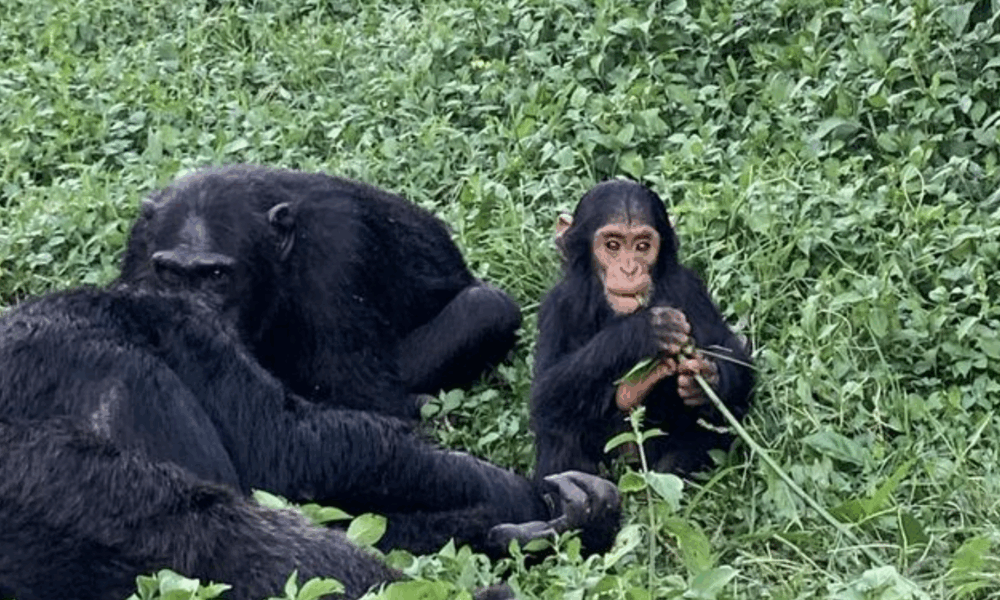
Courtesy of Dr. Laura Simone Lewis
If youve ever found yourself glued to a reality TV show or eavesdropping on a juicy conversation, youre not alone — and you may share that instinct with chimpanzees.
In a study spanning continents and species, researchers have found that both human children and chimpanzees show a strong, measurable curiosity about the social interactions of others. Published in Proceedings of the Royal Society B, the research reveals that social curiosity — a desire to watch and understand how others relate, argue, or bond — may be far more ancient and fundamental than previously thought.
“After years of observing both children and chimpanzees sometimes jumping up in the middle of research games to observe their peers, the research team was inspired to pursue a new social avenue in the blossoming field of curiosity research,” said lead study author Laura Simone Lewis of the University of California in Santa Barbara.
The team conducted three experiments using specially designed “curiosity boxes” — wooden enclosures holding tablets that showed different types of videos. One screen played social scenes, like grooming or playing. The other showed an individual alone.
In the first experiment, children ages 4 to 6 and sanctuary-living chimpanzees consistently chose to watch the social videos. In a second experiment, they were even willing to give up rewards — marbles for kids, jackfruit seeds for chimps — to do so. Younger children and male chimpanzees were especially likely to pay the cost.
“This means social curiosity emerges early in human development and is shared with one of our closest living cousins, the chimpanzees,” Lewis said. “Our strong interest in the lives of others — think gossip magazines and celebrity shows — seems to have deep evolutionary roots in our great ape lineage.”
The third test explored emotional nuance: whether subjects preferred to watch positive interactions like play, or negative ones like conflict. Here, age and gender made a difference. Human boys grew more interested in negative scenes as they got older, while girls preferred positive ones. Chimpanzees showed no strong preference.
“This study tells us that curiosity about what others are doing — what you might call being a bit nosey — starts young and runs deep. Its probably something that helps not only us but also our closest living relatives to survive and thrive in complex social groups,” said Esther Herrmann, co-author and researcher at the University of Portsmouths Center for Comparative and Evolutionary Psychology.
The researchers believe their findings reflect an evolutionary strategy. Observing others helps individuals assess group dynamics, learn social rules, and understand who can be trusted — insights critical to survival in complex societies.
“This kind of social curiosity is actually really important for learning about our environment, making decisions, and building relationships,” Herrmann said.
The study marks one of the first times scientists have directly compared social curiosity in chimpanzees and children using the same method. Next, the team hopes to explore how this curiosity develops in even younger chimps, across more cultures, and in other great apes like bonobos and orangutans.
As it turns out, being a little nosey might just be one of the most deeply human — and deeply primate — traits we have.
‘ The preceding article may include information circulated by third parties ’
‘ Some details of this article were extracted from the following source nationalenquirer.com ’