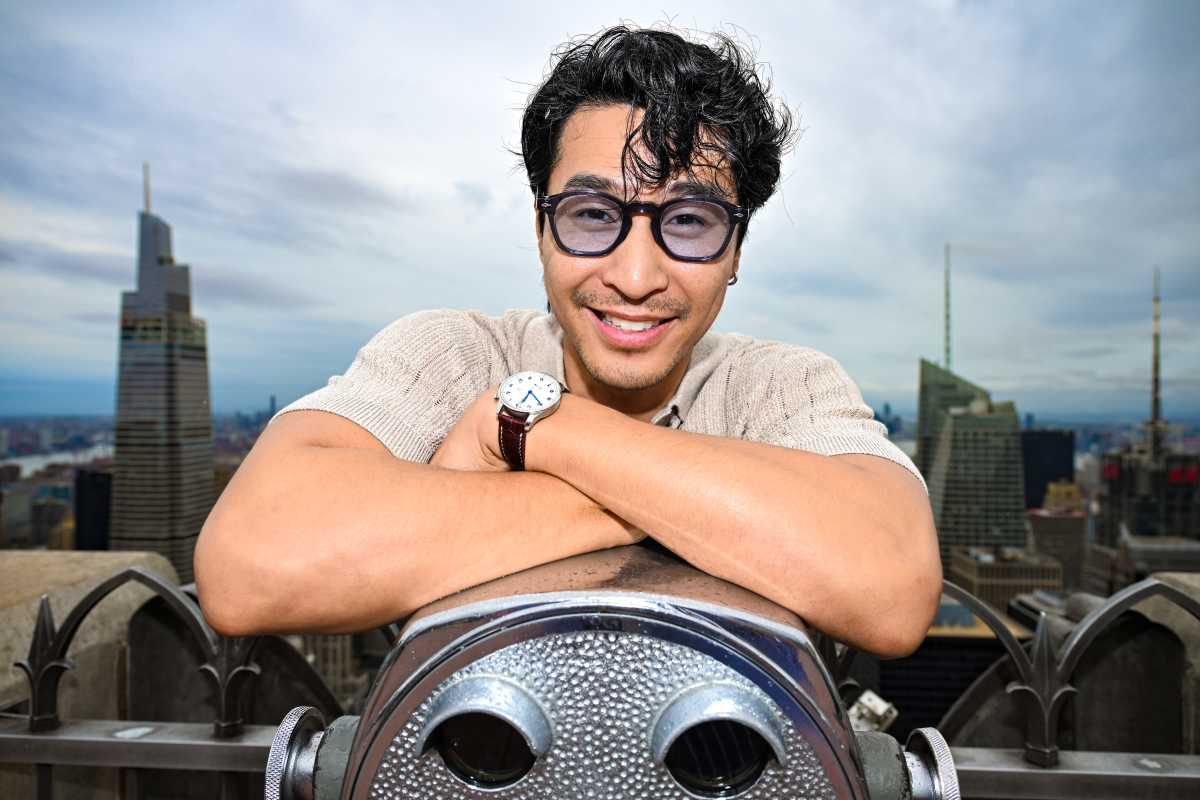
Everyone wants to be the hero. Christopher Pang, however, would rather be the guy audiences love to hate.
The Australian actor, writer, and producer has spent much of his career playing charming best friends and romantic leads. But in The Season, Hulu’s six-part drama set among Hong Kong’s ultrawealthy elite, Pang finally gets to embrace a far messier character.
“It’s so much more fun,” Pang laughed during an interview with amNewYork at Top of the Rock. “I’ve always been cast as the nice guy, the rom-com lead, or the best friend. This time I got to play someone who’s abrasive, selfish, and completely unapologetic.”
Pang stars as Andrew Fong, a wealthy socialite navigating the ruthless world of Hong Kong’s elite, where power, business, and carefully guarded secrets are constantly colliding.
“We love to hate him,” Pang said. “He’s a terrible human being, but he’s so unapologetically himself that somehow you end up liking him.”
Rather than portraying Andrew as a one-dimensional villain, which Pang doesn’t believe he is exactly a bad guy, he worked with the creative team to uncover what was driving the character beneath the surface.
“We decided very early on that all of that arrogance came from insecurity,” he explained. “Underneath it all, he’s just a little kid who wants to be loved. Once we found that, we could balance this huge asshole with someone who’s charismatic, funny and strangely likable.”
For Pang, morally gray characters are often the most rewarding, and he hopes to continue pursuing them in future roles.
“When you’re carrying the story as the hero, there are certain limitations,” he said. “The side characters, and especially the villains, get to have the most fun.”
The Season shows a different side of Hong Kong, and beyond the role itself, Pang tells amNewYork that he was drawn to the series because it offers audiences a side of Hong Kong rarely explored in Western television.
“I’ve always loved Hong Kong cinema,” he said. “It’s one of the most romantic and visually stunning cities in the world, so filming there had always been a dream.”
He describes the series as “a modern-day Bridgerton set in Hong Kong,” blending glamour, family rivalries, and scandal against the backdrop of one of Asia’s most influential cities.
“It’s just a really fun show,” he said. “Put it on and enjoy yourself.”
The Season is just one portion of what Pang says representation begins behind the camera.

Pang, who appeared in the groundbreaking Crazy Rich Asians, believes meaningful representation starts long before actors arrive on set.
“It begins behind the camera,” he said. “We need authentic stories being told by the right people. That creates the foundation for everything we do in front of the camera.”
He also hopes aspiring filmmakers recognize how accessible storytelling has become.
“Everyone has a camera in their pocket now,” Pang said. “If you want to tell stories, go make them. What’s your excuse?”
While he acknowledges Hollywood has made progress since his first film in 2009, he believes the industry still has a long way to go.
“The conversation around diversity has absolutely improved the writing,” he said. “We’re making progress, but for the people pushing for change, it’s never going to happen fast enough.”
Rather than waiting for opportunities, Pang has expanded his career behind the camera as a writer, producer, and director, developing projects that center on underrepresented stories. Developing the stories that he wants to see, rather than just waiting for them to someday happen.

Among them is a biographical film about pioneering Japanese actor Sessue Hayakawa, one of silent Hollywood’s biggest stars.
“He was America’s first male sex symbol, the first actor to start his own studio, drove a gold car around Hollywood, and lived in a 32-room mansion,” Pang said. “Most people have never heard of him.”
Hayakawa became one of early Hollywood’s first international stars before earning an Academy Award nomination decades later for The Bridge on the River Kwai, and it’s this historic significance that Pang believes makes this story deserving of rediscovery.
“I’m obviously not Japanese, so I’m not going to play him,” Pang said. “But it’s an important story that needs to be told.”
The project is just one of many currently on his slate, which also includes romantic comedies, horror films, and crime thrillers.
“If the opportunities aren’t there, you have to create them yourself,” he said.

So how did Pang catch the acting bug? He credits his love of storytelling to his parents, both martial artists, who transformed everyday afternoons into elaborate adventures.
“My mom would put on these one-person performances in our backyard,” he recalled. “She’d be the kung fu master, I’d be the student, and we’d imagine these huge cinematic adventures. That’s where the storytelling bug started.”
Growing up in Australia, however, he rarely saw Asian faces on screen outside of stereotypes, leaving him questioning where he belonged.
“I didn’t know if I was Australian enough or Chinese enough,” Pang said. “I wondered whether I should even want to be Asian because I never saw people like me represented in a positive way.”
Today, that experience fuels everything he creates.
“My mission is to put Asian culture and Asian faces into Western media,” he said. “It’s for the kid I used to be, and for every kid growing up now who deserves to see themselves reflected on screen. Representation gives people a sense of belonging, and that’s something every child deserves.”

‘ The preceding article may include information circulated by third parties ’
‘ Some details of this article were extracted from the following source www.amny.com ’