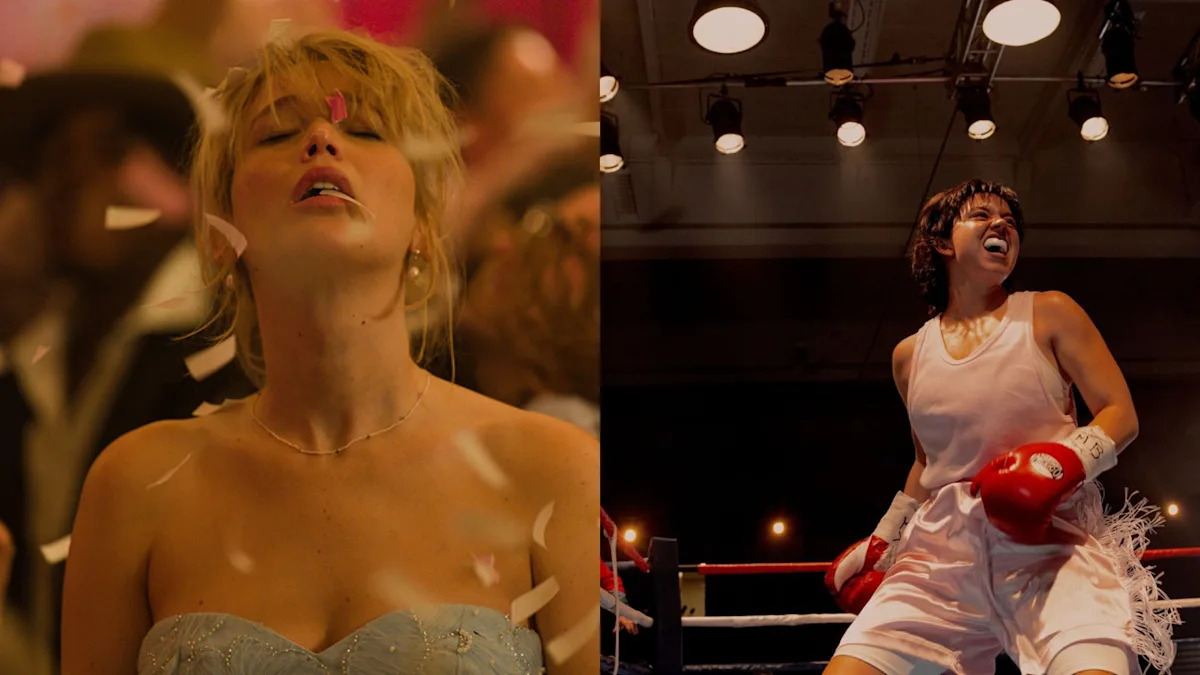
It’s been a bruiser of a weekend for specialty releases. Mubi’s Die My Love, Lynne Ramsay’s psychological thriller starring Jennifer Lawrence and Robert Pattinson, stumbled out of the gate with an estimated $2.61 million on 1,983 screens — the company’s widest push since The Substance. Black Bear’s Christy, with Sydney Sweeney as women’s boxing legend Christy Martin, managed just about $1.31 million across roughly 2,000 theaters.
Sweeney took to Instagram on Monday to say she was “deeply proud” of the movie, noting “we don’t always make art for the numbers, we make it for impact.”
More from The Hollywood Reporter
Sweeney might be impact-oriented, but it’s fair to assume Black Bear, which used the film to launch its new U.S. theatrical arm, is also in it for the money.
What the Christy and Die My Love numbers do point to is a broader realignment in U.S. indie distribution. The traditional safety net — the “pay-one” window, the first pay-TV/streaming license after theatrical — has frayed as streamers scale back third-party buys. Some legacy players still have output pacts (A24’s films go to Max; IFC’s land on AMC+; Neon has long used Hulu for the post-theatrical home), but for most newcomers, the days of pre-sold pay-one economics are over. (Mubi, uniquely, can route to its own platform.)
That pullback is one reason so many festival titles are sitting on the shelf. “There’s still a lot of unsold inventory,” says Upgrade Productions’ Matt Brodlie, pointing to Sundance, Tribeca and Toronto titles that would have found homes a few years ago.
“There are so many films that used to get a theatrical release that aren’t getting theatrical releases anymore,” agrees David Garrett of Mister Smith Entertainment. “There’s a lot out there looking for a home.”
With fewer pay-one deals out there, Garrett argues, the field has “kind of leveled,” enabling newcomers to “pick up a lot of high-profile or buzzy movies for little or no MG (minimum guarantee), then give it a limited theatrical release [and] put it on the digital platforms.”
What is clear is that there are a new cohort of disruptors on the indie distribution scene, new players, large and small, trying to figure out what models can make the numbers work.
Row K Entertainment, launched this year by Media Capital Technologies and led by former Paramount/Imax executive Megan Colligan, is one of the few trying to play in the wide-release space. The company planted a flag with an eight-figure U.S. deal for Jaume Collet-Serra’s reimagining of 1990s actioner Cliffhanger, starring Lily James and Pierce Brosnan.
Another is Black Bear, owned by billionaire Teddy Schwarzman, which has added an ambitious U.S. theatrical arm to its operations, which already span production, international sales and releasing divisions in U.K. and Canada. The company hired longtime Lionsgate distribution chief David Spitz to run domestic releasing and has signaled plans to handle up to a dozen films a year, ranging from specialty to 3,000-screen wide bows. Christy’s soft launch shows how tough that space can be, but Black Bear will be back at bat with Jason Statham’s Shelter, dated for Jan. 30, 2026.
The bigger established indies are still in the game, but both A24 and Neon are shifting strategy. A24 is leaning further into in-house production, taking bigger auteur and genre swings, testing the mid-budget waters, while Neon is doubling down on horror, led by its star director Osgood Perkins (Longlegs, The Monkey). This year’s results have been mixed. A24’s MMA drama The Smashing Machine, directed by Benny Safdie and starring Dwayne Johnson, underperformed, but there is major box office, and Oscar buzz, around brother Josh’s ping pong sports dramedy Marty Supreme. The Timothée Chalamet starrer hits U.S. theaters on Christmas Day.
Further down the food chain, a cohort of specialty “pick-up artists” is scouring festivals for gems the old system left behind. These are lean teams built for agility over overhead, which buy selectively and spend surgically, mainly on social media, targeting the younger cine-savvy audience, the Letterboxd generation, and monetize across windows without a guaranteed pay-one.
Jason Hellerstein’s 1-2 Special fits the mold, launching with Urchin, the directorial debut of Babygirl actor Harris Dickinson (still in release, it has grossed around $200,000 to date) and with several festival titles — Ildikó Enyedi’s Venice competition entry Silent Friend, Rade Jude’s Dracula and Kontinental ’25 — on its upcoming slate.
Smaller micro-distributors are focusing on a specific market niche. Elizabeth Woodward’s Willa, which has acquired Alonso Ruizpalacios’ migrant worker drama La Cocina and Kaouther Ben Hania’s Gaza-set Oscar contender The Voice of Hind Rajab, specializes in titles with “social and cultural importance.” Cartuna x Dweck is leaning into the weird, midnight-madness film crowd, with the acquisition of Grace Glowicki’s low-budget horror comedy Dead Lover out of SXSW. Chicago-based Watermelon Pictures, run by brothers Badie and Hamza Ali, has carved out a space in Palestinian cinema with From Ground Zero (2024), The Encampments (2025) and Cherien Dabis’ All That’s Left of You, which the group will co-release with Dabis’ new distribution company Visibility Films.
Faith-based distributor Angel Studios has shown the profit that can be found in underserved audiences. The Utah-based group’s animated feature, The King of Kings, grossed $60 million at the domestic box office, making it the most successful indie release of 2025 to date
The abundance of new domestic buyers means there are more homes for more movies.
“There are definitely more opportunities to place all of these different types of projects in the U.S. market now,” says Charades co-founder Carole Baraton, who sold Urchin to 1-2 Special and Julia Ducournau’s Titane follow-up Alpha to Neon.
But at the top of the market, the performance of Die My Love, Christy and The Smashing Machine suggests taking indie titles wide is still a challenge.
“The real issue is, if you’re budget’s too high, these [wide-release] models just don’t work,” notes one veteran producer/sales agent. “If your film costs $25 million, what’s the release plan that gets you’re financiers paid back? The real challenge is less distribution than how to get, and keep, those budgets down.”
Best of The Hollywood Reporter
Sign up for THR’s Newsletter. For the latest news, follow us on Facebook, Twitter, and Instagram.
‘ The preceding article may include information circulated by third parties ’
‘ Some details of this article were extracted from the following source www.yahoo.com ’