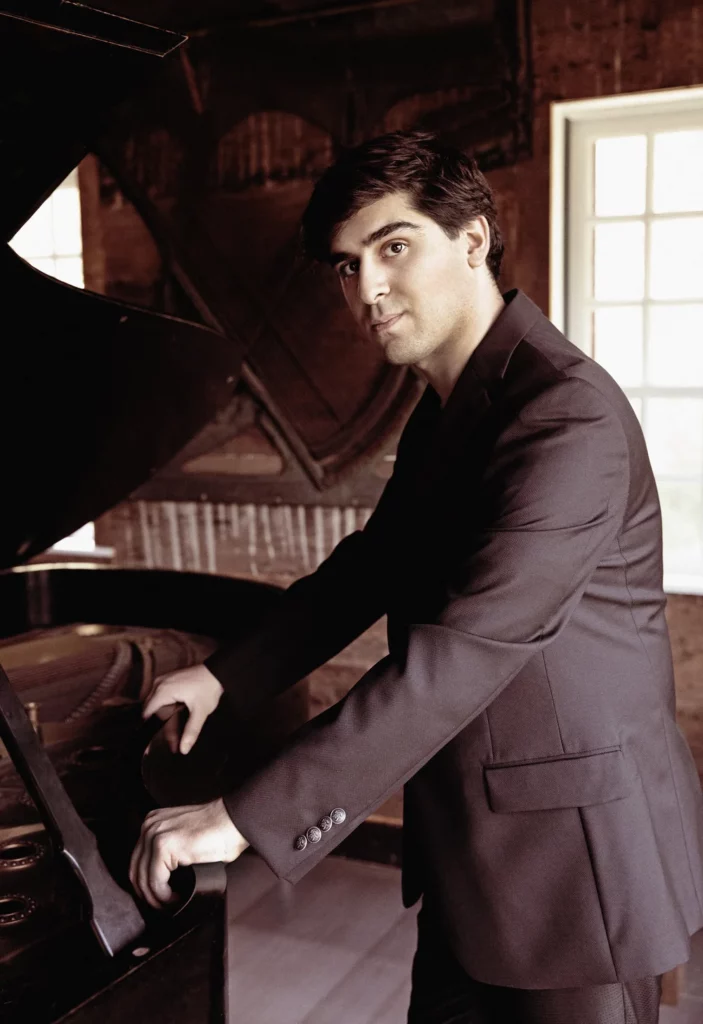
The Terra Quartet with pianist Evren Ozel at Tannery Pond, Sept. 6, 2025
Program
Joseph Haydn, String Quartet in D, Op. 71 No. 1
Béla Bartók, String Quartet No. 3 (1927)
Antonín Dvořák, Piano Quintet No. 2 in A, Op. 81
Almost three years ago (November 2022), the Brentano Quartet performed a program at South Mountain that consisted of quartets by Joseph Haydn, Béla Bartók, and Antonín Dvořák. At the time, I discovered that if a straight line were drawn on a map of Eastern Europe from the birthplace of Dvořák southeast to that of Bartók, it would pass right through the birthplace of Haydn almost at its mid-point. Now again, we have a quartet program of the same three composers, and I am ready to call this “the central European chamber music axis.” While works of Mozart, Beethoven, Mendelssohn, and Brahms are also standard chamber music fare, it is striking to me that Haydn, Dvořák, and Bartók form such a compatible and attractive trio. What connects them, despite their diverse eras (classical, romantic, and modern) and nationalities (Moravia, Austria, Hungary/Romania), is the obvious influence of Eastern European folk music on all three, a major factor in what makes their music so attractive, even in the potentially austere genre of string quartet. At the same time, they represent contrasts in the way these composers from three different eras (Classic, Romantic, and Modern) have absorbed folk influences into their personal styles.
When I reviewed the Terra String Quartet’s Tannery Pond concert last year, I praised them for their adventurous, even daring, program choices. They had played three serious, less-familiar works that contained moments of grim, even tragic, music. These include Mozart’s only minor-key quartet, composed while his wife was in labor; a pre-war work by the young pacifist Benjamin Britten that sharply contrasted idealistic dreams with harsh reality; and Mendelssohn’s tragic final work, the only one he wrote following the early death of his sister Fanny and immediately preceding his own demise. In my review, I described their performance as “full of character, adapting their sound to [the program’s] varied idioms and moods.” At the same time, I noticed some imbalance between first violinist Harriet Langley’s extroverted energy and Amelia Dietrich’s occasional reticence as second.
In looking at the Terra’s press material, I see that such adventurous programming is their norm, with the three Britten quartets as a specialty. All the more reason to be impressed by the contrasts in repertory and performance shown in their return engagement last Saturday. Rather than providing challenging musical adventures, this year’s program offered lyrical beauty, excitement, warmth, and humor. It featured the irresistible romanticism of Dvořák’s Piano Quartet No. 2 (with the expert collaboration of pianist Evren Ozel); the mischievous humor of Haydn’s late Quartet in D, Op. 71 No. 1; and the acerbity and exhilaration of Bartók’s Quartet No. 3 (1927).
In addition to providing a richly enjoyable program, the group itself displayed an increased cohesiveness and richness of sound. Each player had an equal chance to shine in the solo moments of this program, and no one failed to deliver. The volatile textures of the first movement of the Haydn quartet called for the four strings to jump in and out with incisiveness and humor in a musical game of whack-a-mole. The Bartók opened with mordent phrases in a dissonant, expressive, or expressionistic slow counterpoint, each instrument adding its eloquent motive to build up dense sonorities that lead to grand chordal proclamations, with all instruments playing double, triple, or even quadruple stops. There were no signs of reticence or unevenness of texture in any of the complex configurations of this extraordinary work. Finally, there was the rich romanticism of the Dvořák that can be described as “symphonic.” Warm string tone and seamless blend intensified the lyric intensity of this thoroughly inspired work, and the piano part was well integrated into the group sound.
The alert, quick-silver playing in the Haydn quartet gave it a frisky, occasionally hilarious quality, particularly in the outer movements. In the first, a downward-leaping octave forms the main motive, with each instrument jumping, in rapid descending order, into a succession of quickly shifting configurations. The second subject here is a faux-naive folksy tune that reminds us that Haydn served an early tenure as musical accompanist to a “Hanswurst” performer involving improvised slapstick comic routines from both clown and musician. Hanswurst has been described (by Tom Beghin in his book on the Haydn piano sonatas) as “that popular comic figure on the Viennese stage who embodied the same ambiguity between naïve and skilled [as Haydn’s music].” Another subtle element of humor and architecture is the gradual shift in the course of the movement that reverses the direction of the opening motive so that the final cadence is preceded by a welter of such upward overlapping jumps. It has been a practice to distinguish among Haydn’s 83 quartets through nicknames, such as Op. 50 No. 6, known as “The Frog”; thus, Op. 71 No. 1 could be called “The Leapfrog Quartet.”
Bartók’s Quartet No. 3 begins much more seriously, in a dissonant language full of searching, mysterious sonorities (harmonics, on-the-bridge and over-the-fingerboard playing, swoops, and slides) and his characteristic “night music” which mimics the nocturnal sounds of nature in the Hungarian countryside. While this dense atmosphere might turn sinister, here it is eventually permeated with the sounds of song and dance, foreshadowed by plucked strings imitating a folk instrument and emerging, in the “Seconda parte,” into a full-scale evocation of a peasant dance party, with spectacular plucked chords surrounding asymmetrical folk-style melodies (all original to Bartók). After a return to the initial mysterious night music, the festivities resume at a higher energy level for a “Coda, Allegro molto,” which concludes with a determined assertion of life force specific to this composer and to this great quartet.
One reason the string quartet has become such an iconic genre is that it sits on the border between solo and orchestral music and at any moment can move in either direction: It can be intimate one moment and grandiose the next (as dramatically illustrated by the first part of the Bartók). Dvořák’s piano quintet followed intermission, providing an enriched sonic palette: The combination of four strings and piano creates a mass of sound very different than four strings alone. It is an ideal medium for Dvořák’s richly romantic harmonic language with its perfect balance of tonal clarity and chromatic expressiveness. Add a piano to that and the large-scale group statement, all instruments playing together, becomes the norm, while the solo voice or small subgroup becomes the exception. Dvořák’s quintet begins with a solo, a beautiful flowing melody in the cello’s most mellow register, accompanied by piano figures that surround the melody with a halo of harmony. Later the viola receives its own moment in the spotlight. Including the piano redefines the meaning of every texture, and when all play together, the result is indeed symphonic.
The first movement juxtaposes flowing solo lyricism in a major key with increasingly animated dance rhythms including stamping om-pah figures and dotted rhythms. These lead back to the initial melody, now high in the first violin supported by the other instruments in internal conversation and gentle pulsations in the viola that maintain a forward impulse that is never abandoned throughout this formally most complex movement, rarely a step away from the dance. When the music returns to the minor, the energy of the dance ascends to a higher level, with spinning triplets suggesting a kind of Slavic Tarantella. Suddenly the brakes are applied, and after a pause, a new dance spontaneously arises, with a viola solo in a more remote minor key, a melody that is a subtle variation of the opening theme, over steady pulsations. A complex polyrhythmic texture worthy of Brahms evolves with the piano’s flowing triplets layered beneath the four-square melody of violins in thirds, off-beat pulsations in the viola, and a steady cello beneath. The viola melody returns, now played with symphonic strength by the piano in octaves supported by the strings, for a powerful and folk-flavored conclusion to the exposition (yes, all this is just the exposition). After it is all repeated (as played in this performance—not always the case) a true development, recap, and coda follow, in which transitions may be seamlessly developmental on the model of Brahms’ chamber music, or may offer more abrupt contrasts as if in a dance medley determined by the volatile temperaments of the dancers. In the end, the generous dimensions of the form, characteristic of later Dvořák, feel beautifully unified, balancing lyricism with dance impulse, the architectural with spontaneity, and vivaciousness with nostalgia. These qualities, in varying proportions, characterize the remaining three movements. The melodic materials are so rich that they persist in memory for many days afterward, especially as realized in such a satisfying way.
Throughout the program, the Terra Quartet produced a greater richness of sound and warmth of texture than we heard last year, a sign that they are still growing as an ensemble. With the addition of pianist Evren Ozel, they have found a highly compatible chamber music partner. If they return together, I would happily anticipate explorations of more romantic chamber music for these instruments, including works that come from beyond that central European axis (e.g., quintets by Schumann, Brahms, or Fauré).
‘ The preceding article may include information circulated by third parties ’
‘ Some details of this article were extracted from the following source theberkshireedge.com ’