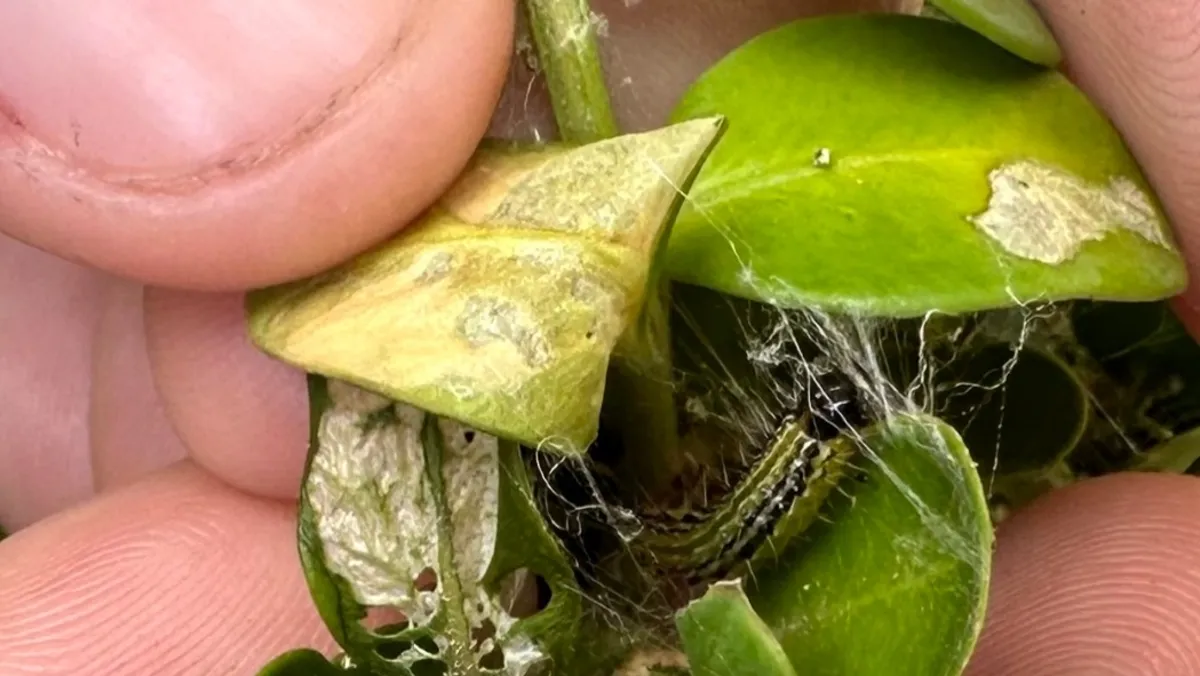
Hopefully by now most of you are aware of the devastating insect called the box tree moth that is affecting boxwood plants throughout the state and country.
Last year, these insects were spreading out of these communities more aggressively. When they invade, they truly catch homeowners off guard. The insects are well camouflaged and eat the foliage of the shrubs from the inside out. They reproduce very quickly. Unfortunately, most people don’t realize they have them until the damage is done.
I will say some varieties of boxwood are more vulnerable to the box tree moth than others. We are still very early in the learning stages sorting through these questions.
You can spray for the insects when they are present. Since they reproduce quickly this can be challenging as it requires multiple sprayings throughout the season. If your boxwoods have been severely damaged, you will most likely want to replace them with something other than more boxwoods.
The vulnerability of boxwoods to this insect is going to have a very negative impact on the nursery and landscaping industries. Boxwoods are truly a staple in these businesses. There are many types of boxwoods. They are very versatile and the foundation plants in most landscapes. So, what should you plant instead? Thankfully there are several viable alternatives.
There are a few options in the Arborvitae family. Most people are familiar with Arborvitaes as tall, narrow evergreens that are frequently used for screening. While some are, there are just as many that are low growing, mounding and spreading.
There is one called Mr. Bowling Ball. These will grow three feet tall and wide. There is a similar one called Golden Globe with a similar shape that will grow slightly taller to four feet tall and wide. There are also some lower growing varieties of Arborvitae such as Anna’s Magic Ball, Pancake and Tater Tot. These plants should get some attention just from their interesting names.
There also alternatives to boxwoods found in the Holly family. Inkberry Hollies have gained popularity since they have a similar appearance to boxwood with dark green leaves that are rounded in shape. The most popular variety is called Strongbox. This variety is known to be the densest.
Going back to the 50s, 60s and 70s, the most popular evergreens for landscaping were the many varieties of Japanese Yews. As new cultivars of boxwood started gaining popularity, they eventually replaced most Japanese Yews in landscape use.
With the challenges this insect is presenting, Yews are set up for a comeback. Plants in the genus Taxus are the Japanese Yews. These are the ones used for decades. The older varieties were replaced because they were hard to maintain. They were also vulnerable to deer feeding upon them.
There is a different Yew available now. It is the Japanese Plum Yew, which is from the genus Cephalotaxus. Japanese Plum Yew (Cephalotaxus) differs from traditional yews (Taxus) primarily by its superior tolerance to heat, humidity, and shade. Unlike traditional yews, they are highly deer resistant. They are also slower growing, making them much easier to maintain.
Another family of plants you can consider as an alternative to boxwoods would be the varieties of Cherry Laurel. These are broadleaf evergreens that produce clusters of tiny white flowers in the spring. There is a variety called Chestnut Hill that has attractive dark green glossy foliage.
This article is not intended to encourage anyone to pre-emptively remove healthy boxwoods from your landscape. Depending upon where you live you may never see the box tree moth. If you do it could be a few years until it gets to your neighborhood.
This is for those who have been affected. Because if you have been, there are not any easy solutions at the current time of how you can keep your boxwoods healthy.
‘ The preceding article may include information circulated by third parties ’
‘ Some details of this article were extracted from the following source www.cincinnati.com ’