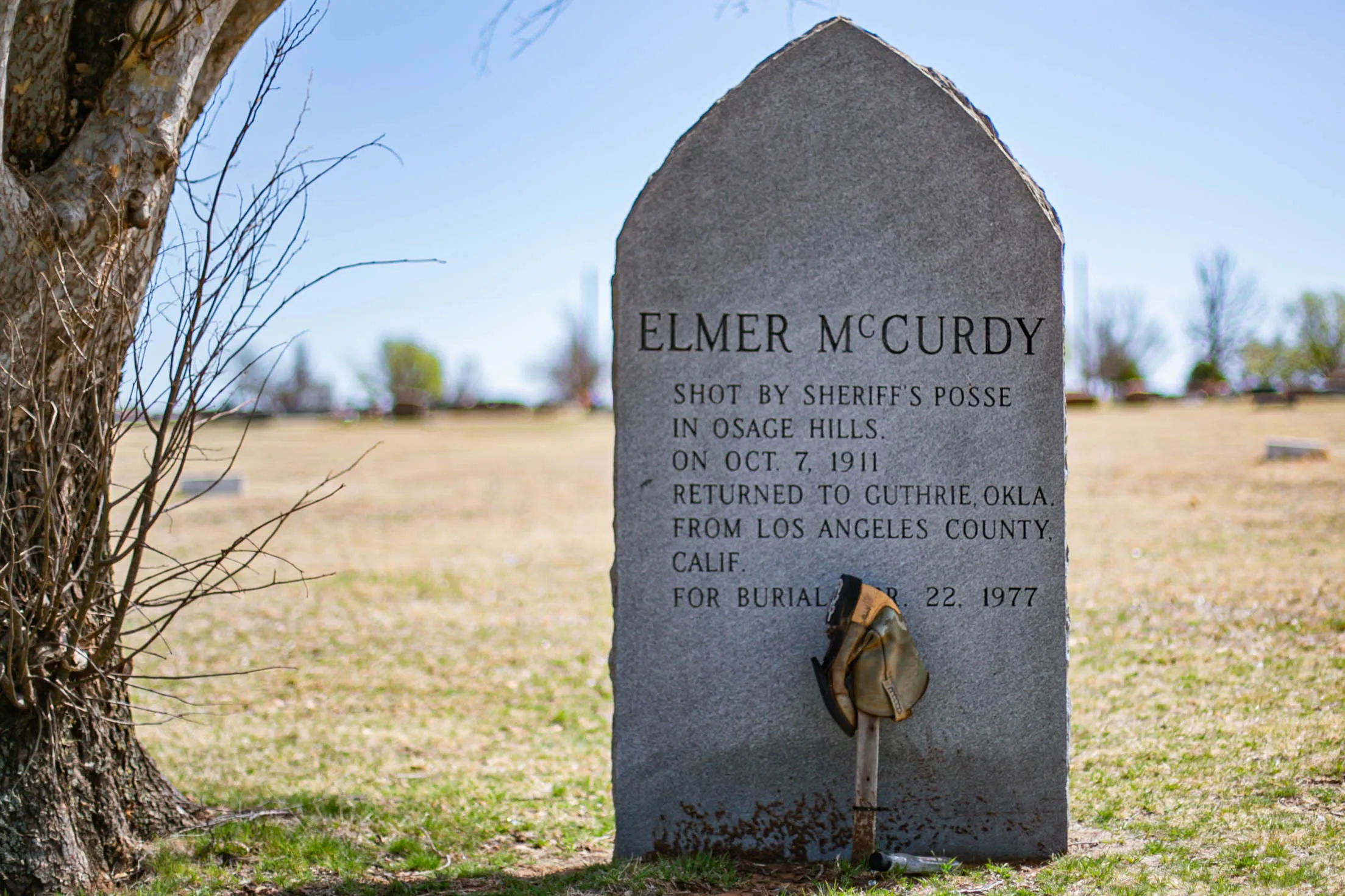

The strange story of Oklahoma outlaw Elmer McCurdy
After Elmer McCurdy’s death, his body appeared in sideshows across the country for decades before finally being returned to Guthrie.
Addison Kliewer and Nathan J. Fish, Oklahoman
- Elmer McCurdy was an Oklahoma outlaw whose mummified corpse became a traveling sideshow attraction for six decades after his death in 1911.
- His body was rediscovered in 1976 on the set of “The Six Million Dollar Man” and was finally buried in Guthrie, Oklahoma.
- McCurdy’s strange life and afterlife inspired the Tony-nominated musical “Dead Outlaw,” which had a brief run on Broadway.
- Despite the show’s closing, its creators hope it will be staged again, possibly in London, and are also working on a documentary.
Nearly 115 years after he was killed and almost half a century since his final burial in Oklahoma, malefactor-turned-mummy Elmer McCurdy‘s unlikely legend has stubbornly refused to die.
If David Yazbek has anything to say about it, the story of the “Dead Outlaw” will keep spreading — perhaps even across an ocean.
“It was 30 years ago, maybe 35 years ago … two brothers shared with me the story of Elmer McCurdy, which grabbed me immediately,” said Yazbek, the composer behind “Dead Outlaw,” the Tony Award-nominated McCurdy-inspired musical.
“The Elmer story gets its hooks in you.”
Although his rollicking theatrical adaptation of McCurdy’s true-crime tale closed its disappointingly brief Broadway run over the summer, Yazbek said in a recent Zoom discussion with an Oklahoma historian that he hopes to see the show back on stage sometime soon.
“I know that there’s going to be — if you’ll excuse the expression — more life to Elmer McCurdy,” Yazbek said in the public online panel presented by the Oklahoma Territorial Museum in Guthrie, where McCurdy is buried.
Who was Elmer McCurdy?
“Dead Outlaw” chronicles the strange life and even stranger afterlife of McCurdy, a Maine native who made his way to Oklahoma at the turn of the 20th century as he was carving out an ill-fated career as a bank and train robber.
On Oct. 7, 1911, McCurdy’s illegal activities caught up with him after he and a pair of accomplices held up a train outside Okesa, a northeastern Oklahoma hamlet near the Kansas border. Three lawmen — Dick Wallace and brothers Bob and Stringer Fenton — tracked McCurdy through the Osage Hills, where the robber had hidden in a hayloft.
After a standoff turned into a shootout, McCurdy, who was just 31 years old, was struck and killed by a single gunshot from Stringer Fenton’s Luger automatic pistol, now part of the Oklahoma Territorial Museum’s McCurdy exhibit.
“This gunfight’s in 1911. It’s not during the Wild West times. So, that’s always shocking,” said Michael D. Williams, the museum’s director and a McCurdy expert, who moderated the autumn Zoom discussion.
McCurdy’s body was embalmed by a Pawhuska undertaker but went unclaimed, eventually drying up and mummifying. The robber’s corpse then spent six decades traveling the country as a macabre attraction in sideshows, wax museums and low-budget movies. The “Dead Outlaw” eventually wound up covered in phosphorescent paint and hung from a rope in the Laff in the Dark funhouse at The Pike amusement park in Long Beach, California.
The cast and crew of the television show “The Six Million Dollar Man” were filming there in 1976 when a grip grabbed the arm of a hanging “mannequin” and accidentally broke it off, revealing a real human bone, which started a search for the origins of his grisly find.
At the Los Angeles County medical examiner’s office, Dr. Thomas Noguchi, who also performed the autopsies of the likes of Marilyn Monroe, Robert F. Kennedy and Natalie Wood, was tasked with figuring out the corpse’s identity.
“There’s a song in our show that’s just him singing about all that,” Yazbek said of the so-called “Coroner to the Stars,” who turns 99 on Jan. 4 and is the subject of a new biography and documentary.
“Yeah, but we didn’t mention Bobby Kennedy. Damn, can we do a rewrite?” joked Erik Della Penna, who co-wrote “Dead Outlaw” with Yazbek.
In 1977, McCurdy’s remains were returned to Oklahoma, where the “Dead Outlaw” was buried in the Boot Hill section of Guthrie’s Summit View Cemetery, with — legend has it — a layer of concrete topping his plain pine coffin to ensure he could finally rest in peace.
How COVID-19 and a trip to Oklahoma helped ‘Dead Outlaw’ become a Broadway musical
For Yazbek, the “Dead Outlaw” origin story starts with songwriter Brian Dewan, a friend from college who learned about McCurdy’s twisty tale from a news clipping his mother had sent him. Dewan and his brother penned a song about McCurdy and shared the strange saga with Yazbek.
“This idea about someone who wanted fame, who wanted riches the easy way … and who was an addict, an alcoholic, it’s just so American,” Yazbek said.
“I had been studying Zen Buddhism for several years when I heard the story. It became also about what it means to be alive and what memory means, these illusions of immortality through memory, because, clearly, Jesse James was dead. But Jesse James was a hero — and he wanted to be like that.”
When he started working on musicals like “The Full Monty” and “Dirty Rotten Scoundrels,” Yazbek thought McCurdy’s story would make a good stage show.
“There are a couple of playwright friends of mine who I asked about it — one in particular, I thought it’d be right up his alley. And he said, ‘You got a problem here, Dave, because the main character, he’s dead,'” Yazbek recalled with a chuckle.
Still, he shared the story in the early 2000s with his friend and bandmate Penna, who was just as captivated. They eventually started writing songs based on it, especially after the COVID-19 pandemic cleared their calendars.
“We thought, ‘Oh, eventually, maybe this will turn into a musical.’ … But it was also late COVID when we started talking about it. So, we were like, ‘What are we going to do? Because we can’t wait,'” Yazbek said.
“We said, ‘We’ll do a documentary about Elmer, but we’ll use our songs.’ So, when we came to (Oklahoma), we were in that phase.”
How is the story of the ‘Dead Outlaw’ living on after Broadway?
In 2022, Yazbek and Penna brought cameras and crew with them to Guthrie, where Williams helped them dive deeper into McCurdy’s legend.
“I do have memories of sitting at that table with gloves on and (Williams) describing these weapons that we were handling. … It was just so surprising that it was a Luger, because you imagine it’s a six-gun,” Yazbek said. “That conversation really helped us start thinking about, ‘Maybe we should do this as a show.'”
In 2023, members of the Audible Theater team saw Yazbek and Penna perform their “Dead Outlaw” songs at New York City’s 54 Below. That led to the short-lived bandit’s long-lasting story becoming the audiobook company’s first commissioned musical.
Yazbek reunited with playwright Itamar Moses and director David Cromer, his collaborators on their 10-time Tony-winning show “The Band’s Visit,” who wrote and directed the “Dead Outlaw.”
“Dead Outlaw” debuted in previews Off-Broadway on Feb. 28, 2024, at Audible’s Minetta Lane Theatre in New York City, with its world premiere on March 10, 2024. Despite only playing a month-long limited engagement, the true-crime musical won top prizes from the Drama Desk, Outer Critics Circle and Off Broadway Alliance awards.
“Dead Outlaw” then made the leap to Broadway, where previews started April 12, 2025, at the Longacre Theatre.
A few days after its star-studded April 27 opening night, “Dead Outlaw” nabbed seven 2025 Tony nominations, for best musical, best original score for Yazbek and Penna, best book of a musical for Moses and best direction of a musical for Cromer, plus three acting nods.
“Dead Outlaw” didn’t snap up any prizes at the June 8 Tonys and met its end on Broadway June 29 after playing 73 regular performances and 14 previews. That didn’t stop USA TODAY from naming it the top Broadway show of 2025, and at least one prominent Oklahoma theater has expressed interest in producing the musical if the rights become available for regional theaters.
Although he’s grateful that it’s preserved in a radio show-style Audible recording, Yazbek said he hopes the musical will find life onstage again.
“I have a very strong feeling it’ll be done in London fairly soon,” Yazbek said during the Zoom. “There may be also a way to at least tour the song cycle — either Erik and I or some other band — and do it the way we used to when we first conceived it.”
Plus, he said the “Dead Outlaw” documentary is getting closer to completion, with fundraising underway to finish the color correction, sound editing and mixing.
Although its Broadway run was short-lived, much like McCurdy’s life, Williams said the celebrated show has still scared up even more interest in the already enduring legend.
“It’s one of the big draws here — and it’s an international draw. We get people from as far away as Japan coming here to look at the gun and to go out to the cemetery and visit the grave,” said Williams, who traveled to NYC for both the Off-Broadway and Broadway premieres.
“I got a big kick out of people showing up here … and taking pictures of their Playbills at the grave. And I tell you what, I did it first.”
‘ The preceding article may include information circulated by third parties ’
‘ Some details of this article were extracted from the following source www.oklahoman.com ’