It’s nice to know that a Spike Lee Joint still means something in today’s age of straight-to-streaming phenoms and blockbuster franchises. The Brooklyn-raised filmmaker can still grab audiences with anything bearing his name, even when he’s reimagining works beyond his typically original filmography.
For more than three decades, Lee has dazzled and revolutionized the movie world with his iconic, out-of-the-box ideas rooted in the complexities of race, class, identity, politics, and, most of all, personal reckonings. The latter is especially true of his latest feature, “Highest 2 Lowest,” a contemporary reimagining of Akira Kurosawa’s 1963 kidnapping thriller “High and Low,” now set against the backdrop of the music industry and its inherent perils.
It’s not often that we see Lee dip into remake territory. However, his longtime love for Kurosawa’s work and a chance to reunite with Denzel Washington — whom he’s collaborated with five times on 1990’s “Mo’ Better Blues,” 1992’s “Malcolm X,” 1998’s “He Got Game,” and 2006’s “Inside Man”— presented a challenge he seemingly couldn’t refuse. Let’s put an emphasis on challenge.
With a screenplay helmed by Alan Fox, Lee had his work cut out for him, updating a black-and-white noir classic to a present-day, New York City-centric thrill ride, although the thrills don’t quite arrive until the film’s riveting final act. Before that, though, Lee takes some creative detours that immediately give his reinterpretation an identity of its own, or rather, his identity.
That much is clear as the film’s opening shots glide around the director’s stomping grounds of Brooklyn and Manhattan as “Oh, What a Beautiful Mornin’” from Rodgers and Hammerstein’s “Oklahoma!” — one of Lee’s late mother’s favorite musicals — blares in the background, showing off NYC as only Lee sees it. The rich walls of a luxurious Dumbo penthouse are decorated with Knicks merch, and posters and paintings by and of prominent Black artists (some from Lee’s personal collection), befitting an abode for a millionaire music mogul who has “the best ears in the business.”
At one point, we catch subtle homages to Lee’s legacy, with brief cameos from “Do the Right Thing” star Rosie Perez and “She’s Gotta Have It” actor Anthony Ramos (who reprised Lee’s role from his 1986 directorial debut). These nods unfold as the film’s protagonist reflects on his own legacy — and, more pointedly, what he’s willing to sacrifice for it.
No doubt, “Highest 2 Lowest” is an unmistakable Spike Lee Joint. And while the film outwardly bears all the hallmarks of the director’s signature style, it also offers a deeper look into what personally resonates with him these days, given his choice to reinterpret this specific Kurosawa film centered on moral conflict. In Lee’s hands, the story becomes even more of a meditation on the consequences of success and the difficult choices one makes when said success is threatened.

That quandary lies at the heart of “Highest 2 Lowest,” though, to Lee’s credit (and detriment), the film takes its time getting there. Much of the first half is devoted to a drawn-out ransom plot that is far less interesting than the repercussions that follow. While the film eventually finds its footing, the first two acts are a tedious watch. The pacing is slow, the boisterous score clashes with the subdued action on screen, and, in some scenes, the dialogue feels redundant — especially when all you’re really waiting for is the best part of the movie: Washington’s eventual showdown with his adversary, Yung Felon, a vengeful aspiring rapper played electrically by A$AP Rocky.
However, once things finally get going, “Highest 2 Lowest” is quite a marvel.
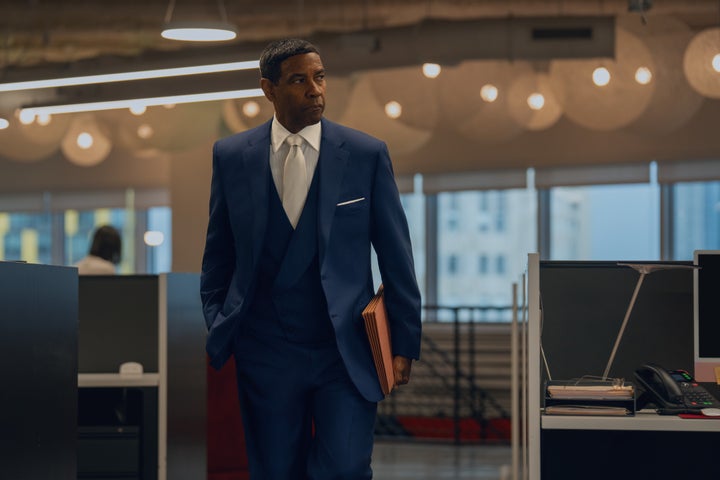
It begins with David King (Washington), the renowned CEO of Stackin’ Hits Records, who’s spent the better part of two decades minting chart-topping artists and snatching up Grammys to build up his music empire. When a proposed merger threatens to undermine his storied success, King David sets his sights on buying back his company, using every asset he has to secure the crown jewel for himself, his wife Pam (Ilfenesh Hadera) and their teenage son Trey (Aubrey Joseph). But, of course, trouble comes knocking, and at the worst possible time.
A mysterious culprit calls to inform David that he’s abducted his son and wants $17.5 million for his return. But there’s been a mix-up. Instead of Trey, his best friend Kyle (Elijah Wright), the son of David’s driver and childhood friend Paul (Jeffrey Wright), is the hostage in question. (Yes, Elijah Wright is the real-life son of Emmy winner Jeffrey Wright). But the kidnapper’s offer still stands: David either pays Kyle’s ransom, or he’ll have blood on his hands.
This is where Lee is most faithful to Kurosawa’s vision, putting David between a rock and a hard place as he decides if his fortune and future are more important than saving a life, the life of his friend’s son, no less. As monotonous as this part of the film is, it builds up just enough for Lee to shift his movie into high gear with a pulsating sequence that reminds you why the filmmaker is such a whiz behind the camera.
The catalyst for that is David, who steps onto a crowded 4 train clutching a bag of Swiss francs for the ransom exchange before it goes completely haywire. The city buzzes around him on what feels like the busiest day in New York, with rowdy baseball fans en route to Yankee Stadium to jeer the Red Sox, and the lively Puerto Rican Day Parade — featuring the legendary Eddie Palmieri and his salsa orchestra — in full swing. The energy is so intense that Lee makes you feel like you’re right in the center of the action in the best way.

It’s organized chaos at its finest, and such a thrilling change of pace as the scene erupts into a dizzying motorcycle chase that finally leads to Kyle’s whereabouts. Still, there’s the mystery of his kidnapper’s identity, which David is determined to get to the bottom of.
The police, who are heavily suspicious of Paul on account of his checkered past (for reasons we never quite learn), dismiss help from David in tracking down the perpetrator, even after a hospitalized Kyle gives them a clue — an earworm track by Yung Felon (performed by Rocky on the film’s soundtrack) that he heard the rapper working on while held hostage, which David eventually discovers. It’s a nice callback to the music titan’s trained ears and a clever reminder that music itself is a storytelling element in the movie.
A prime example of that is a needle drop from James Brown’s “The Payback” that cues up the most delicious face-off between David and Yung Felon in the film’s final stretch, where Rocky somehow gives Washington a run for his money (a worthy follow-up performance after starring in 2018’s “Monster”).
What happens next — David and Yung Felon going bar-for-bar in a spontaneous rap battle that turns into a cathartic therapy session — culminates in a mind-blowing reveal that, while I won’t spoil it, finally makes sense of how and why these two became unexpected foes.
It’s worth noting that “Highest 2 Lowest” offers revelations beyond the central rivalry, particularly when it comes to today’s fast-changing entertainment industry, which Lee argues now operates within an attention economy shaped, and often distorted, by the internet. There are also personal reflections about the toll of prioritizing fame and money over the passions that drive us.
Those themes, baked in Lee’s perspective of Black culture, feel especially timely today when so much of the world feels disconnected from what once was. In true Lee fashion, his film leaves you plenty to sit with.
By its end, “Highest 2 Lowest” gives you precisely what you’d want from a Spike Lee Joint, and then some. As much as the film demonstrates how deeply reverent the filmmaker is, paying homage to those who have inspired him, it also reaffirms that, at 68 years old, Lee still has a sharp eye on the present as well as the future.
That idea is driven home in the film’s final moments, when singer Aiyana-Lee — discovered by David for his new label and, in real life, by Lee — delivers a soulful performance of the title track. As David embraces his next era, it feels like Lee is doing the same, letting this particular message carry his legacy forward.
In many ways, that also aligns with where Lee and Washington are at this point in their careers, letting this new work speak for their legacies. If this does turn out to be their fifth and final collaboration, it’s a fitting finale to a legendary partnership.
Together, they are the main attraction of “Highest 2 Lowest,” which is only getting a two-week theatrical window before heading to streaming. It’s worth seeing a film of this magnitude, so full of star power and weighty ideas, on the big screen if you can help it. That’s the best way to take in Lee’s latest introspection — up close and personal.
“Highest 2 Lowest” is now playing in theaters. You can stream the film on Apple TV+ beginning on Sept. 5.
‘ The preceding article may include information circulated by third parties ’
‘ Some details of this article were extracted from the following source www.celebrity.land ’