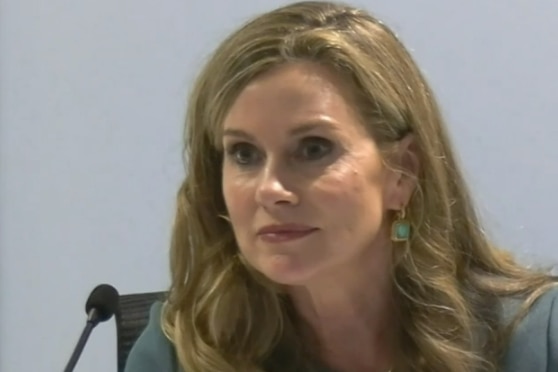
The head of the online safety watchdog has become emotional while apologising to Jewish victims of social media harassment who do not meet the regulator’s legal threshold for intervention.
eSafety Commissioner Julie Inman Grant fronted the Royal Commission on Antisemitism and Social Cohesion, which has been examining efforts to curb online hate.
Ms Inman Grant, who formerly worked at X Corp when it was Twitter, said her office had received 108,000 complaints about harmful online content in the year to June 30, 2026.
She said it was a significant increase from the 55,000 complaints received the previous financial year.
Under the regulator’s Adult Cyber Abuse Scheme, officers are empowered to issue an order to remove content if the social media post, message, image or video contains a direct threat of harm against the adult.
But Ms Inman Grant said that high threshold resulted in just 2 per cent of complaints resulting in a removal notice to the relevant content creator or platform.
Ms Inman Grant said more could be done to combat antisemitism online. (ABC News)
She became emotional when she told the commission she regretted the impact these constraints had had on victims of antisemitism in particular.
“That’s one of the things I regret the most,” she said.
“We’re here to help people and I just want to acknowledge I know that … so many in the Jewish community have been suffering and I’m really sorry about the shortcomings of the scheme when we haven’t been able to help.”
‘We’ve never had looser guardrails’
Ms Inman Grant gave the commission a flavour of the challenges the regulator faces when attempting to get content removed from a platform and measures implemented to prevent the content from being amplified.
The Royal Commission on Antisemitism and Social Cohesion has been examining hateful online messages. (ABC News: Liam Patrick)
She said her office fought hard to prevent harmful videos, images and other content from the Bondi Beach terror attack being amplified on X in the wake of the December 14 shooting.
“[X Corp] said, ‘It is not any worse than you would see in a gore movie’ and I said, ‘I can’t think of anything more horrific for the family members and the Australian Jewish community’,” she said.
“These are mainstream platforms that are fighting for the right and ability to distribute and monetise this content.“
Ms Inman Grant said the office of the eSafety Commissioner was relatively small given its remit, with less than 40 investigators currently on its books.
She said more resources would help the office better achieve its remit, as would reforms to the Online Safety Act 2021.
These included the development of a definition of online hate, changes to the existing complaints schemes and the ability for the regulator to consider the cumulative impact of online harassment that was not overtly threatening violence.
The eSafety office fought hard to prevent harmful content from the Bondi Beach terror attack being amplified on X. (Reuters: File )
But Ms Inman Grant said the responsibility for protecting people online should ultimately rest with the platforms.
“Right now, we have an Adult Cyber Abuse Scheme that wasn’t created for this purpose so it isn’t fit for purpose and I think there are other things we could do to put the responsibility back on the platforms,” she said.
“When you don’t know when you are going to get an offensive text, or a message or social media post that destroys you inside. Who else do you hold to account for that?
“We’ve got the most powerful technology in the world, owned by the richest, wealthiest technologists in the world, but we’ve never had looser guardrails.
“That to me is a recipe for disaster.“
Ms Inman Grant said the role of the regulator was important given the online environment had never been “more toxic or caustic”.
“As a regulator in a middle-power country, that’s relatively small, making sure that we’ve got the tools and the resources that we need to take on these powerful companies, I think is even more important,” she said.
Mixed police relationship with commissioner
The commission also heard from state and federal police agencies about how information is shared with the eSafety commissioner.
There were repeated attempts to formalise a memorandum of understanding (MOU) between WA Police and the eSafety Commissioner between 2022 and 2024, but these were unsuccessful.
WA Police Deputy Commissioner Kylie Whiteley said a memorandum of understanding was needed with the eSafety commissioner (ABC News: Rhiannon Shine)
Deputy Commissioner Kylie Whiteley told the commission restructuring within WA Police during that time coupled with time differences with the east coast meant the project “dropped off the priority list”.
“We certainly see there is a need to ensure there is an MOU in place and we would be keen to enable that to occur,” she said.
“It doesn’t help that there’s time differences from Western Australia to other parts of the country and equally not having a presence that you are able to sit in front of here probably does see things get lost.
“But I wouldn’t say it has hampered us reaching out and possibly having conversations there’s certainly been good engagement but the MOU hasn’t been finalised.”
NSW Police does have an MOU with the eSafety commissioner’s office, which formalises protocols for cooperation when investigating online harm.
Assistant Commissioner Leanne McCusker conceded there was room for improvement in the way NSW Police shared information with the regulator.
Victoria Police said it had a good working relationship with the eSafety Commissioner’s office, which had assisted in the removal of offensive content after the platform refused to take it down.
‘ The preceding article may include information circulated by third parties ’
‘ Some details of this article were extracted from the following source www.abc.net.au ’