Breaking into Korea’s increasingly competitive entertainment industry as a foreigner requires more than talent — it takes persistence, the ability to adapt quickly and a knack for impressing in a system built around local networks.
British actor Adam Strandt, 39, knows this reality all too well. “I had to learn to navigate a lot of different dynamics, different casting systems and understand how productions operate here versus abroad,” he said.
Strandt’s journey to Korea’s entertainment world began in England, where he studied film and photography. He was also scouted as a model, but never pursued it full-time. Restless and ready for change, he left for Japan, and later moved to Korea in 2012 to teach English. What was meant to be a one-year stint stretched on — first in Mokpo, South Jeolla Province, where he met his wife, and later in Seoul.
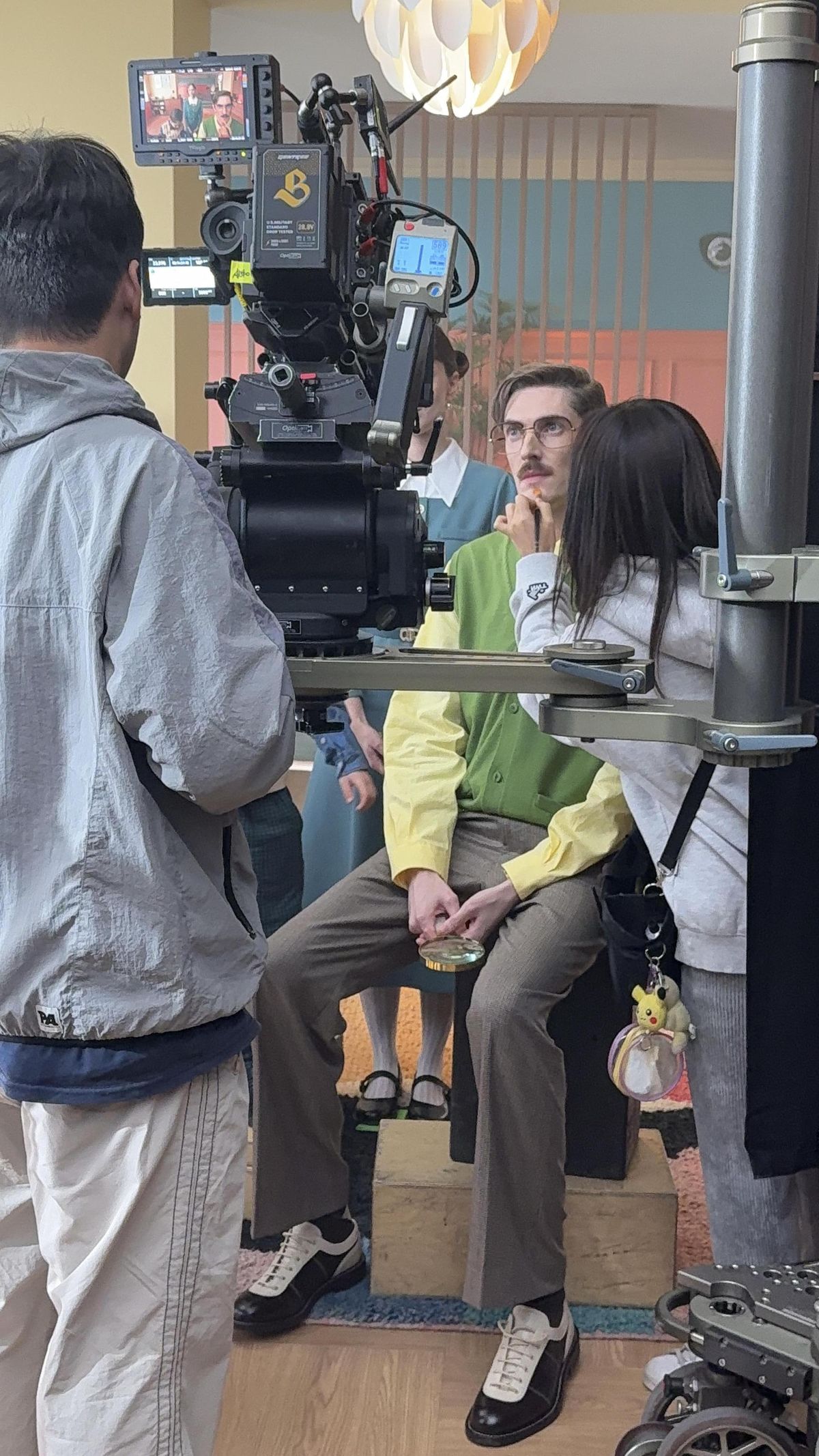
British actor in Korea Adam Strandt on set for a commercial for Coway / Courtesy of Adam Strandt
His marriage gave him the visa freedom to pivot away from teaching, returning to modeling and acting. He started small before moving into dramas with single-line parts that gradually grew into more substantial roles.
“Now I think I’m in a position where I can audition with good confidence to get decent roles in films and dramas,” he said.
Expanding popularity of K-content
The Korean wave, or hallyu, has undeniably expanded the global footprint of Korean media, creating both visibility and competition for foreign talent as production companies balance the growing demand for internationalized content with the local preferences that continue to shape casting decisions.
Recent high-profile titles underscore that divide. The massive popularity of Netflix’s “KPop Demon Hunters,” directed by Korean Canadian Maggie Kang, highlighted the potential for internationalized storytelling, while the so-called “VIPs” in “Squid Game” drew widespread attention for their stilted dialogue, which was a surprise given the scale and global reach of the series.
American actor Carson Allen spent her formative years living at U.S. Army Garrison Yongsan, just minutes from the Itaewon cafe where we met for our interview. She began acting while still in school in Korea, after she was scouted by local agents. She quickly realized that acting was something she wanted to pursue full-time.
After graduating Seoul American High School in 2013, she spent a brief university semester in the U.S. to satisfy her parents’ wishes to experience living stateside after growing up abroad. But it wasn’t long before Allen returned to Korea to pursue her career here in earnest. Since then, she has taken on roles across film, television, music videos and commercials, building a portfolio that has helped her find opportunities behind the camera, too, including on popular Netflix productions.
“I think Korea does have a long way to go,” she said, “but I also hope that by Korean directors going abroad and doing Hollywood films as well, when they come back to Korea, they help make the production standards higher, not just for actors but for the staff, too.”
An evolving industry for foreign talent
Having spent half her life in the industry, Allen said, a lot has changed. There was a time when foreigners didn’t have to audition at all if the part was small. Instead, casting agents seeking a particular look would hire any actor who fit the bill. “That doesn’t happen anymore,” she said. “You need to audition, no matter how small the part.”
For Allen, the international spread of Korean content has opened doors, but not equally for all foreigners. “I think there’s more opportunity for men, actually, than there is for women,” she said, noting that female characters’ storylines still often revolve around a romantic relationship.

British actor Adam Strandt has found himself appearing in music videos, commercials and K-dramas alongside some of Korea’s biggest stars. Courtesy of Adam Strandt
Despite the uneven landscape, she pointed to one production in particular that stood out: “So Not Worth It,” a Korean television series that featured several foreign actors and allowed her to play a named character that was fully developed with a narrative arc independent of other characters.
“It’s kind of rare to have a foreign character in a Korean production where you feel like you can really stand on your own,” she said.
Canadian actor Brad Curtin, 52, emphasized the advantages of longevity and connections. Curtin has worked in Korea for years, initially in voice acting and children’s TV before moving into broader acting and modeling roles.
Those experiences helped him build a solid network, which was instrumental in transitioning to different types of entertainment work. He also pointed to the growing niche for older actors in a field where competition among younger talent is fierce. “Older women, in particular, can find a lot more opportunities, because there are not as many of them competing for the roles,” he said.

Canadian actor Brad Curtin says older actors face less competition in the Korean entertainment industry. Courtesy of Bret Lindquist
Strandt echoed the view that the industry is competitive but full of possibilities, having found himself sharing screens with some of Korea’s biggest stars — from a coffee commercial featuring Gong Yoo to music videos for K-pop megastars like IU.
He notes that production teams are now more willing to trust foreign actors with dialogue and recurring roles, and that the range of opportunities has grown as Korea’s entertainment scene becomes more international.
“I think it’s about finding what niche you fit in and where your background and experiences can enhance the storytelling,” Strandt said.
Tough working conditions persist
Despite the improvements, challenges remain. Securing a fair contract remains a struggle for many working in the industry, and conditions on set can sometimes be grueling for those struggling to break into the industry.
Allen noted the challenges young aspiring actors face, from visa limitations to navigating the informal networks that often govern casting decisions.
“A lot of young people come here wide-eyed and thinking they’re going to quickly find jobs in the industry, but I’ve seen a lot of really sad stories of people going homeless and in bad situations,” she said.
Despite the hurdles, all three actors are optimistic about the future.
“For the most part, people who are hardworking and positive can find good experiences working here,” Curtin said. “And there’s lots of new, really talented young directors and producers making wonderful projects. It’s a good time for the industry here.”
‘ The preceding article may include information circulated by third parties ’
‘ Some details of this article were extracted from the following source www.koreatimes.co.kr ’