A generation ago, around the turn of the millennium, there was a boom in movies perfect for mothers and their teenage daughters to watch together: spiky-humored but warmhearted female-bonding comedies like Nancy Meyers’ The Parent Trap (1998), Mark Waters’ Mean Girls (2004), and above all, Freaky Friday (2003), also directed by Waters and starring Jamie Lee Curtis and Lindsay Lohan as a feuding mother and daughter who find themselves trapped in one another’s bodies for the course of one chaotic day.
That 21st-century Freaky Friday was the third adaptation of Mary Rodgers’ delightful 1972 novel of the same title: In addition to the 1976 Disney movie with Jodie Foster and Barbara Harris, there had been a 1995 made-for-TV version starring Shelley Long and a 13-year-old Gaby Hoffmann. (In 2018, a fourth movie, made for the Disney Channel, adapted Rodgers’ novel from a stage musical.) Speaking as the mother of a teenage girl, the perennial appeal of Freaky Friday’s premise is oddly heartening. The idea of body-swapping as a path to intergenerational empathy—the proposition that there is real value in walking a mile in a misunderstood loved one’s shoes, especially if you would never otherwise dream of donning such grubby combat boots and/or sensible workplace heels—has a timeless wisdom to it.
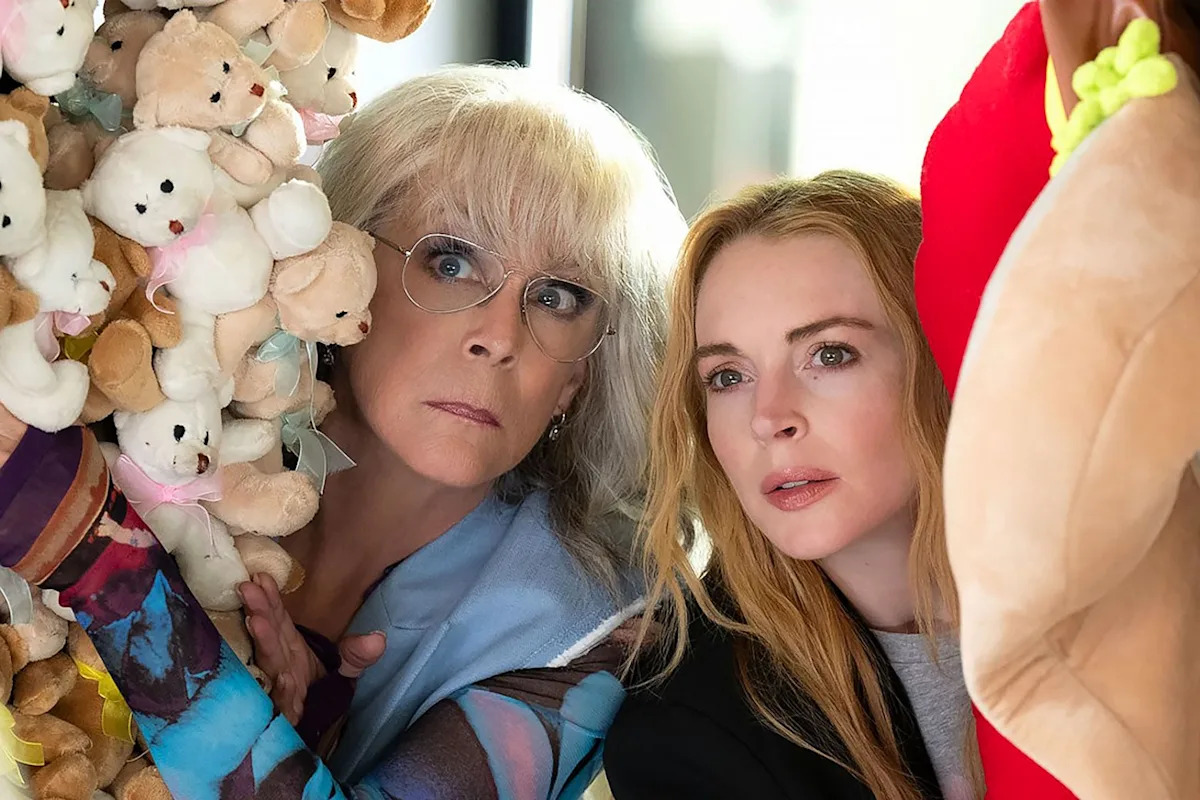
The uneven but endearing Freakier Friday, directed by Nisha Ganatra (Late Night), is the first feature film in the Freaky-verse to position itself as a sequel, returning to Curtis and Lohan’s characters, Tess and Anna Coleman, 20 or so years after the events of the original. Tess is still working as a therapist and trying to launch a self-help podcast from her closet, despite her boomer-coded inability to actually hit Record. Anna, whose young adulthood included a stint as a guitarist in an all-female rock band, now works as a manager for other musicians, including a pop star (Never Have I Ever’s Maitreyi Ramakrishnan) who’s in full meltdown after being publicly dumped by her equally famous boyfriend.
Anna is also the single mother to a teenage daughter, Harper (Julia Butters), a wisecracking rebel who regularly skips school to go surfing. When Anna gets engaged to single dad Eric (The Good Place’s Manny Jacinto), a British chef who’s the father of Harper’s high school archenemy Lily (Sophia Hammons), tensions between mother and daughter mount, with Tess trying to mediate between the two with unasked-for and unwelcome therapeutic advice.
The mechanism that activates the story’s central body swap is both funnier and less offensive than the Chinese-fortune-cookie-enabled swap in the 2003 version. (In the book, no explanation at all is given for the magical switcheroo, a refreshingly straightforward technique that more contemporary movies should try.) At Anna’s bachelorette party, a fortuneteller with multiple side hustles (Saturday Night Live veteran Vanessa Bayer, in top form) takes aside first the bride-to-be and her mother, then the two teenage rivals, to read their palms, but her predictions come only in the form of cryptic riddles. The next morning, all four women wake up stuck in someone else’s mortal coil: Harper and her mother have switched bodies, as have Tess and Lily. This initially confusing four-way swap gives Curtis and Lohan the chance to play a pair of wilding teenagers, while the two younger actresses take on the challenge of inhabiting the physicality of women in, respectively, their mid-60s and late 30s. The rest of the movie interweaves the stories of both duos as they race around Los Angeles, trying to find the fortuneteller and undo the curse (or is it a blessing?) in the day and a half that remains before Anna’s wedding.
The fact that the central twosome has been expanded into a quartet means that Freakier Friday’s plot lacks the neat symmetry of the original. It took me a good 15 minutes after the switch to keep straight who was occupying whose body, especially since, even after being taken over by the brain of an English teenager, the character played by Curtis retains her American accent. Still, it’s easy to see why screenwriter Jordan Weiss, working from a story co-created by Elyse Hollander, chose to distribute the various swapped identities in this way. If Curtis had not been given a youthful character to inhabit, she wouldn’t have had the chance to bust out the rambunctious physical comedy that has been one of her trademarks going all the way back to A Fish Called Wanda, and that earned her a Best Supporting Actress Oscar for 2022’s Everything Everywhere All at Once. Whooping with glee as she drives a borrowed sports car the wrong way down a one-way street or manically posing for a series of ludicrous selfies, Curtis conveys a sense of the freedom people just on the cusp of adulthood feel in their bodies—and also of the raw horror that a dewy-skinned 14-year-old would experience upon looking into the mirror to see the defiantly un-Botoxed face of her classmate’s grandmother.
The movie’s comic high point is a sequence in a record shop owned by Anna’s still-dreamy high school crush Jake, gamely embodied by a returning Chad Michael Murray. Lohan’s secretly 14-year-old character cluelessly tries to flirt with her mom’s confused ex—the girls’ terrible plan being to break up their parents’ impending marriage—while Curtis’ seeming sexagenarian, in reality the more immature of the two high schoolers, hides behind the record bins, hissing instructions into her friend’s earbud, Cyrano-style: “Now wink at him! Bite your lip! No, the lower lip!” What could have been a hard-to-endure scene—a ninth grader attempting to seduce a grown man—winds up being amusingly age-inappropriate in another way entirely. Jake, concerned that Anna’s bizarre facial contortions are symptoms of some medical crisis, suddenly sees who he thinks is Tess crawling on the floor and finds himself once again drawn to the older woman whom he bonded with (not knowing she was in fact her own daughter) on that freaky Friday long ago.
Millennial viewers who grew up alongside Lindsay Lohan, and who worried for her when she went through a period of addiction and personal turmoil, will be pleased to see her looking healthy—so healthy that she appears to be doing her own stunts in a surfing sequence—and sharing the same screwball chemistry she did with Curtis back in 2003. But with the exception of that scene in the record shop, Lohan isn’t given a lot of comic business to execute. Since the character she’s channeling, Harper, is a low-key, reserved kid, most of the shenanigans go to her scene partner.
Besides Curtis, the standout in the cast is 16-year-old Julia Butters, whom fans of Quentin Tarantino’s Once Upon a Time in Hollywood will recall as the preternaturally wise little girl whose questions on the set of a TV Western reduce Leonardo DiCaprio’s character to tears. Butters’ role here requires her to forgive the insensitive behavior of her own bratty teen self, in the process coming to a new understanding of her mother’s personhood. It’s a tricky task, but this precocious actor nails it, leaving you curious who the first director will be to cast Butters in a major leading role.
I don’t mean to overpraise Freakier Friday, which is neither as deftly plotted nor as funny as its 2003 predecessor, and which ends on a sentimental and conventional note. It’s a good movie for a late-summer legacy sequel, not a candidate for the all-time comedy pantheon. But every new generation of mothers and daughters, as they struggle to balance their love for each other with their quest to discover themselves, deserves a body-swap comedy of their—our—own.
‘ The preceding article may include information circulated by third parties ’
‘ Some details of this article were extracted from the following source www.yahoo.com ’